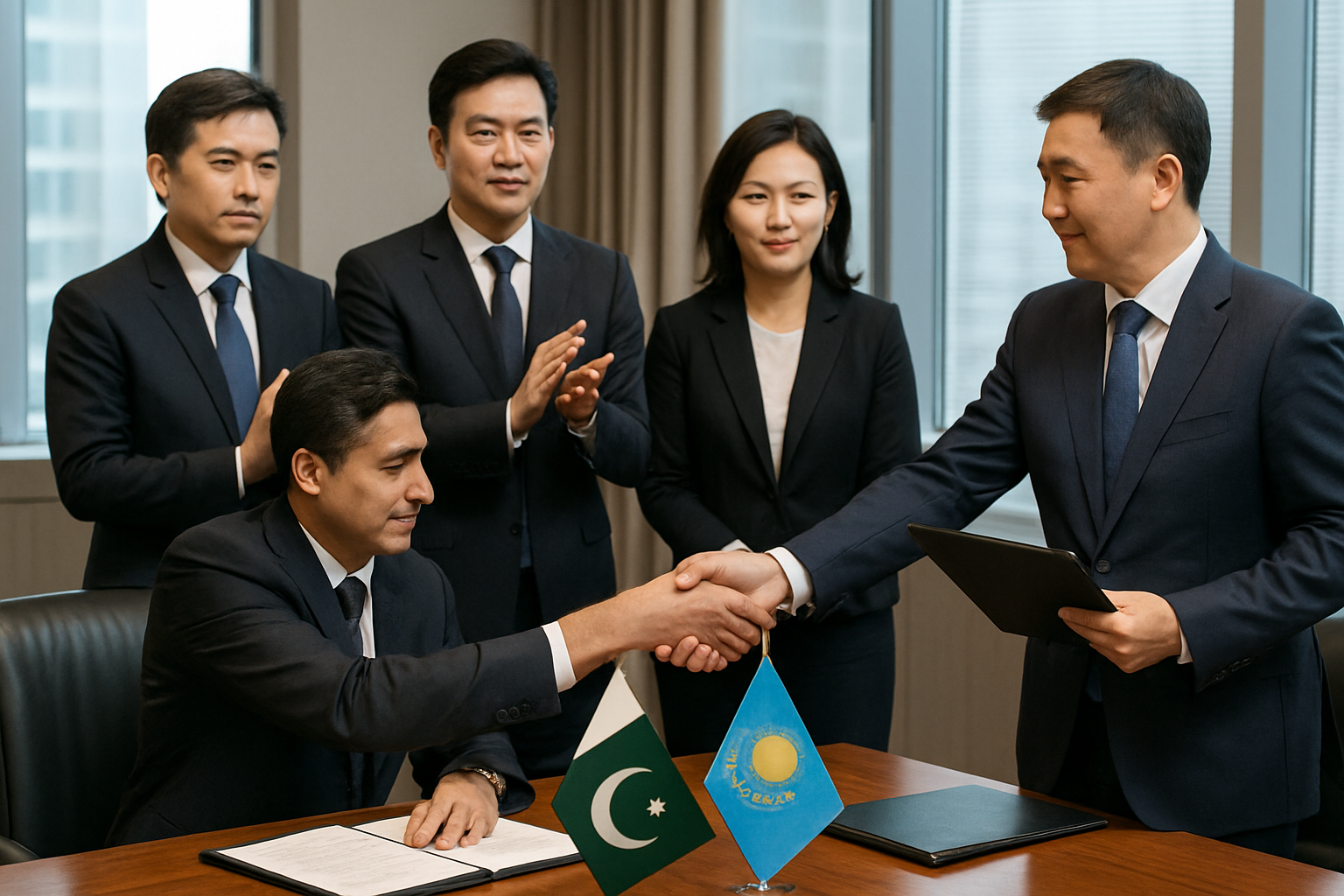
Pakistan and Kazakhstan have signed 37 comprehensive agreements and memorandums of understanding across multiple sectors, marking a pivotal moment in Asian economic cooperation as regional powers strengthen trade relationships amid global economic uncertainties.
The historic signing ceremony took place during Kazakhstani President Kassym-Jomart Tokayev's two-day state visit to Pakistan, with Prime Minister Shehbaz Sharif hosting formal talks at his official residence. The agreements span critical sectors including petroleum exploration, mining operations, and maritime affairs, representing the most comprehensive bilateral economic package between the two nations in decades.
Strategic Sectors Drive Cooperation
The 37 agreements focus on key areas vital to both nations' economic development. Petroleum cooperation takes center stage, with Pakistan seeking to diversify its energy sources while Kazakhstan aims to expand market access for its substantial oil and gas reserves. Mining partnerships will leverage Kazakhstan's vast mineral wealth, including rare earth elements increasingly crucial for global technology supply chains.
Maritime cooperation agreements address Pakistan's strategic position along major shipping routes and Kazakhstan's need for alternative trade corridors to reduce dependency on traditional northern routes. These partnerships align with broader Asian infrastructure development trends, including China's Belt and Road Initiative and India's recent trade expansion efforts.
"This comprehensive partnership represents a new chapter in Pakistan-Kazakhstan relations, built on mutual economic interests and shared regional development goals."
— Prime Minister Shehbaz Sharif, Government of Pakistan
Regional Context and Timing
The Pakistan-Kazakhstan agreements emerge amid a broader wave of Asian economic integration initiatives. Recent developments include the finalization of the historic US-India trade deal, which reduces tariffs from 50% to 18% and commits India to $500 billion in US product purchases over the coming years. Similarly, Malaysia and Indonesia have been resolving territorial disputes while pursuing closer economic ties.
The timing is particularly significant as Asian economies seek to strengthen intraregional trade relationships. Kazakhstan, as Central Asia's largest economy, represents a crucial bridge between European and Asian markets, while Pakistan's strategic location provides access to the Arabian Sea and broader maritime trade networks.
Energy Security and Resource Access
Energy cooperation forms the backbone of the new partnership, addressing Pakistan's chronic energy shortages and Kazakhstan's export diversification goals. Pakistan currently imports approximately 1.5 million barrels of oil daily, with recent geopolitical tensions highlighting the importance of supply diversification. Kazakhstan's proven oil reserves exceed 30 billion barrels, making it an attractive long-term energy partner.
The petroleum agreements include exploration rights, refining partnerships, and infrastructure development projects. These align with Pakistan's broader energy strategy, which has seen increased focus on renewable sources and reduced dependence on volatile international markets.
Mining and Critical Minerals
Mining cooperation addresses global supply chain vulnerabilities, particularly in critical minerals essential for renewable energy and technology sectors. Kazakhstan possesses significant uranium reserves (world's largest producer), copper, zinc, and rare earth elements increasingly vital for green energy transition.
The mining agreements complement recent international efforts to diversify critical mineral supply chains. The EU-US cooperation initiative on rare earth elements, led by European Commissioner Stéphane Séjourné, demonstrates growing recognition of supply chain vulnerabilities currently dominated by Chinese production.
Maritime and Trade Corridors
Maritime cooperation agreements leverage Pakistan's Gwadar Port and broader China-Pakistan Economic Corridor (CPEC) infrastructure. For landlocked Kazakhstan, these partnerships provide alternative trade routes to supplement northern corridors through Russia, particularly important given current geopolitical tensions.
The agreements facilitate Kazakhstan's access to warm-water ports, reducing transportation costs and transit times for exports to Asian and Middle Eastern markets. This complements broader Central Asian infrastructure development, including recent railway projects and cross-border connectivity initiatives.
Economic Impact and Investment Flows
While specific financial commitments were not disclosed, the comprehensive nature of the agreements suggests substantial investment flows in both directions. Pakistan's recent economic stabilization efforts, including successful negotiations with international creditors, have improved its attractiveness for foreign investment.
Kazakhstan's sovereign wealth fund and state enterprises are expected to play key roles in implementing the agreements. The country's strong fiscal position, supported by energy exports and mineral revenues, provides substantial capacity for overseas investment.
Challenges and Implementation
Despite the promising framework, implementation faces several challenges. Pakistan's ongoing economic recovery requires careful management of new commitments alongside existing obligations. Recent security concerns in Balochistan province, including February's counter-terrorism operations, highlight infrastructure protection needs for major economic projects.
Currency stability represents another consideration, with both nations experiencing volatility in recent years. The agreements include provisions for trade in national currencies, reducing dollar dependency and transaction costs.
Regional Integration Implications
The Pakistan-Kazakhstan partnership contributes to broader Asian economic integration trends. Recent initiatives include enhanced Turkey-Saudi renewable energy cooperation, the Malaysia-Indonesia territorial resolution, and strengthened India-US trade relationships. These developments collectively represent a shift toward greater Asian economic self-reliance.
The agreements also complement existing regional frameworks, including the Shanghai Cooperation Organization (SCO) and Central Asia-South Asia connectivity initiatives. Both Pakistan and Kazakhstan are SCO members, providing institutional support for bilateral cooperation.
Future Prospects and Strategic Outlook
The 37 agreements establish a foundation for long-term strategic partnership extending beyond immediate economic benefits. Regular high-level consultations, technical working groups, and joint investment committees will oversee implementation and identify additional cooperation opportunities.
Success could serve as a model for broader Central-South Asian integration, potentially attracting other regional partners. Afghanistan's eventual stabilization could provide additional connectivity opportunities, while Central Asian neighbors monitor the partnership's development with interest.
The Pakistan-Kazakhstan economic partnership represents a significant step toward greater Asian economic integration, demonstrating how regional powers can leverage complementary strengths to build resilient trade relationships. As global economic uncertainties persist, such bilateral partnerships provide stability and growth opportunities for participating nations while contributing to broader Asian economic dynamism.