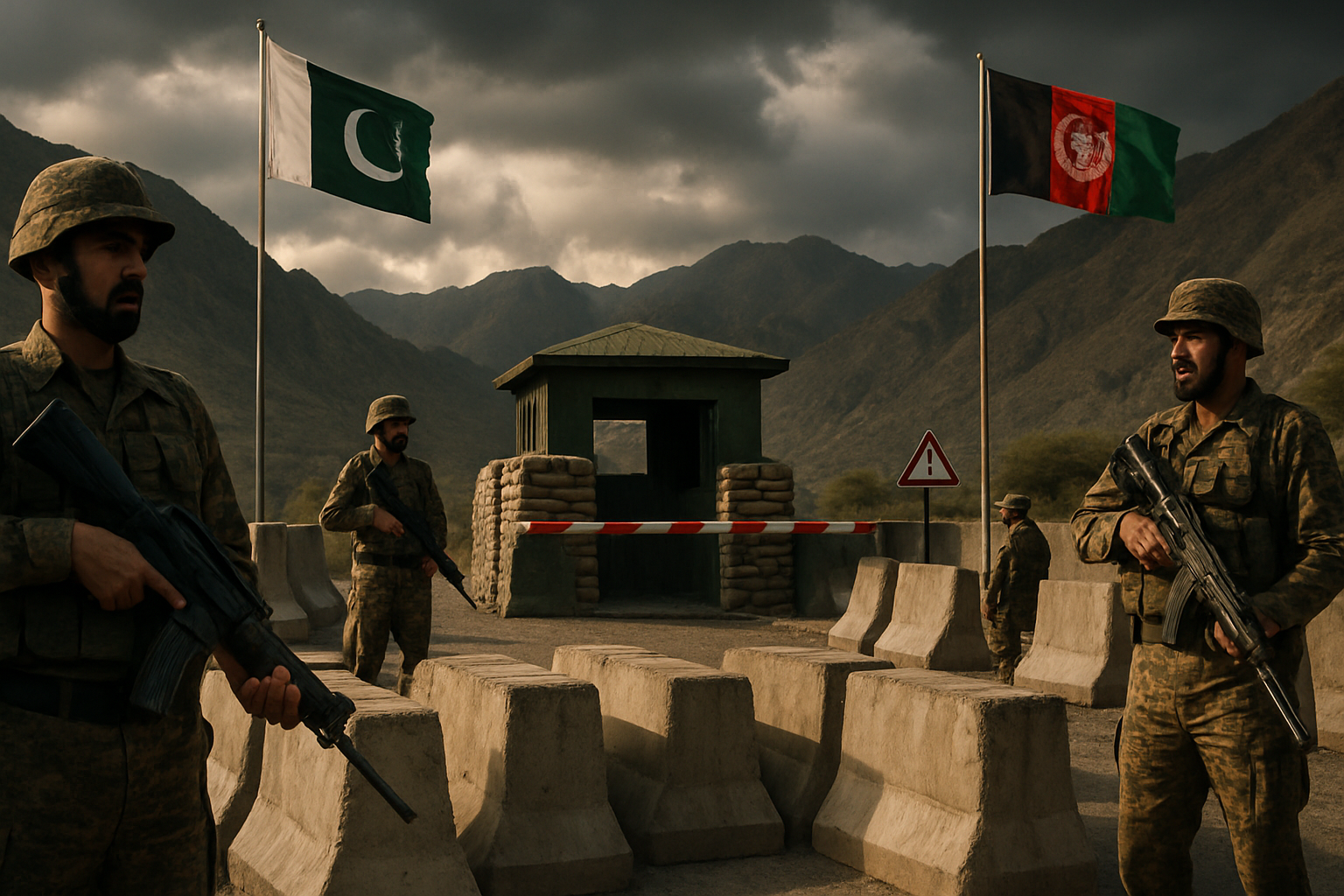
Pakistan will maintain its uncompromising security approach toward Afghanistan following recent deadly cross-border airstrikes, as tensions between Islamabad and the Taliban government reach dangerous new heights with threats of military retaliation.
Pakistan's Interior Ministry official Talal Chaudhry announced Wednesday that Islamabad would not change its hardline policy toward the Taliban after conducting airstrikes across the border. Speaking to Geo News, Chaudhry emphasized that Afghan authorities must take "immediate, concrete and verifiable measures against all terror groups operating from Afghan soil."
The declaration comes as Afghanistan's Islamic Emirate warns of a "military response" to Pakistani airstrikes that targeted what Pakistan claims were terrorist camps but resulted in significant civilian casualties. Taliban spokesman Zabihullah Mujahid told Al Arabiya that the strikes in Nangarhar and Paktika provinces were "a shameful act" and declared that "Pakistan must receive a response."
Escalating Military Confrontation
The latest crisis represents the most serious Pakistan-Afghanistan border escalation in recent months, building on a dangerous pattern of cross-border violence that has tested diplomatic solutions. Pakistani airstrikes on February 22, 2026, targeted seven terrorist camps, killing what Pakistan claims were over 80 militants from the Tehreek-e-Taliban Pakistan (TTP) and ISIS-K affiliates.
However, the strikes also resulted in devastating civilian casualties, with Taliban officials and UN sources confirming at least 18 civilians killed, including eight schoolchildren aged between 5 and 15 years old in Nangarhar's Behsud district. The civilian toll has drawn international condemnation and prompted Afghanistan to file a formal complaint with the UN Security Council.
The Taliban's retaliation threat represents a significant escalation in rhetoric, with officials describing the protection of sovereignty and population as "religious obligations and national duties." This language suggests potential military action that could dramatically worsen bilateral relations.
Root Causes of Border Crisis
The current tensions stem from a series of deadly attacks on Pakistani forces that Islamabad attributes to militants operating from Afghan territory. The February 16, 2026, Bajaur district attack killed 11 Pakistani soldiers when TTP militants used a vehicle-borne improvised explosive device against a security checkpost, prompting Pakistan's military response.
This attack was part of a broader pattern of cross-border terrorism that has plagued Pakistan since the Taliban's return to power in August 2021. Pakistani forces have conducted intensive counter-terrorism operations, eliminating over 400 militants in February 2026 alone during operations in Balochistan province.
Defense Minister Khawaja Asif had previously threatened airstrikes if cross-border attacks continued, arguing that Pakistan maintains the right to self-defense when its territory is used for attacks by groups operating "with impunity from Afghan soil."
Diplomatic Efforts Prove Insufficient
The escalation occurred despite recent diplomatic efforts, including a Saudi-mediated prisoner exchange in February 2026 that saw the release of three Pakistani soldiers captured during October 2025 border clashes. The confidence-building measure was intended to provide a foundation for broader diplomatic engagement but proved insufficient to address underlying security challenges.
Pakistan has also faced the reality of diminished regional influence in Afghanistan, with Defense Minister Asif acknowledging that Pakistan has lost its traditional role as a power broker to wealthier regional powers including Turkey, the UAE, Qatar, Saudi Arabia, and China. This reduced leverage has increased Pakistan's reliance on military solutions when diplomatic approaches fail.
"We will not change our policy toward the Taliban after conducting recent airstrikes across the border. Afghan authorities must take concrete measures against terror groups."
— Talal Chaudhry, Pakistan Interior Ministry Official
International and Regional Implications
The crisis has drawn international attention, with concerns about spillover effects and regional stability. Chinese officials have warned the UN Security Council about the persistent presence of ISIS-K, al-Qaeda, and other terrorist groups in Afghanistan, contradicting Taliban claims that terrorism has been defeated.
Iran has offered mediation services, with Foreign Ministry spokesman Esmaeil Baghaei warning that escalation could affect the broader region. UN Special Rapporteur Richard Bennett has expressed grave concerns over civilian casualties, while Amnesty International has called for thorough investigations into violations of international humanitarian law.
The timing is particularly sensitive as the strikes occurred during Ramadan, adding religious dimensions to an already complex crisis. The civilian casualties, including the deaths of schoolchildren, have created additional humanitarian concerns and international scrutiny.
Economic and Trade Impact
The deteriorating security situation has had severe economic consequences for both countries. Bilateral trade between Pakistan and Afghanistan has collapsed by 59%, with Pakistan's exports plummeting from over $550 million to $228 million in the first seven months of the current fiscal year, according to State Bank data.
This trade collapse affects border communities that have historically depended on cross-border commerce for their livelihoods. The repeated closure of traditional trade routes through Chaman-Spin Boldak and Torkham has disrupted the economic foundations of the border regions.
Strategic and Security Challenges
The current crisis tests the Taliban's capability and willingness to control militant groups operating from Afghan territory while challenging Pakistan's ability to balance security concerns with diplomatic engagement. The sophisticated nature of recent attacks, including coordinated assaults and vehicle-borne improvised explosive devices, demonstrates that militant groups retain significant operational capabilities despite sustained military pressure.
Pakistan maintains that TTP leadership is "based entirely in Afghanistan" and operates "with impunity" despite Taliban assurances. The Taliban, for its part, denies providing sanctuary to militant groups and argues that Pakistan's military actions violate Afghan sovereignty and international law.
Intelligence suggests that many of these groups benefit from the difficult terrain and limited governance in Afghanistan's mountainous border regions, where traditional tribal dynamics and economic factors contribute to the challenges of effective control.
Path Forward Uncertain
The future trajectory of Pakistan-Afghanistan relations remains highly uncertain as both sides have adopted increasingly hardline positions. Pakistan's commitment to maintaining its tough security policy suggests continued military action may be forthcoming if cross-border attacks persist.
Meanwhile, Taliban threats of "measured and appropriate response" indicate potential military retaliation that could escalate the conflict further. The failure of recent diplomatic initiatives, including Saudi mediation efforts, has limited the options for peaceful resolution.
Regional observers note that the success or failure of diplomatic solutions versus military escalation in this case may provide a template for addressing similar challenges where territorial sovereignty intersects with transnational terrorism. The stakes extend beyond bilateral relations to broader questions of regional stability and the international community's ability to manage complex security challenges in the post-2021 South Asian security architecture.
As tensions continue to mount, the international community faces pressure to develop more effective mechanisms for conflict prevention before the situation spirals into a broader regional confrontation with potentially severe consequences for regional and global security.