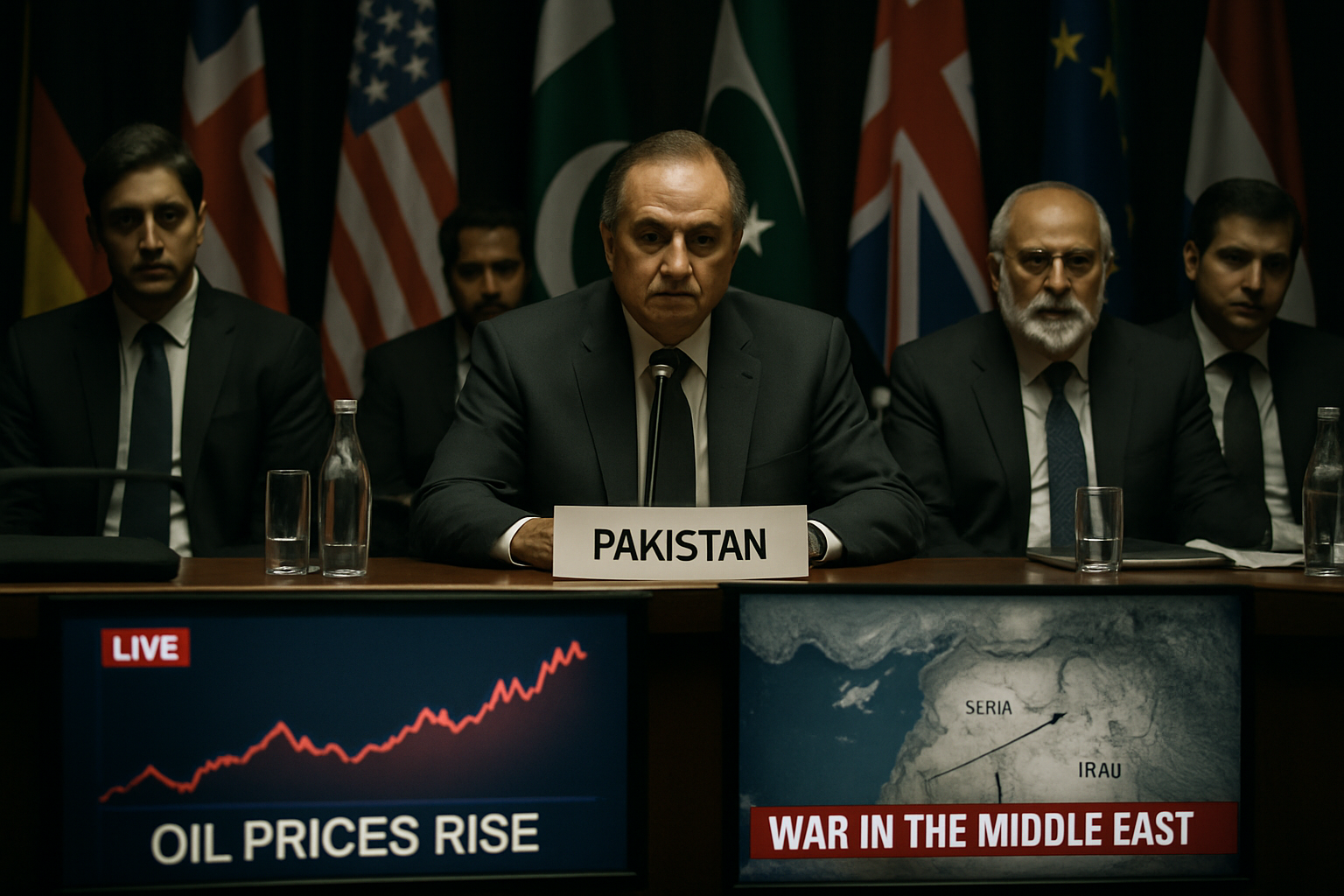
Pakistan has positioned itself as the crucial mediator in international efforts to end the devastating Iran conflict, announcing preparations to host "meaningful talks" between warring parties as the crisis enters its most dangerous phase since beginning February 28, 2026.
Foreign Minister Ishaq Dar confirmed Pakistan's role in facilitating "indirect talks" between the United States and Iran through a "message relay system," revealing that the US has shared a "15-point peace proposal" that Iran is currently deliberating. Speaking after regional foreign minister consultations, Dar stated Pakistan would be "honored to host and facilitate meaningful talks between the two sides in coming days, for a comprehensive and lasting settlement of the ongoing conflict."
Regional Energy Infrastructure Under Attack
The diplomatic efforts come as Iran dramatically escalated attacks against energy facilities across the Gulf region. Iranian forces struck Kuwait's desalinization plant, killing one Indian worker and causing "significant damage to the structure" according to local authorities. The attacks marked Iran's expansion of targeting beyond military installations to critical civilian infrastructure supporting regional populations.
President Trump had earlier issued what analysts describe as the most explicit energy infrastructure ultimatum yet, demanding Iran "FULLY OPEN, WITHOUT THREAT, the Strait of Hormuz, within 48 HOURS" or face attacks on Iranian "POWER PLANTS, STARTING WITH THE BIGGEST ONE FIRST." The strait remains effectively closed by Iranian naval mines, disrupting 40% of global oil transit and stranding over 150 commercial vessels worth billions in cargo.
"Pakistan will be honored to host and facilitate meaningful talks between the two sides in coming days, for a comprehensive and lasting settlement of the ongoing conflict."
— Ishaq Dar, Pakistani Foreign Minister
US Military Escalation and Congressional Opposition
The Wall Street Journal reports that Trump is actively considering a military mission to recover uranium stockpiles in Iran, with the Pentagon preparing for potential ground operations. This development has intensified Congressional scrutiny, with Senator Richard Blumenthal stating he is "more concerned than ever" about the deployment of US ground troops. The conflict maintains historically low public support at just 25%.
Operation Epic Fury has already cost $11.3 billion in its first week alone, with 150 US troops wounded (8 in critical condition) and 3 confirmed deaths - the first American casualties in the largest Middle East operation since 2003. The US submarine USS Charlotte made history by sinking the Iranian frigate IRIS Dena off Sri Lanka, killing over 80 crew members in the first enemy vessel destroyed by a US submarine since World War II.
Iranian Leadership Transition Amid Warfare
The crisis has fundamentally altered Iran's power structure following Supreme Leader Ali Khamenei's death on March 1. His son, Mojtaba Khamenei, has emerged as the new Supreme Leader in the first hereditary succession in the Islamic Republic's 47-year history. CIA assessments suggest the Revolutionary Guards have consolidated unprecedented military control over Iranian governance during the active warfare.
Iran's "Operation True Promise 4" continues systematic targeting across the region under the doctrine that "no red lines remain." The campaign has resulted in casualties across multiple Gulf states: UAE (1 civilian killed in Abu Dhabi), Kuwait (32 injured in airport strikes), Qatar (8 injured while intercepting 65 missiles and 12 drones), and Cyprus (the first European territory attacked since World War II).
Global Economic Crisis and Aviation Paralysis
The conflict has triggered an unprecedented global aviation crisis with over 18,000 flights cancelled worldwide - the most severe disruption since COVID-19. Eight countries have simultaneously closed their airspace, completely severing critical Asia-Europe flight corridors. Dubai International Airport, the world's busiest with 86 million annual passengers, remains shuttered from missile damage.
Oil prices have surged past $100 per barrel for the first time since 2014, with energy ministers warning prices could reach $150-200 per barrel if the conflict continues. The International Energy Agency has authorized the largest strategic petroleum reserve release in its 50-year history - 400 million barrels from 32 countries - in an attempt to stabilize global energy markets.
European Security Implications
The Iranian drone attack on RAF Akrotiri in Cyprus marked the first attack on European territory since World War II, fundamentally altering the conflict's scope. This unprecedented escalation prompted an international naval coalition response, with HMS Dragon leading Spanish, Italian, French, Dutch, and Greek vessels to protect European interests. The European Union activated its ESTIA crisis mechanism for the first time in the bloc's history.
French officials report growing concern about proxy attacks, with the death of Adjutant-Chief Arnaud Frion in Iraqi Kurdistan highlighting the conflict's expansion beyond traditional Middle Eastern boundaries. Pro-Iranian groups have explicitly threatened French interests as being "under targeting fire."
Humanitarian Crisis and War Crimes Allegations
The Iran Red Crescent reports over 787 civilian casualties from US-Israeli strikes, with international organizations investigating potential Geneva Conventions violations. The Pentagon has confirmed US responsibility for an elementary school strike that killed 165-185 students, citing "outdated targeting data" - an admission that has intensified calls for war crimes investigations.
The humanitarian disaster has prompted the largest international evacuation effort since the Arab Spring in 2011, with Australia reporting 115,000 nationals trapped and Germany evacuating 30,000 stranded tourists. Multiple countries have ordered immediate evacuations from Iran citing "extremely uncertain" security conditions.
Nuclear Diplomacy Collapse
The current military escalation emerged from the complete breakdown of nuclear negotiations despite achieving "broad agreement on guiding principles" in Geneva - the most significant diplomatic progress since the JCPOA collapse in 2018. The fundamental obstacle proved insurmountable: Iran demanded nuclear-only talks while excluding ballistic missiles and regional proxy activities as "red lines," while the US insisted on comprehensive agreements addressing missiles, armed groups, and human rights.
Iran continues uranium enrichment at 60% purity with over 400kg of weapons-grade material - sufficient for multiple nuclear weapons if weaponized. The crisis unfolds against the broader context of nuclear governance breakdown, with the New START treaty having expired on February 5, marking the first time in over 50 years without US-Russia nuclear constraints.
Regional Coalition Under Severe Strain
The unprecedented diplomatic coalition of Saudi Arabia, UAE, Qatar, and Egypt that had backed peace efforts now faces severe strain as Iranian retaliation has directly targeted their territories. Egyptian President Sisi has condemned attacks on "sisterly Arab countries," warning of "comprehensive chaos" spreading across the region.
Kuwait has been forced to relocate Jazeera Airways operations to Saudi Arabia due to repeated drone attacks, while the UAE has suspended operations under Iranian pressure. The attacks have fundamentally challenged decades-old security arrangements and alliance structures in the Gulf region.
Template-Setting Crisis for 21st Century
UN Secretary-General António Guterres has characterized the crisis as the "greatest test of multilateral cooperation and crisis management in the modern era." The rapid transition from promising diplomatic framework to military escalation demonstrates the fragility of crisis management in the multipolar era.
The stakes extend far beyond the immediate participants, affecting global energy security, nuclear governance credibility, and international law enforcement mechanisms. Success in containing the crisis could provide a framework for nuclear crisis resolution in the 21st century, while failure may accelerate military solutions and encourage nuclear proliferation globally, undermining diplomatic credibility for decades.
Critical Juncture Ahead
As Pakistan prepares to host what could be the most consequential peace negotiations since the conflict began, the window for diplomatic resolution appears to be narrowing rapidly. Trump's explicit demands for Iran's "unconditional surrender" and his claim of the right to personally choose Iran's next Supreme Leader represent the most direct assertion of American control over Iranian affairs since 1979.
The coming days will likely determine whether innovative diplomatic solutions can bridge fundamental disagreements that have persisted for over a decade, or whether the international community will witness the acceleration of military solutions that could reshape Middle Eastern geopolitics for decades to come.
With oil prices threatening global economic stability, aviation networks paralyzed, and European territory under attack for the first time since World War II, the March 2026 crisis represents a watershed moment that will influence international approaches to conflict resolution, energy security architecture, and diplomatic precedents extending far beyond the current events.