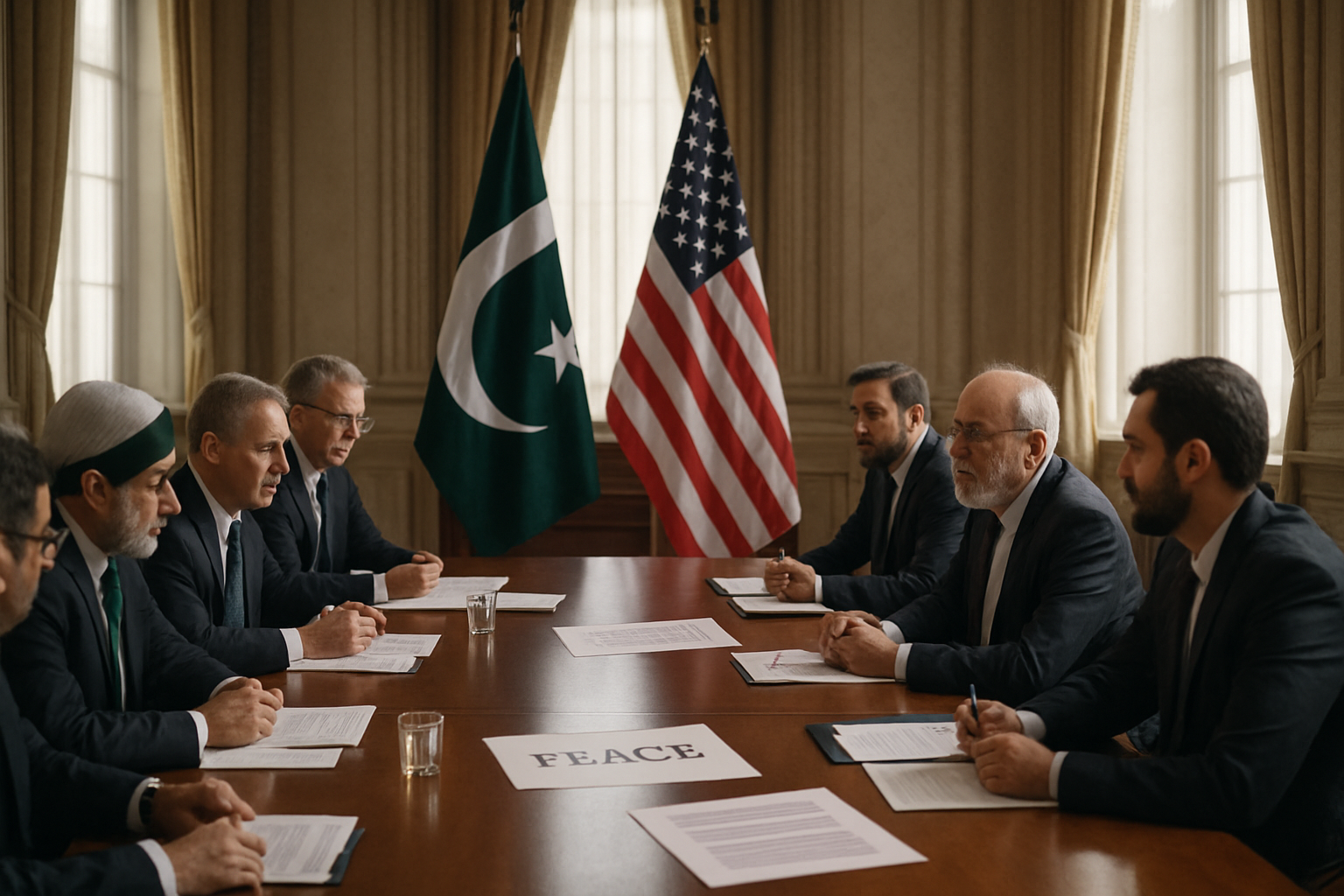
Pakistan has delivered a groundbreaking 45-day ceasefire proposal to both the United States and Iran, marking potentially the last diplomatic opportunity to prevent broader regional war as the month-long Middle East crisis reaches its most dangerous phase since the Cold War.
Foreign Minister Ishaq Dar officially confirmed Pakistan's role as intermediary, announcing that both nations have received what diplomatic sources call the "Islamabad Accord" - a comprehensive two-phase peace framework designed to end hostilities and reopen the strategically vital Strait of Hormuz.
The Pakistani Peace Initiative
Prime Minister Shehbaz Sharif formally offered Pakistan as host for "meaningful and conclusive talks" between Washington and Tehran, positioning Islamabad as the primary mediator in what UN Secretary-General António Guterres has called "the greatest test of multilateral cooperation in the modern era."
The proposal, tentatively named the "Islamabad Accord," outlines a sophisticated two-tier approach: an immediate 45-day ceasefire during which comprehensive negotiations would secure a long-term settlement. Pakistan's army chief, Field Marshal Asim Munir, has maintained contact "all night long" with US Vice President JD Vance, special envoy Steve Witkoff, and Iranian Foreign Minister Abbas Araghchi.
"All elements must be agreed upon today," a diplomatic source told international media, adding that the initial understanding would be formalized as a memorandum processed electronically through Pakistan, serving as the sole communication channel.
— Pakistani Diplomatic Source
Global Crisis at Peak Level
The mediation efforts come as the world faces its most severe energy and security crisis since the 1970s. Iran's Revolutionary Guard has effectively closed the Strait of Hormuz through naval mining operations, blocking 40% of global oil transit and stranding over 150 tankers worth billions in cargo.
Oil prices have surged past $100 per barrel for the first time since 2022, with Brent crude reaching peaks of $119.50 and warnings that prices could hit $200. The International Energy Agency has deployed the largest strategic petroleum reserve release in its 50-year history - 400 million barrels from 32 countries - to stabilize markets.
The aviation industry faces its worst crisis since COVID-19, with over 18,000 flights cancelled worldwide. Eight Middle Eastern countries have simultaneously closed their airspace, creating what experts call an "aviation black hole" that severs critical Asia-Europe corridors. Dubai International Airport, the world's busiest with 86 million passengers annually, remains shuttered due to missile damage.
Military Escalation and Casualties
Operation Epic Fury, the largest US-Israeli coordinated military campaign since the 2003 Iraq invasion, has cost $11.3 billion in its first week alone, with operations running at $1 billion daily. Pentagon sources confirm the deployment of dual aircraft carriers USS Gerald Ford and USS Abraham Lincoln, representing approximately one-third of the active US Navy fleet.
The conflict has produced the first American casualties in a major Middle East operation since 2003: three service members killed and 150 wounded, including eight in critical condition. The USS Charlotte submarine achieved the first enemy vessel sinking by a US submarine since World War II, destroying the Iranian frigate IRIS Dena near Sri Lanka.
European territory was attacked for the first time since World War II when Iranian drones struck RAF Akrotiri in Cyprus, prompting an unprecedented naval coalition response featuring HMS Dragon alongside Spanish, Italian, French, Dutch, and Greek vessels.
Nuclear Dimensions and Diplomatic Breakdown
The crisis emerged from the complete collapse of Geneva nuclear talks in February, despite achieving what officials called "broad agreement on guiding principles" - the most progress since the 2018 JCPOA withdrawal. The fundamental disagreement persists: Iran demands nuclear-only discussions excluding ballistic missiles and regional proxies as "red lines," while the US insists on comprehensive agreements addressing missiles, armed groups, and human rights.
Iran continues uranium enrichment at 60% purity, approaching the 90% weapons-grade threshold, with intelligence estimates suggesting sufficient material for multiple weapons if weaponized. The crisis unfolds amid broader nuclear governance breakdown, as the New START treaty expired in February 2026 - the first time in over 50 years without US-Russia nuclear constraints.
Regional Coalition Under Strain
Iran's systematic "Operation True Promise 4" retaliation campaign has severely strained the unprecedented regional coalition supporting diplomatic solutions. The UAE reported one civilian killed in Abu Dhabi, Kuwait suffered 32 injuries from airport strikes, and Qatar intercepted 65 missiles and 12 drones with eight injuries reported.
Egyptian President Abdel Fattah el-Sisi condemned attacks on "sisterly countries," warning of "comprehensive chaos" spreading across the Middle East. The coalition of Saudi Arabia, UAE, Qatar, and Egypt - representing extraordinary Middle Eastern consensus - faces mounting pressure as Iranian retaliation directly targets member territories.
Congressional Opposition and Public Sentiment
The conflict faces unprecedented domestic opposition in the United States, with only 25% public support - described by analysts as "almost unprecedented" unpopularity for early-stage military operations. Senator Richard Blumenthal expressed being "more concerned than ever" about potential ground troop deployment.
Pentagon operations are planned through September 2026, far beyond the administration's initial 4-6 week timeline. Financial markets serve as what experts call the "ultimate constraint" on prolonged escalation, with Pakistan's KSE-100 suffering its largest decline in history at -8.97%.
International Support for Pakistani Mediation
China has expressed "full support" for Pakistan's mediation initiative, with Foreign Minister Wang Yi describing peace talks as "conducive to restoring normal navigation in the Strait of Hormuz." German Foreign Minister Roderich Kiesewetter noted "positive signs" that direct US-Iran talks may begin "very soon" with Pakistan as the venue.
The mediation framework represents what European diplomatic sources describe as Pakistan's role as a "net regional stabilizer" alongside Turkey and Egypt, providing crucial communication channels when direct dialogue remains impossible.
Humanitarian and Economic Consequences
The Iran Red Crescent reports over 787 civilian casualties from US-Israeli strikes, including a devastating Pentagon-confirmed elementary school strike that killed 165-185 students due to "outdated targeting data." The incident has prompted calls for Geneva Conventions violations investigations.
International evacuations have reached Arab Spring 2011 levels, with Australia reporting 115,000 citizens trapped and Germany evacuating 30,000 stranded nationals. The EU activated its ESTIA crisis mechanism for the first time in bloc history following the Cyprus attack.
Energy infrastructure warfare has created a global supply chain crisis. Qatar's LNG production halt affects approximately 20% of global exports, while natural gas prices have surged 24% in Europe and 78% in the United States. Major shipping companies Maersk and MSC have suspended Persian Gulf operations entirely.
Trump's Position and Iranian Response
President Trump has explicitly demanded "unconditional surrender" from Iran, claiming the right to personally choose the next Iranian Supreme Leader - the most direct assertion of American control over Iranian affairs since 1979. His policy has evolved from nuclear-focused demands to comprehensive political transformation.
Iran categorically rejected Trump's earlier 15-point peace proposal, with senior officials declaring Iran "will not allow Trump to dictate the timing of war's end." However, CNN reports that Iranian sources remain "ready to listen to sustainable proposals," suggesting complex internal dynamics amid unprecedented external pressure.
Template-Setting Implications
The crisis represents what experts describe as a "template-setting moment" for 21st-century conflict resolution, testing whether diplomatic innovation can bridge fundamental disagreements or whether military solutions become the preferred approach for international disputes.
Success in containing the crisis could provide a framework for future nuclear crises and strengthen international law enforcement. Failure may accelerate military solutions for decades, encourage nuclear proliferation globally, and fundamentally undermine diplomatic credibility for territorial and security disputes worldwide.
Critical Juncture
Pakistan's mediation efforts represent potentially the final diplomatic window before the crisis escalates into broader regional war with global consequences. The stakes extend beyond the immediate Middle East to affect energy security architecture, nuclear governance credibility, and the post-World War II international order.
As Field Marshal Asim Munir maintains round-the-clock contact with key officials from both sides, the coming days will determine whether innovative diplomatic solutions can prevent what could become the most consequential international crisis since the Cold War's end, with implications extending decades beyond current events.