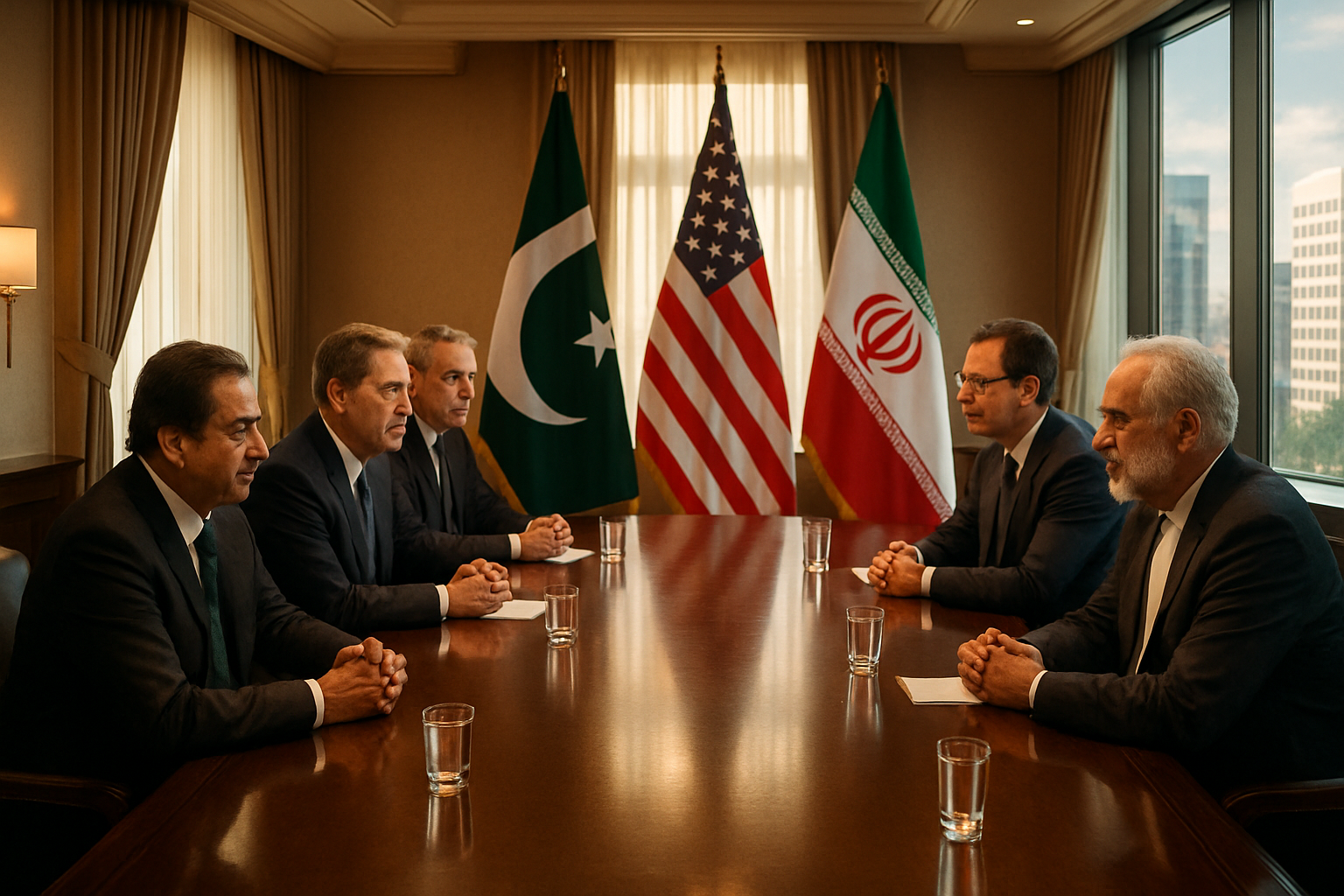
Pakistan has formally emerged as a critical mediator in the escalating US-Iran crisis, with Deputy Prime Minister and Foreign Minister Ishaq Dar confirming that both Washington and Tehran have expressed confidence in Pakistan's ability to facilitate peace talks amid the ongoing Middle East conflict.
Speaking after a crucial quadrilateral meeting in Islamabad attended by foreign ministers from Saudi Arabia, Turkey, and Egypt, Dar announced that Pakistan would be "honored" to host direct negotiations between the United States and Iran in the coming days, marking a significant diplomatic breakthrough in one of the world's most dangerous international crises.
Pakistan's Mediation Role Confirmed
For the first time publicly, Dar acknowledged that Pakistan is actively facilitating indirect communications between the adversaries through a sophisticated message relay system. "US-Iran indirect talks are taking place through messages being relayed by Pakistan. The United States has shared 15 points, being deliberated upon by Iran," Dar stated, confirming Pakistan's central role in diplomatic efforts to prevent broader regional warfare.
The confirmation represents a watershed moment for Pakistan's diplomatic standing, positioning the country as what European sources describe as a "net regional stabilizer" alongside Turkey and Egypt. Pakistan's historical neutrality and diplomatic relationships with all major regional powers have uniquely positioned it to bridge the divide when direct communication between Washington and Tehran has become impossible.
Regional Coalition Supporting Peace Efforts
The quadrilateral meeting in Islamabad underscored unprecedented regional coordination in seeking diplomatic solutions to the crisis. The gathering marked the second such consultation among Pakistan, Saudi Arabia, Turkey, and Egypt, with the first held in Riyadh on March 19, 2026.
This innovative regional framework represents a departure from traditional Western-led mediation efforts, showcasing the emergence of regional crisis management mechanisms in an increasingly multipolar world. Turkish Foreign Minister Hakan Fidan emphasized the importance of establishing effective de-escalation mechanisms, while Egyptian Foreign Minister Dr. Badr Abdelatty's participation underscores Arab world investment in diplomatic solutions.
"Pakistan, Saudi Arabia, Turkey, and Egypt are extending support to this initiative. This represents coordinated regional effort to prevent broader Middle Eastern warfare."
— Deputy PM Ishaq Dar, Pakistan Foreign Ministry
The 15-Point Peace Proposal
According to multiple diplomatic sources, the United States has transmitted a comprehensive 15-point peace proposal to Iran through Pakistani intermediaries. While specific details remain classified, diplomatic sources indicate the framework addresses Iran's nuclear program, ballistic missiles, regional proxy activities, and the crucial issue of reopening the Strait of Hormuz to international shipping.
The proposal represents a potential evolution from earlier Trump administration demands for "unconditional surrender" toward a more negotiated framework for conflict resolution. However, fundamental disagreements persist, with Iran maintaining that ballistic missiles and regional proxies remain "red lines" excluded from nuclear-focused discussions.
Crisis Context and Global Implications
The Pakistani mediation efforts come against the backdrop of the most dangerous international crisis since the Cold War's end. The conflict has already resulted in unprecedented global disruption: over 18,000 flights cancelled worldwide, oil prices surging past $100 per barrel, and the effective closure of the Strait of Hormuz, which handles 40% of global oil transit.
The humanitarian toll continues to mount, with Iran's Red Crescent reporting over 787 civilian casualties from US-Israeli strikes. The conflict has expanded geographically, with European territory attacked for the first time since World War II when Iranian drones struck RAF Akrotiri in Cyprus, prompting an unprecedented naval coalition response from European powers.
Nuclear Diplomacy Breakthrough Attempts
The current Pakistani mediation efforts follow the complete collapse of previous Geneva talks, despite achieving what Iranian Foreign Minister Abbas Araghchi called "broad agreement on guiding principles" – the most significant diplomatic progress since the 2018 JCPOA collapse. The fundamental scope disagreement proved insurmountable: Iran demanded nuclear-only talks excluding missiles and proxies, while the US insisted on comprehensive agreements addressing missiles, armed groups, and human rights.
Iran continues uranium enrichment at 60% purity, approaching the 90% weapons-grade threshold, with over 400kg of enriched material sufficient for multiple weapons if weaponized. The crisis occurs amid a broader nuclear governance breakdown, with the New START treaty having expired in February 2026, leaving the world without US-Russia nuclear constraints for the first time in over 50 years.
Regional Coalition Under Strain
The unprecedented Saudi-UAE-Qatar-Egypt consensus supporting diplomatic solutions faces severe strain as Iranian "Operation True Promise 4" systematically targets coalition member territories. The UAE reported one civilian killed in Abu Dhabi, Kuwait suffered 32 injuries from airport strikes, and Qatar intercepted 65 missiles and 12 drones, resulting in eight injuries.
Egyptian President Sisi condemned attacks on "sisterly countries," warning of "comprehensive chaos" if the conflict continues to escalate. This regional coalition strain adds urgency to Pakistani mediation efforts, as the diplomatic consensus that has prevented broader military confrontation faces increasing pressure from Iranian retaliation policies.
US Military Posture and Congressional Concerns
Operation Epic Fury, the largest US-Israeli coordinated campaign since the 2003 Iraq invasion, has cost $11.3 billion in its first week alone. The deployment of dual-carrier groups USS Gerald R. Ford and USS Abraham Lincoln, representing approximately one-third of the active US Navy fleet, demonstrates unprecedented military commitment to the region.
Congressional scrutiny has intensified, with bipartisan lawmakers demanding answers about strategy, costs, and the potential for ground troop deployment. Senator Blumenthal expressed being "more concerned than ever" about boots on the ground, while conflict unpopularity reaches historic levels with only 25% American support – described as "almost unprecedented" for major military operations.
Template-Setting Moment for 21st Century Diplomacy
UN Secretary-General António Guterres has described the situation as the "greatest test of multilateral cooperation and crisis management in the modern era." Pakistan's confirmed mediation role offers potentially the final diplomatic opening before broader regional warfare with global consequences affecting energy markets, supply chains, and nuclear proliferation mechanisms for decades.
The Pakistani initiative represents innovation in regional crisis management, demonstrating how middle powers can effectively bridge divides between major adversaries. The country's ability to maintain relationships across traditional alliance lines positions it as an increasingly valuable diplomatic asset in a multipolar world.
"Pakistan is very happy that both Iran and the US have expressed their confidence in Pakistan to facilitate the talks. We will be honored to host dialogue in coming days."
— FM Ishaq Dar, March 29, 2026
Economic and Energy Security Stakes
The global economic implications of the crisis continue to escalate. Pakistan's own KSE-100 index suffered its largest single-day decline in history, while the Dubai International Airport – the world's busiest with 86 million passengers annually – remains shuttered due to missile damage. The crisis has exposed fundamental vulnerabilities in global energy architecture and over-dependence on strategic chokepoints.
Natural gas prices have surged 24% in Europe and 78% in the United States, while major shipping companies including Maersk and MSC have suspended Persian Gulf operations entirely. Over 150 tankers remain stranded with billions in cargo, affecting global supply chains far beyond the energy sector.
The Path Forward
Pakistan's emergence as the primary mediator represents a critical diplomatic window as military preparations continue on all sides. Prime Minister Shehbaz Sharif's formal offer to host "meaningful and conclusive talks" for comprehensive settlement positions Islamabad as the potential venue for breakthrough negotiations.
The success or failure of Pakistani mediation efforts will have implications extending decades beyond the current crisis, potentially establishing new templates for regional crisis management or, alternatively, demonstrating the limitations of diplomatic approaches in resolving fundamental security disagreements between major powers.
As Chinese Foreign Minister Wang Yi expressed support for Pakistan's role, calling peace talks "conducive to restoring normal navigation in the Hormuz," and German Foreign Minister Wadephul noted "positive signs" that direct US-Iran talks may begin "very soon" in Pakistan, the international community watches to see whether innovative diplomatic solutions can bridge longstanding disagreements or whether the momentum toward military confrontation has become irreversible.
March 29, 2026, may well be remembered as a watershed moment in international relations – either as the beginning of a new era of effective regional mediation or as the final diplomatic effort before a broader Middle Eastern conflict with global implications for energy security, nuclear governance, and international law enforcement mechanisms that would reshape the post-World War II order for generations to come.