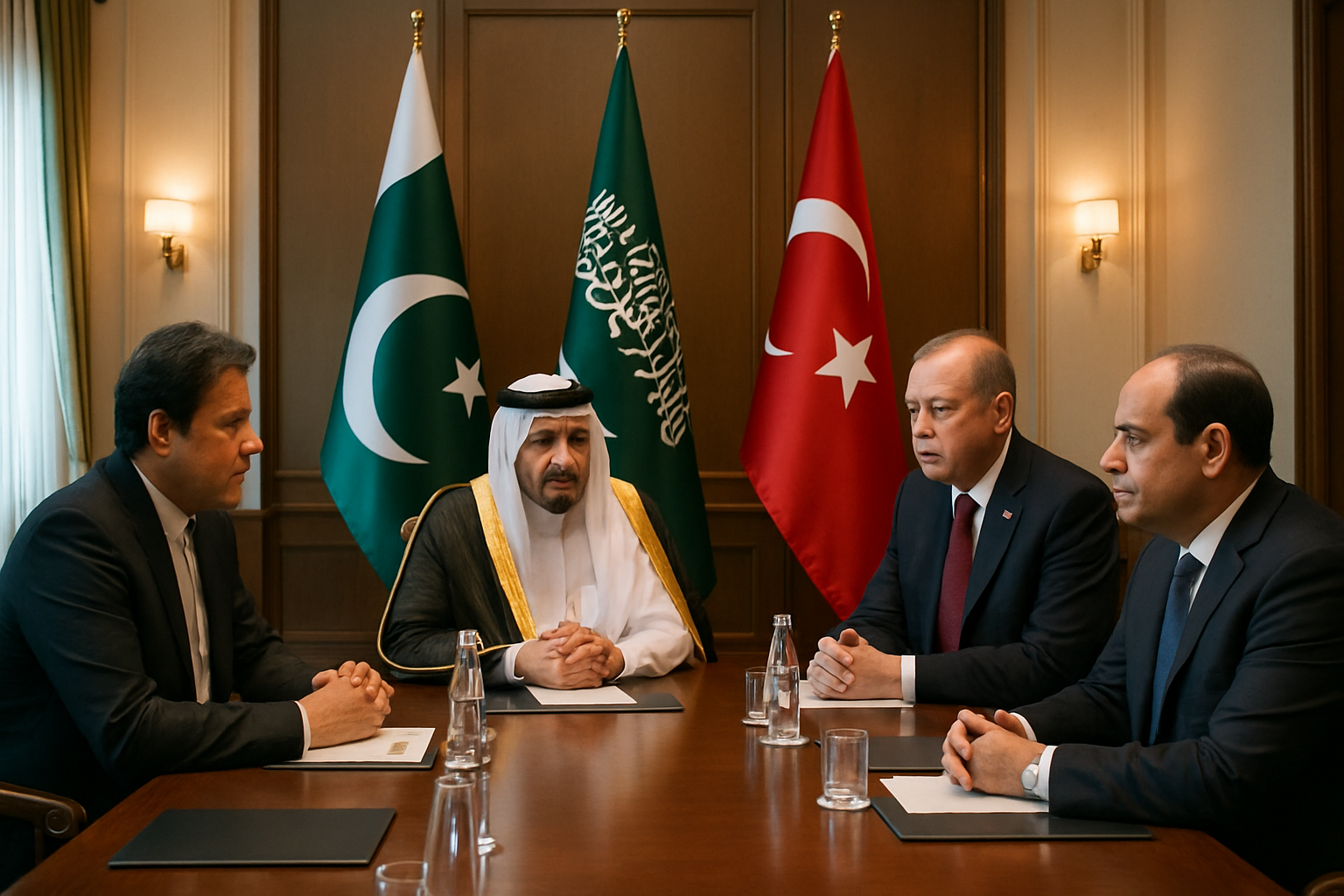
Pakistan has positioned itself as a pivotal mediator in Middle East diplomacy as Foreign Minister Ishaq Dar hosts high-stakes talks with counterparts from Saudi Arabia, Turkey, and Egypt in Islamabad, seeking to encourage diplomatic solutions to mounting regional conflicts.
The four-nation summit, confirmed by multiple sources including Al Jazeera and Reuters, represents Pakistan's emergence as what European diplomatic sources describe as a "net regional stabilizer" with unique capabilities to facilitate dialogue between adversaries when direct communication proves impossible.
Unprecedented Quadrilateral Framework
According to Saudi Gazette, Saudi Foreign Minister Prince Faisal bin Farhan met with Pakistan's Deputy Prime Minister and Foreign Minister Ishaq Dar in Islamabad on Sunday. The meeting was held on the sidelines of the quadrilateral ministerial meeting scheduled for Sunday and Monday, with discussions focused on "regional developments and joint efforts being exerted to address them."
The talks come within what officials describe as a "framework of consultation and coordination among the participating countries to discuss developments in the region and ongoing efforts to de-escalate tensions and enhance regional security and stability."
Channel News Asia reports that Pakistan has emerged as a key facilitator between Iran and the United States as their conflict drags on, serving as an intermediary for messages between the two sides. This role has been publicly acknowledged by Pakistani officials, marking a significant diplomatic evolution.
Focus on Strait of Hormuz Crisis
Initial discussions have centered on proposals to reopen the Strait of Hormuz to shipping, according to Reuters sources familiar with the matter. The Strait, previously a conduit for about a fifth of global oil and liquefied natural gas supplies, has been effectively halted by Iran in response to US and Israeli air strikes that began a month ago.
Cyprus Mail reports that countries meeting in Pakistan have floated proposals to Washington tied to maritime traffic and reopening the strategic waterway, representing part of wider efforts to stabilize shipping flows that are critical to global energy security.
The talks occur against the backdrop of surging global oil prices and continued fighting between Iran, the US, and Israel, creating urgent pressure for diplomatic breakthrough.
Pakistan's Growing Mediation Role
Pakistan's diplomatic prominence has grown significantly as the country maintains communication channels with all major regional powers while coordinating with traditional allies and strategic partners. Prime Minister Shehbaz Sharif has formally offered Pakistan to host "meaningful and conclusive talks" for comprehensive settlement of regional conflicts.
The country's historical neutrality, combined with diplomatic relationships spanning from Iran to Saudi Arabia and from Turkey to Egypt, positions it uniquely to facilitate dialogue across traditional alliance lines. This capability has become increasingly valuable as direct communications between adversaries remain suspended.
European diplomatic sources note that Pakistan's role alongside Turkey and Egypt as message relays between adversaries represents a departure from traditional Western-led mediation efforts, showcasing the emergence of innovative regional crisis management frameworks in an increasingly multipolar world.
Regional Coalition Building
The participation of Saudi Arabia, Turkey, and Egypt underscores the unprecedented level of regional cooperation in addressing Middle Eastern crises. This extraordinary consensus among typically opposing Middle Eastern powers reflects the gravity of current tensions and shared investment in preventing broader military confrontation.
Turkish Foreign Minister Hakan Fidan's participation emphasizes Turkey's NATO membership and strategic significance, while Egypt's involvement represents the Arab world's investment in diplomatic solutions. Saudi Arabia's engagement demonstrates Gulf state concerns about regional stability and energy security.
This multi-country mediation network, according to Pakistani officials, involves "other unnamed countries also extending support to this initiative," representing a coordinated regional effort to prevent broader Middle Eastern warfare.
"Pakistan has emerged as a key facilitator between Iran and the United States as their war drags on, serving as an intermediary for messages between the two sides."
— Channel News Asia
Context of Escalating Regional Crisis
The Islamabad talks coincide with warnings from Iran against launching ground attacks as American marines continue arriving in the region. France 24 reports that Iranian parliament speaker Mohammad Bagher Ghalibaf accused the United States of plotting ground attacks even while claiming diplomatic engagement.
The Israeli army has announced combat deaths in south Lebanon, while multiple international travel warnings and embassy evacuations signal the potential for further escalation. This creates urgent pressure for the diplomatic initiatives being discussed in Islamabad.
The timing of these talks is particularly significant given the ongoing nuclear negotiations between the US and Iran, which have achieved some framework progress but remain deadlocked on fundamental scope disagreements.
Strategic Implications
The success of Pakistan's diplomatic initiative could establish a new template for regional crisis management, demonstrating how middle powers can effectively bridge divides between major adversaries. The country's ability to maintain relationships across traditional alliance lines positions it as an increasingly valuable diplomatic asset.
The quadrilateral collaboration represents an innovative approach to regional frameworks that could influence future international crisis management. If successful, it would showcase regional powers' capacity to develop effective solutions independently of traditional great power mediation.
The talks also address broader regional economic cooperation and security coordination. Pakistan's energy needs and trade relationships with Gulf states create natural incentives for diplomatic engagement, while Turkey's NATO membership and Egypt's regional influence provide additional strategic dimensions to the partnership.
Looking Forward
As the four-nation talks continue in Islamabad, the international community is closely watching whether this regional diplomatic framework can produce tangible results in de-escalating Middle East tensions. The success or failure of these efforts could determine the trajectory of regional conflict resolution approaches for years to come.
The Pakistan-hosted summit represents what UN Secretary-General António Guterres has called the "greatest test of multilateral cooperation in the modern era." The innovative approach of regional powers taking the lead in crisis management reflects changing international relations dynamics in an increasingly multipolar world.
With global energy security, nuclear governance, and regional stability all at stake, the diplomatic initiative being pursued in Islamabad carries implications that extend far beyond the immediate region. The coming days will be crucial in determining whether diplomatic innovation can succeed where traditional approaches have struggled.