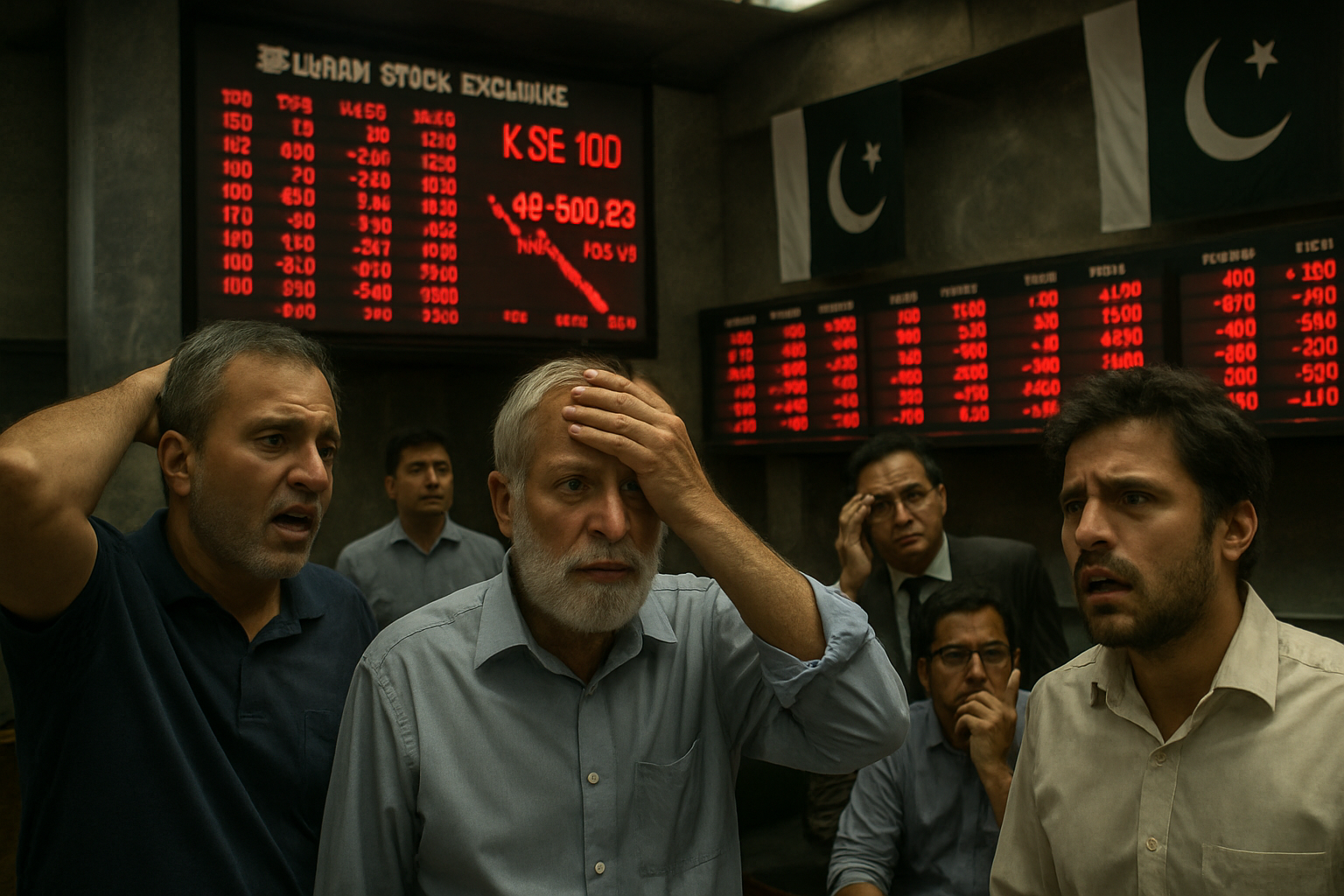
Pakistan's benchmark KSE-100 index experienced its most devastating trading session in history on Monday, crashing by 4,687.50 points (3.05%) to close at 149,178.66 points, marking a turbulent start to the week as global oil crisis and Middle East tensions sent shockwaves through regional markets.
The catastrophic decline occurred amid unprecedented global energy market disruption, with Iran's Revolutionary Guard declaring the Strait of Hormuz "unsafe for shipping," effectively blocking 40% of global seaborne oil transit. The geopolitical crisis has triggered the most severe energy security emergency since the 1970s oil shocks, creating ripple effects across financial markets worldwide.
Historic Market Decline Triggers Circuit Breakers
During Monday's trading session, the KSE-100 touched an intraday high of 153,943.69 points before plummeting to a low of 148,747.72 points, reflecting persistent downward pressure throughout the day. The sharp decline represents the continuation of the index's seventh consecutive week of losses, highlighting the sustained impact of geopolitical uncertainty on Pakistani equities.
Analysts at Topline Securities noted that the market remained under pressure for most of the trading session, with the index largely trading in negative territory as investors adopted an increasingly cautious stance. The sell-off was so severe that trading suspensions were implemented to prevent further panic selling.
"This represents the largest single-day point decline in the history of the Pakistan Stock Exchange," confirmed market officials, as the 4,687-point drop surpassed previous records set during global financial crises.
Global Energy Crisis Drives Market Panic
The market crash coincides with an unprecedented global energy crisis triggered by Iran's closure of the strategic Strait of Hormuz waterway. Oil prices have surged past $100 per barrel for the first time since 2022, with Brent crude reaching peaks of $119.50 and WTI jumping a record 18.98% to $108.15 in the largest single-day increase on record.
"The recent surge in oil prices was triggered by US-Israel aggression against Iran, which led to the complete disruption of global energy supply chains."
— Topline Securities Analysis Report
The energy crisis has forced Pakistan to implement wartime austerity measures, with Prime Minister Shehbaz Sharif announcing unprecedented cost-cutting initiatives including four-day work weeks for government offices, 50% cuts in fuel allowances for official vehicles, and the suspension of 60% of government vehicles.
Pakistan's fuel costs have reached Rs321.17 per liter, the highest in South Asia, forcing consumers to grapple with the most dramatic price increases since the 2008 financial crisis. The government has been forced to provide Rs23 billion in subsidies to oil marketing companies to prevent even steeper price increases for petrol and high-speed diesel.
Regional Market Contagion Spreads
The Pakistan market crash is part of a broader regional financial contagion affecting markets across Asia and beyond. South Korea's KOSPI plunged 12% with circuit breakers activated, while the Korean won hit a 17-year low. Japan's Nikkei experienced its third-largest point drop in history, and stock markets from Australia to Europe suffered severe declines.
The crisis has exposed the vulnerability of emerging markets to geopolitical shocks, particularly those heavily dependent on energy imports. Natural gas prices have exploded by 24% in Europe and 78% in the United States, reaching €47.32/MWh in Europe—the highest level since February 2025.
Major shipping companies including Maersk and MSC have suspended all operations in the Persian Gulf, leaving over 150 oil and LNG tankers stranded with billions of dollars worth of cargo. This supply chain disruption is particularly devastating for Pakistan, which imports the majority of its energy needs through Middle Eastern routes.
Aviation and Trade Routes Severely Impacted
The crisis has extended beyond energy markets to devastate global aviation, with over 18,000 flights cancelled worldwide—the most extensive disruption since the COVID-19 pandemic. Eight countries, including Iran, Iraq, Israel, UAE, Qatar, Syria, Kuwait, and Bahrain, have simultaneously closed their airspace, severing critical trade and travel corridors.
Dubai International Airport, the world's busiest with 86 million passengers annually, remains completely shut down due to missile damage, while major carriers including Emirates, Air France-KLM, Wizz Air, and Bulgaria Air have suspended operations indefinitely.
Economic Ripple Effects Intensify
The International Energy Agency (IEA) has announced the largest strategic petroleum reserve release in its 50-year history—400 million barrels from 32 countries—in an attempt to stabilize global markets. This release is more than double the 182.7 million barrels released during the 2022 Ukraine crisis, highlighting the unprecedented severity of the current situation.
Japan is releasing 80 million barrels starting March 16, marking the first deployment since the 2011 Fukushima disaster. With 95% of Japan's oil dependence on the Middle East and 70% transiting through the Strait of Hormuz, the country faces particular vulnerability to the ongoing crisis.
Government Emergency Responses
Pakistan's government has implemented the most dramatic cost-cutting measures since the 2008 crisis, affecting over 240 million people. The measures include:
- Four-day work weeks for all government offices with mandatory work-from-home Fridays
- 50% reduction in fuel allowances for official vehicles
- Suspension of 60% of government vehicles
- Federal cabinet members forgoing salaries for two months
- 25% salary cuts for parliamentarians
- 50% of government staff working from home
Educational institutions have also been affected, with Sindh province schools closed March 16-31 for an extended "spring vacation," while universities have moved to online classes to conserve energy resources.
International Emergency Coordination
The crisis has prompted unprecedented international coordination, with central banks including the European Central Bank and Bank of Japan implementing emergency liquidity measures to prevent broader financial contagion. Traditional monetary policy tools are proving limited in effectiveness against structural geopolitical disruptions of this magnitude.
Multiple governments are exploring emergency measures including temporary fuel tax reductions, retail price caps, and enhanced supply diversification initiatives. France has deployed 500 fuel station inspectors to prevent price manipulation, while Romania has developed five scenarios to prevent diesel prices from exceeding critical thresholds.
"This represents the most severe energy security crisis in decades, exposing dangerous single-chokepoint vulnerabilities in global logistics systems."
— Samuel Ciszuk, Energy Security Analyst
Long-term Implications for Pakistan
The crisis highlights Pakistan's dangerous over-dependence on energy imports and vulnerable supply chains that transit through geopolitically unstable regions. The 21-mile Strait of Hormuz represents a geographic single-point failure for modern logistics, with no realistic alternative routes capable of handling the diverted volume without significant time and cost penalties.
Experts warn that Pakistan's economy faces a prolonged period of adjustment, with the recovery timeline uncertain and dependent on military operations and diplomatic resolution rather than predictable weather-related disruptions. The crisis is accelerating discussions about fundamental energy architecture transformation, though renewable transitions require years or decades of implementation.
The current situation represents a template-setting moment for 21st-century crisis management, demonstrating how regional conflicts can instantly become global economic disruptions in an interconnected world. The stakes extend beyond immediate financial markets to include regional war prevention, global energy security, nuclear governance credibility, and international law enforcement mechanisms.
Market Outlook and Recovery Prospects
Financial analysts warn that traditional market recovery patterns may not apply to the current crisis, given its structural geopolitical nature. Unlike weather-related disruptions with predictable timelines, this crisis depends entirely on military operations resolution and diplomatic normalization.
The Pakistan Stock Exchange has implemented enhanced monitoring protocols and is coordinating with international partners to maintain market stability. However, the fundamental challenges remain as long as global energy supply chains continue to face disruption through the world's most critical maritime chokepoints.
As of Monday's close, the KSE-100's dramatic decline serves as a stark reminder of Pakistan's vulnerability to global geopolitical shocks and the urgent need for economic diversification and energy security planning that reduces dependence on volatile international supply chains.
The coming weeks will be decisive in determining whether this crisis can be contained through diplomatic means or will escalate into broader Middle Eastern conflict with global economic consequences that could reshape international trade and energy markets for decades to come.