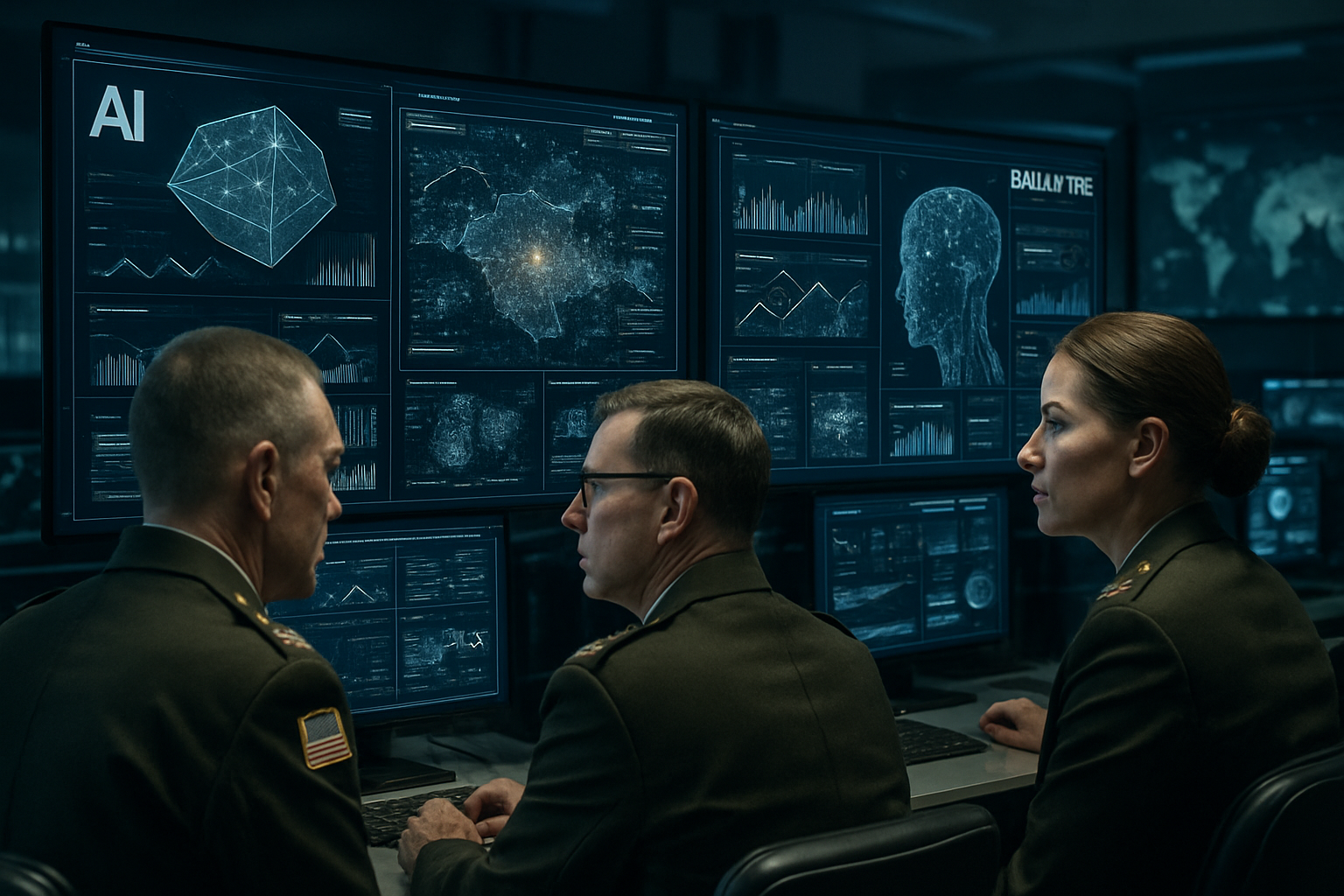
The Pentagon has officially designated Palantir's Maven artificial intelligence system as a "program of record," cementing the most comprehensive AI integration in US military history and fundamentally transforming how American forces detect, analyze, and engage threats across all operational domains.
Deputy Secretary of Defense Steve Feinberg announced the historic decision in a March 9 letter to senior Pentagon leaders and military commanders worldwide, declaring that embedding Palantir's Maven Smart System would provide warfighters "with the latest tools necessary to detect, deter, and dominate our adversaries in all domains." The decision represents a watershed moment in the militarization of artificial intelligence, elevating experimental technology to essential infrastructure status.
Maven System Becomes Military Standard
Maven is a sophisticated command-and-control software platform that analyzes vast streams of battlefield data in real-time, identifying potential targets and providing tactical recommendations at superhuman speeds. The system has already been deployed as the primary AI operating system for US military operations, with sources indicating it has been utilized in thousands of missions since its initial implementation.
The formal "program of record" designation, expected to take effect by the close of the current fiscal year in September, ensures long-term funding and standardization across all military branches. This marks the culmination of years of experimental deployment where Maven proved its operational value through practical battlefield applications.
"This technology represents a fundamental shift in how we approach modern warfare. Maven doesn't just process information—it transforms raw intelligence into actionable battlefield advantages faster than any human analyst could achieve."
— Former Pentagon AI Specialist
The integration builds upon extensive real-world testing, including controversial applications such as the February 2026 operation that captured former Venezuelan President Nicolás Maduro. That mission utilized Palantir's AI through partnership arrangements despite ongoing debates about civilian oversight of military AI systems.
Context of Military AI Revolution
The Maven adoption occurs during the most critical period in military artificial intelligence development. The Pentagon has simultaneously integrated OpenAI's ChatGPT into classified military networks, serving over 800 million weekly users with 10% monthly growth, while pressuring AI companies to expand tools into sensitive operational environments.
This integration strategy contrasts sharply with resistance from some AI developers. Anthropic, the company behind Claude AI, faced designation as a "supply chain risk" after CEO Dario Amodei refused Pentagon demands for unrestricted military access, maintaining that the company "cannot in good conscience provide unrestricted AI capabilities that could be turned against civilian populations or undermine democratic institutions."
The divide illustrates broader tensions within the AI industry over military applications. While OpenAI and Palantir have embraced defense partnerships with layered security protections, other companies maintain strict ethical boundaries around autonomous weapons and mass surveillance capabilities.
Global Military AI Competition
The Pentagon's AI integration accelerates amid intensifying international competition. Ukrainian forces have deployed AI-enhanced drone systems with improved low-light vision capabilities, demonstrating practical battlefield applications of artificial intelligence. Chinese military forces have announced their own AI-assisted systems, including breakthrough aerial refueling technology that improves operational efficiency and safety.
King's College London research revealed alarming patterns in AI decision-making, with chatbots choosing nuclear escalation in 95% of war game simulations when placed in national leadership roles. These findings underscore the critical importance of maintaining human oversight in military AI systems, even as automation capabilities expand rapidly.
Only one-third of countries globally have agreed to AI warfare governance frameworks, while major powers including the United States and China have abstained from comprehensive commitments on autonomous weapons regulation. This governance gap creates significant risks as AI military capabilities proliferate without international oversight mechanisms.
Infrastructure and Development Challenges
The Maven integration occurs during a global memory semiconductor crisis that has driven chip prices up sixfold, affecting major manufacturers including Samsung, SK Hynix, and Micron. These shortages, expected to persist until 2027 when new fabrication facilities come online, create critical vulnerabilities in AI system deployment and maintenance.
Despite infrastructure constraints, major technology companies continue massive AI investments. Alphabet committed $185 billion to AI infrastructure in 2026—the largest single-year corporate technology investment in history—while Amazon announced over $1 trillion in AI development plans. These investments demonstrate industry confidence in AI's transition from experimental to essential infrastructure status.
Regulatory and Oversight Concerns
The military AI expansion coincides with unprecedented global regulatory intensification. Spain implemented the world's first criminal executive liability framework for technology platforms, creating imprisonment risks for executives. France has conducted cybercrime raids on AI companies, while the European Union investigates potential Digital Services Act violations with billions in penalties at stake.
The United Nations established an Independent Scientific Panel with 40 global experts led by Secretary-General António Guterres, representing the first fully independent international AI assessment body. This governance initiative responds to growing concerns about AI development outpacing safety measures and democratic oversight mechanisms.
"We are at a civilizational choice point where AI will either serve human flourishing and democratic values, or become a tool for surveillance and control that undermines the foundations of open societies."
— UN AI Governance Expert
Successful Civilian AI Integration Models
While military AI applications expand, successful civilian integration models demonstrate alternative approaches that prioritize human welfare and democratic values. Canadian universities have implemented AI teaching assistants while maintaining critical thinking standards, Malaysia operates the world's first AI-integrated Islamic school combining technology with traditional learning, and Singapore's WonderBot 2.0 has achieved remarkable success in heritage education.
These civilian models share common characteristics: AI serves as amplification tools rather than replacement systems, preserving creativity and cultural understanding while leveraging computational advantages. They demonstrate that effective AI deployment requires human-centered approaches, cultural sensitivity, and sustained stakeholder engagement.
Strategic Implications and Future Trajectory
The Pentagon's Maven adoption represents the most significant AI governance decision of 2026, establishing precedents that will influence military technology development for decades. The success or failure of this integration will determine whether AI serves democratic resilience or becomes primarily an instrument of military competition and surveillance.
March 2026 has been identified as a critical inflection point in AI development—the transition from experimental to essential infrastructure across military and civilian sectors. The decisions made during this period will determine whether artificial intelligence achieves its transformative promise for human welfare or creates systemic risks requiring dramatic corrections.
The integration occurs against a backdrop of global infrastructure constraints, regulatory intensification, and fundamental questions about democratic oversight of military technology during great power competition. Success requires unprecedented coordination between governments, technology companies, and civil society institutions to ensure AI serves humanity's highest aspirations rather than its darkest impulses.
Looking Ahead
As the Maven system becomes operational standard across US military forces, the international community faces urgent questions about AI warfare governance, civilian oversight of military technology, and the balance between national security requirements and human welfare considerations.
The template established by the Pentagon's Palantir integration will likely influence allied nations developing their own military AI capabilities. Whether these systems ultimately serve democratic values and international stability—or accelerate a new arms race in autonomous warfare—depends on the governance frameworks established in the coming months.
The stakes could not be higher: the decisions made about military AI in 2026 will determine the relationship between human judgment and artificial intelligence in matters of life and death for generations to come.