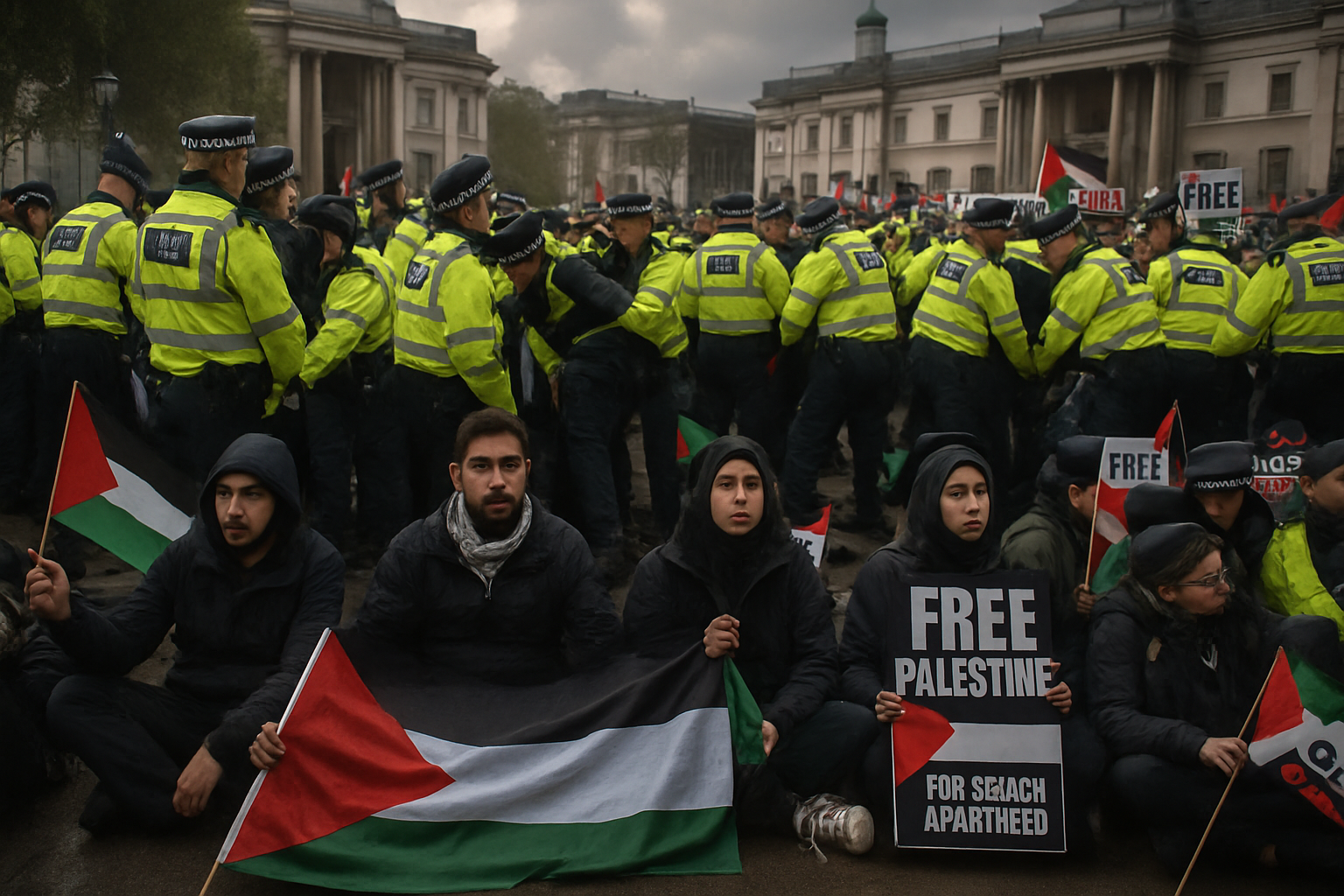
London's Metropolitan Police arrested 212 people Saturday during a demonstration in Trafalgar Square supporting Palestine Action, a pro-Palestinian group recently designated as a terrorist organization by the British government but whose ban was ruled unlawful by the High Court.
The mass arrests represent the largest police operation against Palestine solidarity protesters in central London since the group's proscription under anti-terrorism legislation last July. The demonstration marked the first major gathering since London's High Court ruled in February that the terrorism ban was "disproportionate" and violated freedom of expression and assembly rights.
Historic Court Ruling Under Government Appeal
The protest took place against the backdrop of ongoing legal uncertainty surrounding Palestine Action's status. While the High Court declared the ban unlawful in February, finding the Home Secretary's terrorism proscription violated fundamental democratic rights, the UK Interior Ministry has been granted permission to appeal the ruling.
"The gathering was the first since London's High Court ruled in February that a ban designating the pro-Palestinian group as a terrorist organisation was unlawful."
— Dawn News Report
The three-judge panel, led by Dame Victoria Sharp, found that while Palestine Action "promotes political cause through criminality," the terrorism ban still constituted a disproportionate interference with democratic rights. This marked the first successful legal challenge to the proscription of a direct action protest group under modern anti-terrorism laws.
Peaceful Demonstration Turns to Mass Arrests
Event organizers had described the demonstration as showing that "resistance" to the ban was "stronger than ever." Between 300 and 400 protesters gathered in Trafalgar Square for what French media described as a "silent gathering" during midday hours.
During the demonstration, placard-holding protesters wore black and white Palestinian scarves and waved Palestinian flags while sitting peacefully on the ground or in camping chairs. Despite the non-violent nature of the protest, Metropolitan Police proceeded with what sources described as a return to their "mass arrest policy."
The Times of Israel reported that protesters defied the government's order, with demonstrators saying the legal "flip-flop" over the ban did not affect their "morals" or commitment to supporting Palestinian causes.
Legal and Political Background
Palestine Action was banned under anti-terrorism legislation in July 2025 after some members broke into RAF Brize Norton military base. The group, which accuses Britain's government of complicity in what it characterizes as Israeli war crimes in Gaza, had been subject to over 2,000 arrests during its civil disobedience campaign.
The organization has targeted Israeli defense companies, particularly Elbit Systems, causing an estimated £1 million in damage during a 2024 raid. Co-founder Huda Ammori brought the legal challenge that resulted in February's High Court victory, which she called a "monumental victory for fundamental freedoms."
The case set an important precedent for protest movement regulation, strengthening freedom of expression protections and establishing boundaries for anti-terrorism legislation application to domestic political movements.
Government Response and Enforcement
UK Interior Minister Shabana Mahmood has maintained the government's position despite the court ruling, securing approval to appeal the decision. The terrorism designation remains temporarily in place pending the appeal process, creating legal uncertainty about the group's status.
Following the February High Court ruling, Metropolitan Police had stopped making arrests related to Palestine Action activities and shifted to evidence-gathering approaches. However, Saturday's mass arrests suggest a return to more aggressive enforcement tactics.
International Context and Civil Rights Implications
The case has drawn international attention as a test of how democratic governments balance security concerns with fundamental rights. Legal experts have described the proceedings as establishing crucial precedents for how anti-terrorism legislation can be applied to domestic political movements.
The controversy occurs amid rising tensions over Palestine solidarity activism across Europe and concerns about government restrictions on protest movements. Civil rights organizations have closely monitored the case as an indicator of democratic institutions' capacity to protect dissent and political expression.
"Protesters defy order, say legal 'flip-flop' does not affect 'morals'"
— Metropolitan Police sources, Times of Israel
Questions About Proportionate Response
The scale of Saturday's arrests has raised questions about proportional policing responses to peaceful protest. With over 3,000 total arrests since the group's formation, Palestine Action represents one of the most heavily policed protest movements in recent UK history.
Legal observers note that the mass arrest approach continues despite the High Court's specific finding that government responses to the group have been disproportionate to the threat posed. The court acknowledged criminal activity by some members but found the terrorism designation excessive.
Ongoing Legal Battle
The government's appeal of the High Court ruling means Palestine Action's legal status remains in limbo. While the court found the ban unlawful, the appeal process allows authorities to maintain enforcement actions pending final resolution.
This legal uncertainty has created a complex environment where peaceful demonstrators supporting the group face arrest despite a High Court ruling that their cause should be protected under freedom of assembly and expression rights.
The outcome of the government's appeal will have significant implications for protest rights in the UK and could influence how democratic nations worldwide approach the regulation of direct action movements that challenge government policies through civil disobedience.