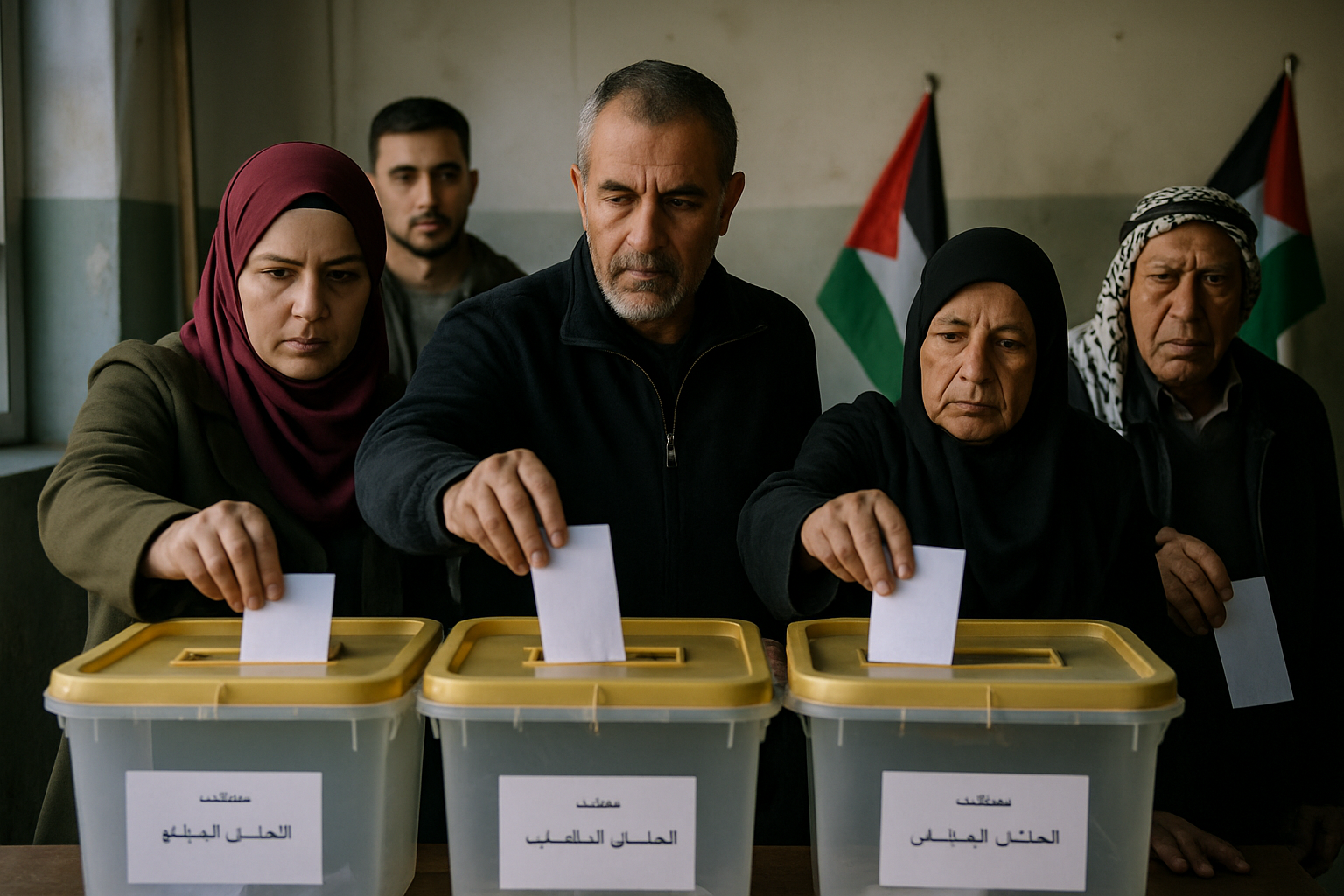
Palestinian parties loyal to President Mahmoud Abbas secured decisive victories in historic municipal elections held across the West Bank and Gaza Strip, marking the first democratic exercise in nearly two decades and the first Gaza participation since Hamas took control in 2007.
The elections, held on April 25, 2026, saw Abbas-aligned candidates and independent lists dominating races throughout Palestinian territories, with turnout reaching 25.3% in the West Bank compared to 21.2% in Gaza's participating area of Deir al-Balah. Palestinian Electoral Commission officials confirmed that loyalist parties won most municipal seats across both regions despite challenging circumstances.
Gaza Participation After 19 Years
The symbolic participation of Gaza in these elections represents a breakthrough after nearly two decades of political division. Voting was limited to central Deir al-Balah due to extensive war damage throughout the rest of the enclave, with over half of Gaza remaining under Israeli control and the remainder managed by Hamas.
"This is a historic moment for Palestinian democracy," said Hussein Ibish of the Arab Gulf States Institute, describing the vote as a "barometer" of Palestinian public opinion during extraordinary circumstances. Nearly 1.5 million voters were registered in the West Bank, with an additional 70,000 in Gaza's Deir al-Balah area.
The Palestinian Electoral Commission confirmed that voting was impossible in the remainder of Gaza due to widespread destruction from the ongoing conflict, which has resulted in over 71,800 Palestinian deaths according to official counts, with independent studies suggesting actual casualties exceed 75,000.
Limited Political Competition Raises Concerns
The electoral landscape was notably constrained, with most candidate lists aligned with Abbas's Fatah party or running as independents. Significantly, no Hamas-affiliated candidates appeared on the ballots, reflecting the complex political divisions that have paralyzed Palestinian governance for two decades.
"The absence of genuine competition fundamentally undermines the democratic process."
— Hassan Abu Lebda, Former Elections Committee Official
Hassan Abu Lebda, a former Palestinian Elections Committee official, warned that the narrow political field "fundamentally undermines the democratic process." The limited competition reflects the ongoing security situation and political constraints under Israeli occupation policies.
Elections Amid Systematic Violations
The democratic exercise occurred against a backdrop of severe challenges, with over 1,600 documented ceasefire violations since the October 2025 truce agreement, resulting in more than 600 Palestinian deaths during the supposed peace period. Gaza's Civil Defense services have completely shut down due to fuel shortages, while the Rafah crossing operates at severely limited capacity.
Voting took place in damaged buildings and temporary facilities, with some Gaza residents casting ballots in tents. The Palestinian Electoral Commission described the conditions as "extraordinarily difficult circumstances" that nonetheless demonstrated Palestinian resilience and commitment to democratic participation.
International Context and Support
The elections fulfill reform demands from international peace initiatives, including the $17 billion Gaza reconstruction commitments from the February 2026 Board of Peace summit - the largest international pledge in Gaza's history. However, implementation faces significant obstacles due to ongoing violations and Hamas's categorical rejection of disarmament demands.
The United Nations, European Union, and Arab League provided technical and logistical support, recognizing the elections' significance for Palestinian state-building and democratic consolidation despite the constraints of systematic occupation policies.
Regional Implications and Challenges
The electoral process coincides with Israel's most comprehensive West Bank settlement expansion since 1967, with Finance Minister Bezalel Smotrich explicitly stating policies designed to "kill the Palestinian state idea." These territorial seizures, targeting hundreds of thousands of dunams in the strategically vital Jordan Valley, have drawn unprecedented international condemnation from 85 UN member states.
Eight Arab nations, including countries that have normalized relations with Israel such as the UAE and Saudi Arabia, issued joint condemnations calling the Israeli measures violations of international law "aimed at imposing unlawful Israeli sovereignty" that undermine the two-state solution.
Democratic Achievement Under Occupation
Despite the constraints, political analysts view the elections as a template for democratic development under occupation conditions and a test case for international support of Palestinian political normalization. The voting demonstrates Palestinian determination to maintain democratic aspirations while highlighting the complex relationship between democratic participation and sovereignty under systematic occupation policies.
The elections occurred amid ongoing regional instability, including the collapse of the November 2024 Israel-Hezbollah ceasefire and broader Middle East tensions following recent developments in Iran. European frustration with Israeli policies has grown significantly, with over 400 EU diplomats demanding increased pressure and more than 400,000 petition signatures against EU-Israel partnerships.
Looking Ahead
The successful conduct of these elections, despite extraordinary limitations, provides a foundation for future democratic exercises. However, the broader challenges of Palestinian statehood remain unresolved, with systematic occupation policies and ongoing territorial seizures creating what international law experts argue constitute deliberate obstacles to Palestinian political development.
The results demonstrate that Palestinians maintain strong democratic aspirations even under the most challenging circumstances. As Dr. Mohamed Abu Selmiya of Al-Shifa Hospital has repeatedly asked amid ongoing violations, "Where is the ceasefire?" - a question that underscores the gap between international commitments and ground realities.
The April 25, 2026 elections represent both an achievement of democratic participation and a reminder of the substantial work needed to establish fully free and fair electoral processes throughout Palestinian territories, amid ongoing territorial and sovereignty constraints imposed by systematic occupation policies that continue to challenge Palestinian statehood prospects.