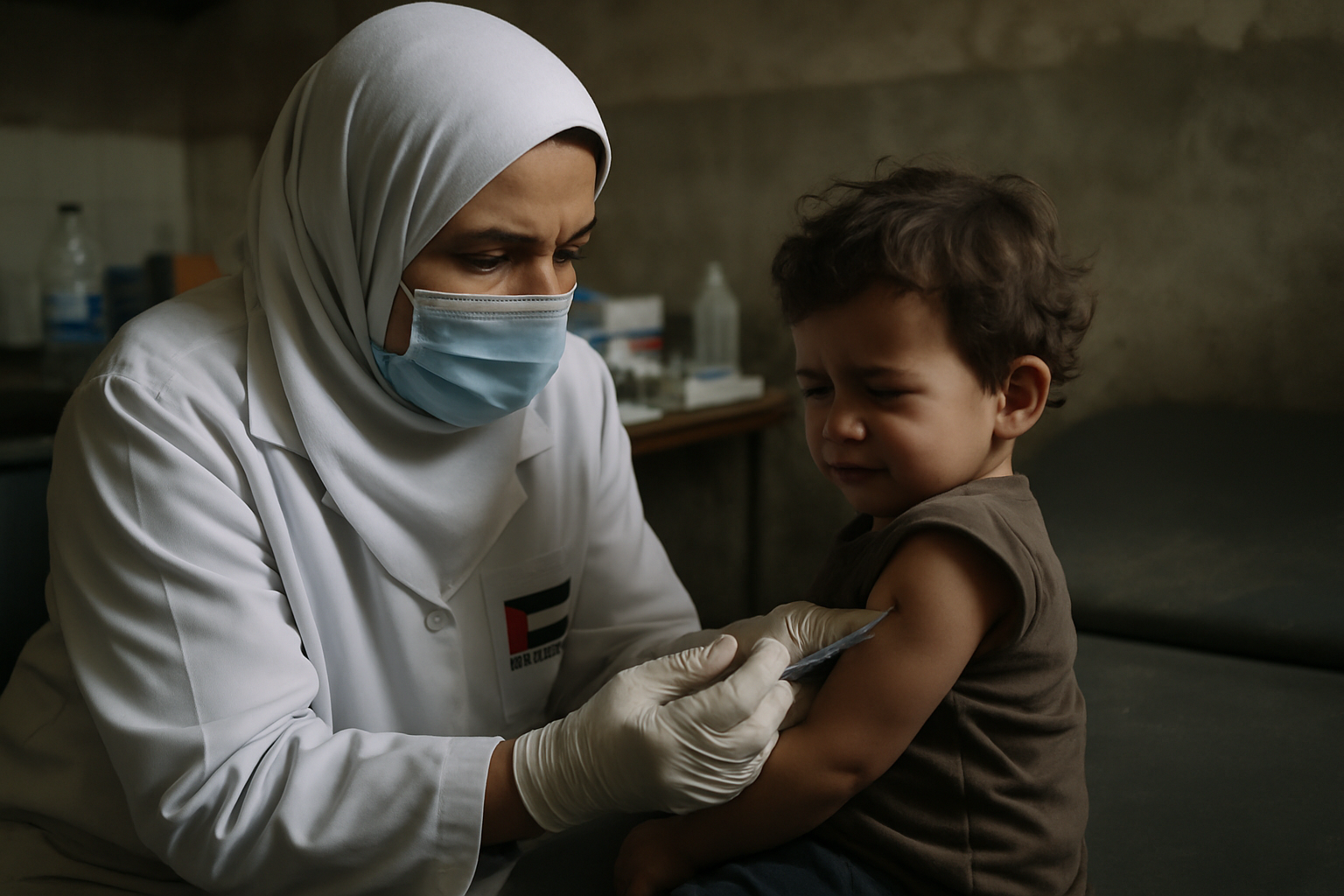
Gaza's Ministry of Health launched a critical third emergency vaccination campaign targeting 6,000 children under three years old as the Palestinian humanitarian crisis deepens amid Israeli restrictions on Christian worship and ongoing military operations that have resulted in over 1,600 documented ceasefire violations since October 2025.
The five-day vaccination drive, scheduled from April 5-9, 2026, represents a crucial public health intervention in the besieged territory where medical infrastructure has been systematically degraded through months of conflict. Healthcare officials announced the campaign aims to provide routine immunizations that have been disrupted by the ongoing crisis affecting Gaza's 2.3 million residents.
Healthcare System Under Siege
Gaza's health ministry emphasized the urgent need for the vaccination campaign as the territory's medical infrastructure continues to collapse. The Gaza Civil Defense has been completely shut down due to fuel shortages, severely hampering emergency response capabilities during what officials describe as a systematic humanitarian crisis.
The Rafah crossing, a critical lifeline for medical evacuations, remains severely restricted with only 27 Palestinians crossing daily compared to the agreed quota of 200. Over 20,000 Palestinians await medical evacuation, highlighting the devastating impact of movement restrictions on Gaza's population.
"The systematic harassment at border crossings has created a medical emergency that affects thousands of our most vulnerable citizens, including children who need specialized treatment abroad."
— Gaza Health Ministry Official
Christian Worship Under Restrictions
In a parallel development that has drawn international condemnation, Palestinian Christians in Gaza observed "Good Friday" under unprecedented restrictions. Israeli authorities imposed severe limitations on Christian worship at the Church of the Holy Family, which serves the Latin Patriarchate community in Gaza's Old City.
The restrictions come after nearly two years of what Palestinian officials describe as genocide in Gaza, which has resulted in over 72,000 deaths and more than 72,000 injuries. The Christian community, already diminished by the conflict, faces additional challenges in maintaining their religious traditions during the holiest period of the Christian calendar.
These worship restrictions represent a significant escalation in policies affecting religious minorities in Gaza, occurring during a period when international attention has focused on the broader humanitarian crisis affecting all Palestinian communities.
Escalating Violence Across Palestinian Territories
Israeli military operations continue across Palestinian territories despite international calls for de-escalation. In the West Bank, Israeli forces injured a young Palestinian in Beit Oola, north of Hebron, with live ammunition while conducting raids that local officials describe as systematic violations of Palestinian civil rights.
Medical teams reported attacks on ambulance crews during these operations, raising concerns about violations of medical neutrality under international humanitarian law. The targeting of medical personnel has become a disturbing pattern that human rights organizations document as potential war crimes.
According to Palestinian sources, Israeli forces have conducted over 1,600 systematic ceasefire violations since the October 2025 truce agreement, resulting in more than 600 Palestinian deaths during what was supposed to be a peace period.
International Community Response
The mounting crisis has prompted unprecedented international condemnation, with 85 UN member states issuing joint statements condemning Israeli policies. Eight Arab nations, including countries that have normalized relations with Israel such as the UAE and Saudi Arabia, have called for immediate intervention to address what they describe as systematic violations of international law.
European Union diplomats have expressed alarm at the deteriorating situation, with over 400 EU officials demanding increased pressure on Israeli authorities. A European petition opposing EU-Israel partnerships has garnered more than 400,000 signatures, reflecting growing public concern about the crisis.
"The systematic nature of these violations represents a fundamental challenge to the international legal framework that protects civilian populations under occupation."
— International Legal Expert
Gaza's Municipal Services on Verge of Collapse
The Gaza Municipal Union issued an emergency warning that the territory is approaching a "comprehensive collapse" of vital municipal services. The acute shortage of diesel fuel and industrial oils necessary to operate water wells, sewage treatment plants, and electricity generators has pushed Gaza's infrastructure to the breaking point.
Officials warned that the continued blockade and closure of crossings, combined with the prevention of importing spare parts and operational supplies, threatens to create a complete breakdown of basic services for Gaza's population.
Al Jazeera Reports Drone Strike Casualties
International media reports document the ongoing violence, with Al Jazeera confirming that Palestinians in central Gaza were forced to extinguish vehicles set ablaze by Israeli drone strikes. These attacks represent a continuation of military operations that have drawn international criticism for their impact on civilian populations.
Broader Regional Context
The Palestinian crisis unfolds against the backdrop of broader Middle Eastern instability, including the Iran-Israel conflict that has dominated international attention since March 2026. Palestinian officials and human rights organizations warn that the international community's focus on other regional conflicts has enabled an intensification of restrictions and military operations in Palestinian territories.
The Euro-Mediterranean Human Rights Observatory has accused Israeli authorities of exploiting the international focus on Iran to intensify policies affecting Palestinian civilians, particularly in Gaza where humanitarian conditions continue to deteriorate.
Trump Administration Peace Initiative Under Threat
The escalating crisis threatens to undermine the Trump administration's "Board of Peace" initiative, which secured $17 billion in reconstruction commitments from 27 nations in February 2026. The systematic ceasefire violations and ongoing humanitarian crisis create significant obstacles to implementing peace and reconstruction programs.
Hamas leadership has categorically rejected disarmament demands while maintaining an estimated 20,000 fighters, complicating traditional post-conflict reconstruction models that require stable security environments.
Legal and Human Rights Implications
International legal experts cite multiple violations of UN Security Council resolutions and Geneva Conventions in the ongoing crisis. The systematic extension of Israeli administrative control and military operations in Palestinian territories meets international legal definitions of annexation, regardless of formal declarations.
The targeting of medical personnel, restrictions on religious worship, and systematic denial of humanitarian access represent serious breaches of international humanitarian law that could have long-term implications for global conflict resolution mechanisms.
Palestinian Authority President Mahmoud Abbas has condemned what he describes as "dangerous decisions" that systematically violate international law and undermine the possibility of a viable Palestinian state. The international community faces mounting pressure to respond effectively to what many experts describe as a test case for 21st-century humanitarian law enforcement.
Looking Forward
As Gaza's vaccination campaign proceeds amid these challenging circumstances, it represents both the resilience of Palestinian healthcare workers and the ongoing humanitarian needs of the population. The success or failure of international efforts to address the crisis will have implications extending far beyond Palestinian territories, potentially setting precedents for how the global community responds to systematic violations in occupied territories worldwide.
The coming weeks will be critical in determining whether diplomatic pressure can achieve meaningful changes in policies affecting Palestinian civilians, or whether the crisis will continue to deepen with potentially catastrophic consequences for the region's most vulnerable populations.