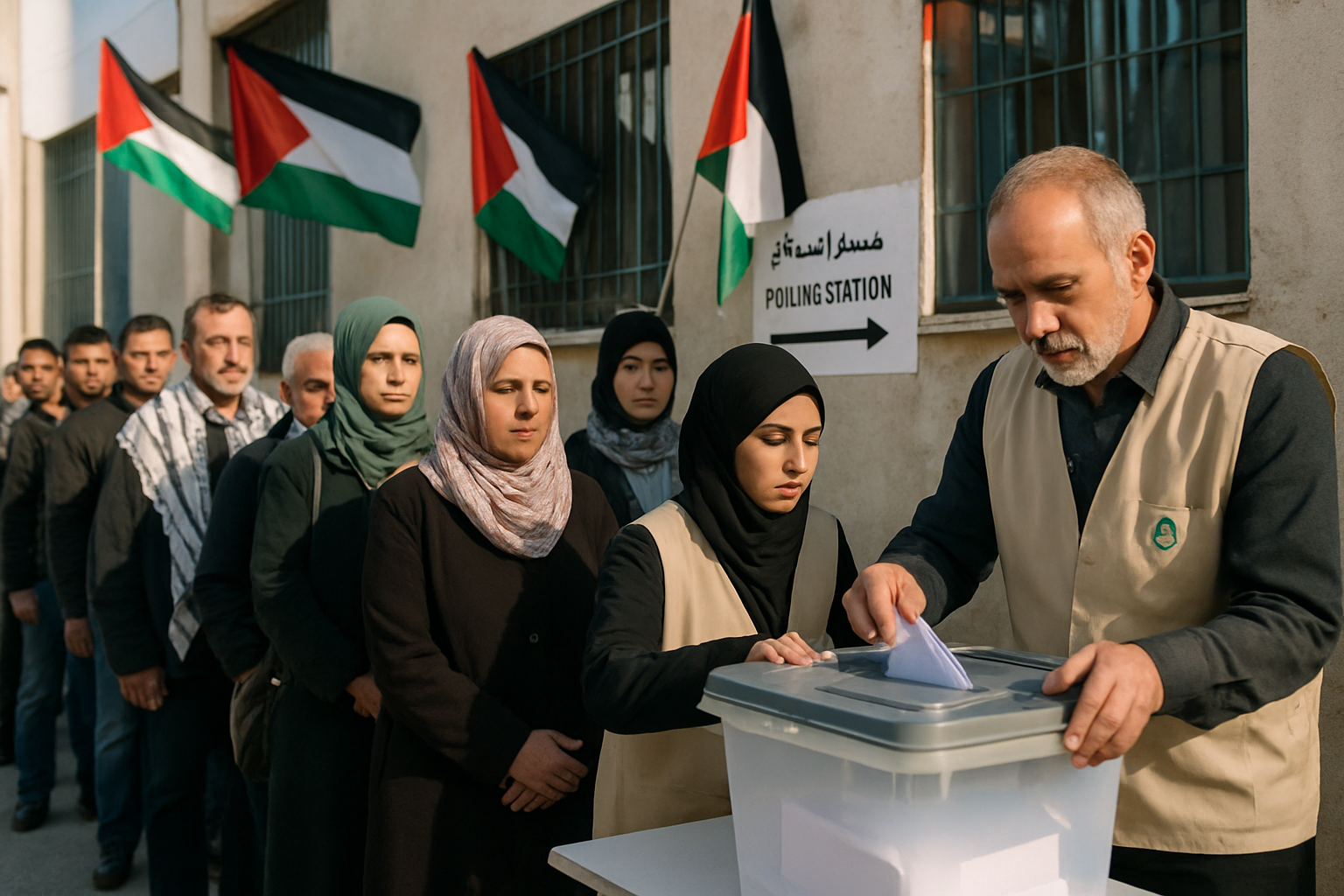
Palestinians went to the polls on Saturday April 25, 2026, in historic local elections marking the first democratic exercise since the Gaza war erupted, with some areas participating in voting for the first time since 2007.
The elections, taking place across the occupied West Bank and symbolically in parts of Gaza including Deir al-Balah, represent a crucial moment for Palestinian democracy amid extraordinary political constraints imposed by Israeli occupation and internal Palestinian divisions.
Limited Competition Raises Democratic Concerns
High abstention rates were expected as voters in many localities faced only single candidate lists, primarily from President Mahmoud Abbas's Fatah party or independent candidates. Notably absent were Hamas candidates from electoral lists, reflecting the continued political schism that has divided Palestinian territories since 2007.
Hassan Abu Lebda, a former member of the Central Elections Committee, warned that the absence of competition in numerous local bodies "fundamentally undermines the democratic process and deprives citizens of their right to choose." This criticism highlights ongoing concerns about the exclusionary nature of the current electoral law.
French media reports indicated that voter apathy was compounded by the Palestinian Authority's reduced power under Israeli presence, with the occupation significantly constraining local governance capabilities.
Gaza Participation: Symbolic but Significant
The inclusion of Deir al-Balah in Gaza marks a particularly significant development, representing the first Gaza voting since Hamas took control in 2007. This symbolic participation serves multiple purposes for the West Bank-based Palestinian Authority, which hopes to reinforce its claim to authority over the war-torn territory.
"I've been hearing about elections since I was born," said Adham Al-Bardini, a Gaza resident sitting outside his family's tent home. "We are eager to take part... so we can change the reality imposed on us."
Despite the enthusiasm among some Gazans, the practical impact remains limited. The vote in Gaza is largely ceremonial given the territory's devastating conditions following the war and Hamas's continued de facto control over most of the Strip.
International Context and Reform Demands
These elections fulfill one of the key reforms demanded in recent peace initiatives, including elements of international reconstruction plans. However, the political environment remains fraught, with systematic violations of previous ceasefire agreements continuing to plague the region.
The elections occur against a backdrop of unprecedented international pressure on Israel, with 85 UN member states having condemned Israeli West Bank expansion policies in February 2026. Eight Arab nations, including countries that have normalized relations with Israel like the UAE and Saudi Arabia, have issued joint condemnations of what they term "systematic violations of international law."
Challenging Electoral Conditions
Electoral observers noted the extraordinary circumstances under which these elections are being conducted. With over 1,600 documented ceasefire violations since October 2025 resulting in more than 600 Palestinian deaths during the supposed peace period, the democratic exercise takes place amid continued instability.
The restrictive conditions extend to basic infrastructure. Gaza's Civil Defense has been completely shut down due to fuel shortages, while the Rafah crossing operates at severely limited capacity - only 27 Palestinians were able to cross versus the agreed quota of 200 on the opening day, with Hamas condemning what it terms "systematic harassment" by Israeli security.
West Bank Expansion Threatens Political Landscape
The elections coincide with Israel's most comprehensive West Bank territorial expansion since 1967, which Palestinian officials argue represents an existential threat to Palestinian statehood prospects. Finance Minister Bezalel Smotrich has openly declared policies designed to "kill the idea of a Palestinian state," while Energy Minister Eli Cohen has acknowledged implementing "factual sovereignty" to establish "the reality that there will be no Palestinian state."
These territorial policies, targeting hundreds of thousands of dunams in the strategically vital Jordan Valley, have drawn unprecedented international opposition but continue to proceed despite diplomatic pressure.
Democratic Constraints and Future Prospects
Political analysts note that while these elections represent an important step toward normalizing democratic participation, they highlight the severe constraints facing Palestinian political development. The electoral framework remains limited by both external occupation policies and internal Palestinian political divisions that have persisted for nearly two decades.
"The elections offer participation without power, revealing how occupation shapes and limits Palestinian political life."
— Regional Political Analyst
The Palestinian Authority's ability to govern effectively remains constrained by Israeli administrative control over significant portions of the West Bank, while Gaza's participation, though symbolically important, carries little practical governance impact given Hamas's continued control and the territory's devastated condition.
International Implications
These elections serve as a test case for international efforts to support Palestinian democratic development amid ongoing conflict. The $17 billion Gaza reconstruction commitment from the February 2026 Board of Peace summit - the largest international Gaza pledge in history - faces implementation challenges due to continued violations and security concerns.
European officials have expressed growing frustration with the situation, with over 400 EU diplomats demanding increased pressure on Israeli authorities and European Left Coalition petitions against EU-Israel partnerships exceeding 400,000 signatures.
The elections also highlight the complex relationship between democratic participation and sovereignty. While Palestinians exercise their democratic rights at the local level, broader questions of territorial control and political autonomy remain unresolved, shaped by occupation policies that international law experts argue constitute systematic annexation regardless of formal declarations.
Looking Forward
As ballot counting proceeds, these elections mark both progress and the persistent challenges facing Palestinian democracy. They demonstrate the Palestinian people's commitment to democratic participation despite extraordinary constraints, while simultaneously highlighting the limitations imposed by occupation and internal division.
The international community's response to ongoing violations and territorial expansion will likely determine whether these elections represent a stepping stone toward broader Palestinian political normalization or remain isolated democratic exercises within a constraining political framework.
The success of Palestinian local governance will depend not only on electoral outcomes but on resolving broader questions of territorial control, administrative authority, and the international community's willingness to enforce legal frameworks governing occupied territories in the 21st century.