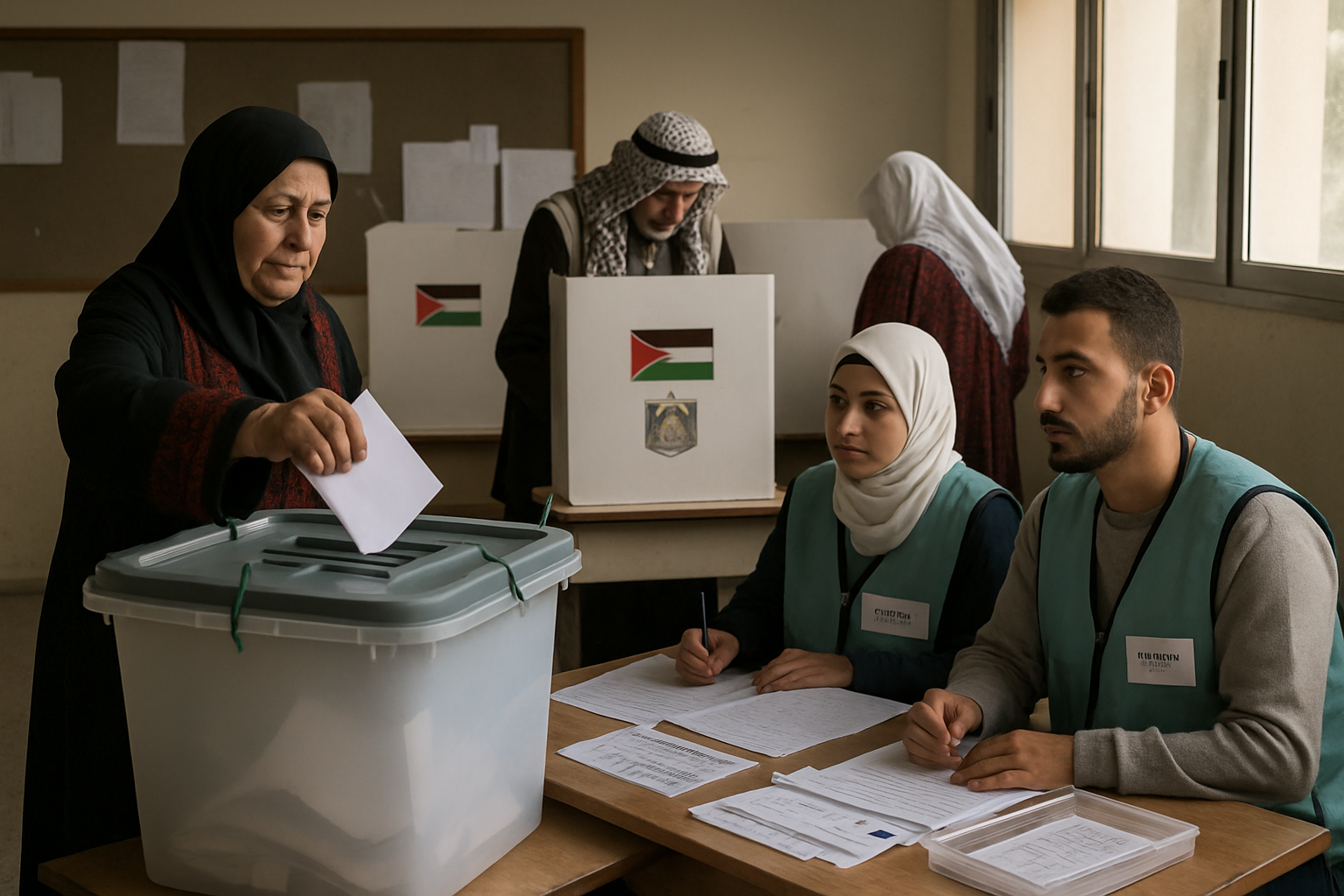
Palestinians participated in historic local elections on Saturday, marking the first time in over two decades that voting included both the West Bank and Gaza Strip, though turnout reached only 21% in Gaza compared to higher participation rates in the West Bank.
The elections for mayors and municipal councils represent a significant democratic milestone, taking place amid extraordinary circumstances as the Palestinian Authority seeks to reassert governance in Gaza following years of Hamas control and recent conflict devastation. Nearly 1.5 million people were registered to vote in the Israeli-occupied West Bank, alongside 70,000 in Gaza's Deir al-Balah area, according to the Ramallah-based Central Elections Commission.
Gaza's Symbolic Return to Palestinian Authority Elections
For residents of Deir al-Balah, the opportunity to vote represented their first chance to participate in Palestinian Authority elections since 2006, before Hamas seized control of Gaza in 2007. The West Bank-based Palestinian Authority has positioned the inclusion of this Gazan city as reinforcing its claim to authority over the entire territory from which it was ousted nearly two decades ago.
"As a Palestinian and a son of the Gaza Strip, I feel proud that after this war the democratic process is returning,"
— Mamdouh al-Bhaisi, 52-year-old voter in Deir al-Balah
However, the voting was largely symbolic, limited to central Deir al-Balah due to extensive war damage throughout the rest of Gaza. The Palestinian Electoral Commission confirmed that voting was impossible in the remainder of Gaza due to widespread destruction, with over half of the enclave under Israeli control and the rest managed by Hamas.
By early afternoon, turnout in Deir al-Balah stood at just 13.8% by 1 p.m. local time, eventually reaching 21.2% by the close of polls. This contrasted sharply with West Bank turnout of 25.3% in the afternoon, reflecting the challenging conditions facing Gaza voters.
West Bank Elections Proceed Despite Constraints
In the West Bank, a more festive atmosphere prevailed despite ongoing tensions. Most electoral lists aligned with President Mahmud Abbas's secular-nationalist Fatah party or ran as independents. Notably absent were any lists affiliated with Fatah's rival Hamas, which controls nearly half of the Gaza Strip.
The elections occurred under systematic constraints, with over 1,600 documented ceasefire violations since the October 2025 truce resulting in more than 600 Palestinian deaths during the supposed peace period. This violence has coincided with Israel's most comprehensive West Bank settlement expansion since 1967, with Finance Minister Bezalel Smotrich openly declaring policies designed to "kill the Palestinian state idea."
Limited Political Competition Raises Democratic Concerns
Hassan Abu Lebda, former head of the Palestinian Elections Committee, warned that the absence of genuine competition "fundamentally undermines the democratic process." The narrow political field reflected the complex security situation and ongoing political divisions that have paralyzed Palestinian governance for two decades.
Hussein Ibish of the Arab Gulf States Institute described the vote as a "barometer" of Palestinian public opinion under extraordinarily difficult circumstances. The elections were conducted in tents and damaged buildings in Gaza, while facing systematic constraints in the West Bank from ongoing Israeli military operations and settlement expansion.
International Support and Broader Context
The elections received technical and logistical support from the UN, European Union, and Arab League, recognizing their significance for Palestinian state-building and democratic consolidation despite the constraints. International observers viewed the voting as a template for democratic development under occupation conditions, though they highlighted the substantial work needed to establish fully free and fair electoral processes throughout Palestinian territories.
The voting coincided with unprecedented international condemnation of Israeli policies, with 85 UN member states issuing joint criticism of West Bank expansion measures in February 2026. Eight Arab nations, including those with normalized relations with Israel such as the UAE and Saudi Arabia, condemned what they termed "systematic violations of international law."
Challenges to Reconstruction and Peace Efforts
The elections occurred against the backdrop of threatened international peace initiatives. The Trump administration's Board of Peace summit in February 2026 secured $17 billion in Gaza reconstruction commitments from 27 nations, but implementation faces severe obstacles from ongoing violations and Hamas's categorical rejection of disarmament demands.
Khaled Meshaal's February statement from Doha made clear that Hamas would maintain armed resistance "while occupation exists," with Israeli sources estimating 20,000 Hamas fighters remain active. This position challenges traditional post-conflict reconstruction models that typically require demilitarization.
Historic Significance Despite Limitations
Despite the constraints and limited scope, the elections represent a historic milestone in Palestinian democratic development. They demonstrate the resilience of democratic aspirations while highlighting the complex relationship between political participation and sovereignty under systematic occupation policies.
The voting serves as both an achievement of democratic participation and a reminder of the substantial work needed to establish comprehensive electoral processes throughout Palestinian territories. International experts view the elections as a test case for international community support of Palestinian political normalization despite ongoing territorial and sovereignty constraints.
Looking Forward
Preliminary results are expected to show dominance by Fatah-affiliated candidates, with independent lists gaining ground in several municipalities where local governance and service delivery grievances have been prominent. The elections provide a template for democratic development under occupation conditions while underscoring the urgent need for resolution of broader political and territorial control issues affecting Palestinian statehood prospects.
April 25, 2026, marks a historic milestone in Palestinian democratic development—an achievement of democratic participation amid unprecedented constraints that also highlights the ongoing challenges to establishing fully free and fair electoral processes throughout Palestinian territories under systematic occupation policies.