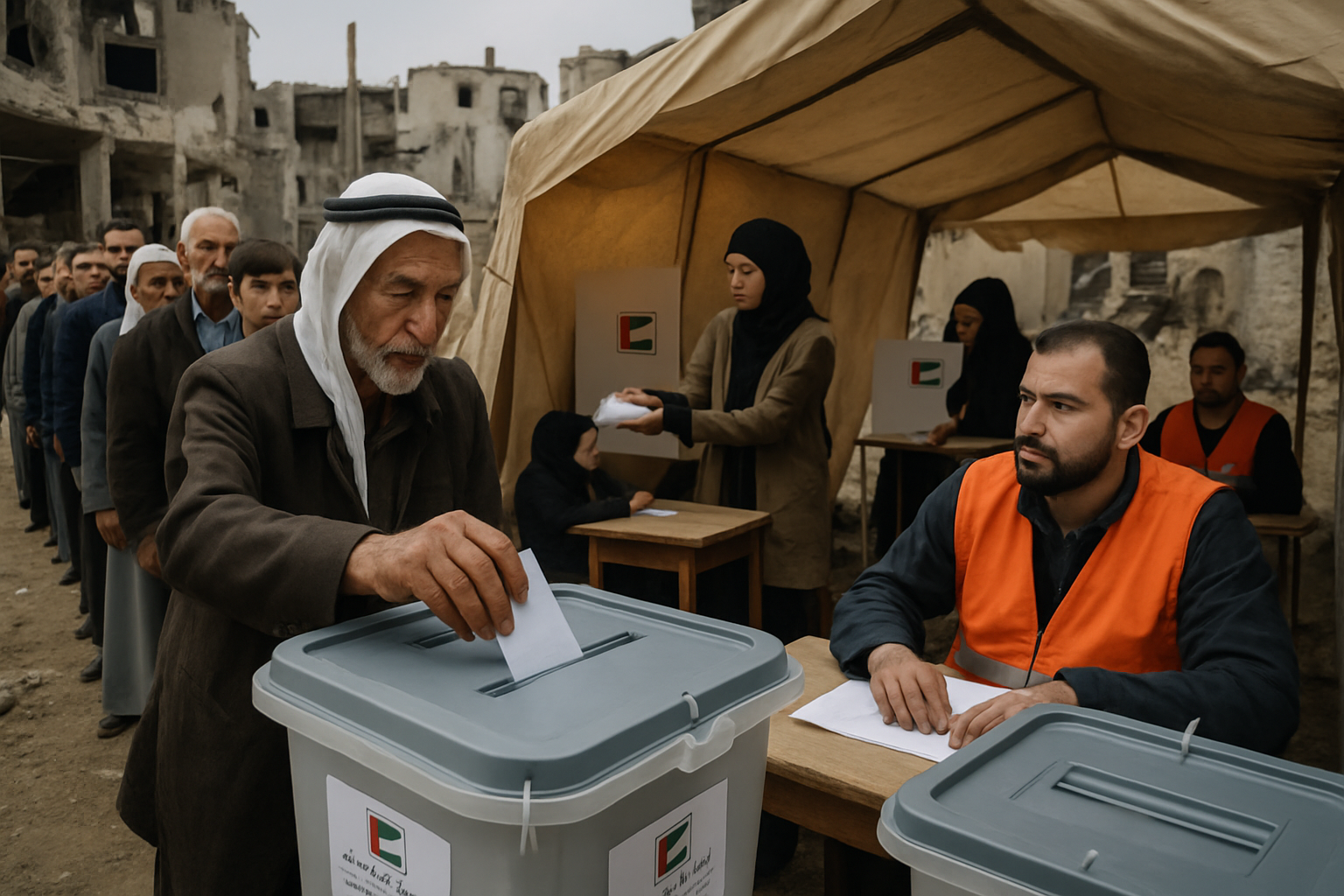
Palestinians in the West Bank and a portion of Gaza cast ballots Saturday in historic municipal elections marking the first electoral process in over two decades, with nearly 1.5 million people registered to vote despite challenging circumstances and limited competition.
The elections proceeded in what experts described as extraordinarily difficult conditions, with voting taking place in tents and damaged buildings in Gaza's Deir al-Balah area while 70,000 Palestinians participated alongside their 1.5 million counterparts across the Israeli-occupied West Bank, according to the Ramallah-based Central Elections Commission.
Historic Democratic Exercise Amid Constraints
The electoral process represents the first vote since Israel's invasion of Gaza and marks the first time Gaza residents have participated in any election since Hamas took control in 2007. Hussein Ibish, Senior Resident Scholar at the Arab Gulf States Institute, characterized the vote as serving as a "barometer" on Palestinian public opinion during this critical period.
Polling stations opened at 7am local time, with election officials present as Palestinians came to cast ballots in what German media described as conditions that "could not be more unfavorable." The elections fulfill reform demands from international peace initiatives, including the $17 billion Gaza reconstruction commitments pledged at the February 2026 Board of Peace summit.
Limited Political Competition Raises Democratic Concerns
The electoral landscape was notably constrained, with most electoral lists aligned with President Mahmoud Abbas's secular-nationalist Fatah party or running as independents. Significantly, there were no lists affiliated with Fatah's archrival Hamas, which continues to control nearly half of the Gaza Strip despite the ongoing ceasefire.
Hassan Abu Lebda, former Elections Committee official, warned that the absence of genuine competition "fundamentally undermines the democratic process," highlighting systemic constraints facing Palestinian democratic institutions under occupation conditions.
In most cities, Fatah-backed tickets ran against independent lists headed by candidates from various factions, including the Popular Front for the Liberation of Palestine. The narrow political field reflected both the complex security situation and ongoing political divisions that have paralyzed Palestinian governance for nearly two decades.
Gaza's Symbolic Participation Despite Devastation
Gaza's participation was largely symbolic, limited to the central Deir al-Balah area due to extensive war damage throughout the rest of the territory. The Palestinian Electoral Commission noted that voting could not be conducted in the remainder of Gaza due to widespread destruction, with over half the enclave under Israeli control and the rest managed by Hamas.
The challenging logistics were evident in the voting arrangements, with Palestinians casting ballots in improvised polling stations set up in tents and partially destroyed buildings. Election officials worked under extraordinary circumstances to maintain democratic procedures despite the ongoing humanitarian crisis affecting 2.3 million Gaza residents.
"These elections demonstrate Palestinian commitment to democratic participation despite extraordinary limitations imposed by the occupation."
— Palestinian Authority spokesperson
International Context and Regional Implications
The elections occurred against the backdrop of systematic violations of the October 2025 ceasefire agreement, with over 1,600 documented incidents resulting in more than 600 Palestinian deaths during the supposed peace period. This pattern of violations has complicated international reconstruction efforts and undermined confidence in negotiated solutions.
Simultaneously, Israel has implemented what experts describe as the most comprehensive West Bank territorial expansion since 1967, with Finance Minister Bezalel Smotrich openly declaring policies designed to "kill the Palestinian state idea." These developments have drawn unprecedented international condemnation from 85 UN member states and eight Arab nations, including countries that have normalized relations with Israel.
Democratic Resilience Under Occupation
Despite the constraints, the elections represent what analysts call a template for democratic development under occupation conditions. The vote serves as a test case for international community support of Palestinian political normalization while highlighting the complex relationship between democratic participation and sovereignty.
The electoral process demonstrates Palestinian aspirations for democratic governance even as broader territorial control and autonomy questions remain unresolved through what international law experts argue constitute systematic annexation policies.
Mahmud Bader, a businessman from Tulkarem in the northern West Bank, exemplified the challenges facing Palestinian democratic institutions, operating in areas where refugee camps have been under intensive Israeli military operations that have significantly disrupted civilian life and governance structures.
Broader Democratic Implications
The limited nature of the competition and the restricted geographic scope underscore the systematic challenges facing Palestinian democratic institutions. With widespread disillusionment among the Palestinian public and narrow political choices, these elections highlight the urgent need for comprehensive political reforms and genuine democratic alternatives.
The absence of Hamas from the electoral process, while politically significant, also represents a lost opportunity for broader Palestinian democratic reconciliation that could have strengthened the legitimacy of Palestinian institutions across political divisions.
International Support and Future Prospects
International observers view these elections as a crucial step toward Palestinian institutional development, despite their limitations. The European Union and Arab League have emphasized the importance of supporting Palestinian democratic processes while calling for expanded participation and reduced constraints in future electoral cycles.
The United Nations and various international bodies have provided technical and logistical support for the electoral process, recognizing its significance as a foundation for future Palestinian state-building efforts and democratic consolidation.
As vote counting proceeded Saturday evening, preliminary results were expected to reflect the dominance of Fatah-affiliated candidates, though independent lists were anticipated to make gains in several municipalities, particularly in areas where local grievances about governance and service delivery have been prominent.
April 25, 2026, thus represents a historic milestone in Palestinian democratic development, demonstrating both the resilience of democratic aspirations and the urgent need for addressing the broader political and territorial issues that continue to constrain Palestinian sovereignty and democratic expression. The elections serve as both an achievement in democratic participation and a reminder of the substantial work needed to establish fully free and fair electoral processes throughout Palestinian territories.