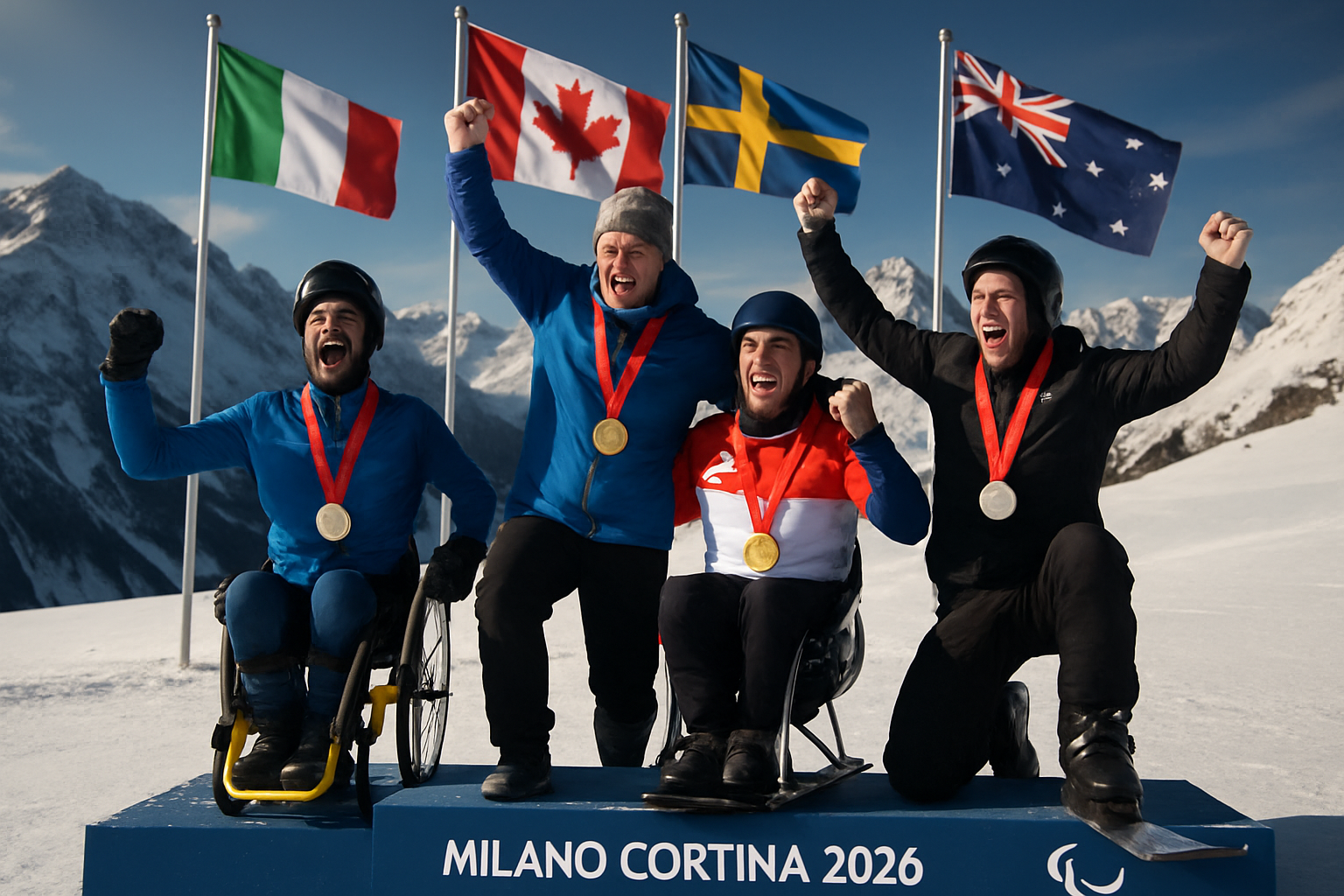
The Milano-Cortina 2026 Winter Paralympics concluded as one of the most successful Games in history, with Italy achieving a record-breaking medal haul of 14 podium finishes while athletes from around the globe delivered exceptional performances that showcased the remarkable growth of adaptive winter sports.
Italy's unprecedented success at the home Paralympics surpassed their previous record set at Lillehammer 1994, with the host nation capturing multiple gold medals across alpine skiing and other disciplines. The achievement represents a watershed moment for Italian Paralympic sport and demonstrates the power of home advantage combined with systematic investment in adaptive athletics programs.
Italy's Historic Medal Breakthrough
The Italian Paralympic team's extraordinary performance included multiple standout achievements, led by Chiara Mazzel's emotional victories in alpine skiing. Mazzel secured Italy's first-ever Winter Paralympic alpine skiing gold medal in the women's visually impaired super-G, competing with guide Nicola Cotti Cottini in front of passionate home crowds.
"This victory means everything to me and to Italian Paralympic sport," Mazzel said through tears after her historic gold medal performance. "To achieve this at home, with this incredible support, is beyond my dreams."
— Chiara Mazzel, Italian Paralympic Gold Medalist
Mazzel's success continued throughout the Games, adding silver and bronze medals to become Italy's most decorated athlete at Milano-Cortina 2026. Her three-medal performance exemplifies the depth and quality that propelled Italy to their record-setting 14 total medals.
Australian Paralympic Excellence
Australia's remarkable Paralympic campaign built upon their historic Winter Olympic success from February, with Ben Tudhope leading the charge. Tudhope captured bronze in the men's snowboard banked slalom SB-LL2 classification, adding to his impressive Paralympic medal collection and continuing Australia's emergence as a genuine winter sports powerhouse.
The Australian success reflects systematic investment in adaptive winter sports programs that paralleled their breakthrough Olympic performances. Athletes like Tudhope have benefited from enhanced coaching, equipment, and training facilities that have transformed Australia from a marginal winter sports participant to a competitive force across multiple disciplines.
Liana France, at just 16 years old, made history as Australia's youngest female Winter Paralympian, representing the next generation of Australian adaptive athletes. Her participation with family support, including a custom pink flag bearing her image, symbolized the growth of Paralympic sport accessibility and youth engagement.
Canadian Paralympic Dominance
Canada's Paralympic delegation delivered exceptional performances led by alpine skiing and biathlon athletes. Kalle Eriksson and guide Sierra Smith achieved multiple podium finishes, including silver in the men's downhill vision impaired category and bronze in super-G, representing Canada's continued excellence in adaptive alpine disciplines.
The Canadian biathlon program reached new heights with Natalie Wilkie's gold medal victory in the women's standing 12.5km event, marking Canada's first gold medal at Milano-Cortina 2026 Paralympics. The achievement highlighted Canada's systematic approach to Paralympic sport development and their ability to compete at the highest levels across multiple winter disciplines.
Swedish Curling Achievement
Sweden's wheelchair curling team provided one of the most compelling stories of the Paralympics, with captain Viljo Petersson Dahl delivering dominant performances in crucial moments. The team secured bronze after a commanding 7-4 victory over South Korea, with Petersson Dahl's strategic shot-making proving decisive in pressure situations.
"We refused to go home without a medal. This bronze represents years of dedication and teamwork."
— Viljo Petersson Dahl, Swedish Wheelchair Curling Captain
Sweden's curling success built upon their previous Paralympic medal from Beijing 2022, demonstrating consistency and growth in their adaptive curling program. The bronze medal validated Sweden's investment in wheelchair curling infrastructure and coaching development.
Global Paralympic Expansion
The Milano-Cortina 2026 Paralympics featured unprecedented global participation, with athletes from six continents competing at the highest levels. Norway's veteran athlete Jostein Stordahl, competing in his 10th Paralympics at age 59, exemplified the Paralympic values of determination and inspiration nearly four decades after his life-changing train accident.
France demonstrated remarkable depth across multiple disciplines, with athletes like Aurélie Richard capturing bronze in giant slalom standing and building upon their successful Olympic campaign. The French Paralympic delegation's 10-medal performance reflected their systematic approach to adaptive sport development.
Germany's Anna-Lena Forster continued her dominance in monoski alpine skiing with multiple gold medals, while establishing new performance benchmarks in her classification. Her victories at the Italian venues showcased the technical precision and athletic excellence that defines Paralympic competition.
Revolutionary Hosting Model
The Milano-Cortina 2026 Paralympics successfully utilized the same revolutionary dual-city hosting model that proved successful during the February Olympics. Spanning over 400 kilometers across northern Italy, the Games demonstrated that environmental sustainability and competitive excellence can coexist without compromise.
The Paralympics featured the same technological innovations that enhanced the Olympics, including AI-powered systems for performance analysis and broadcasting enhancement. Cultural elements such as bilingual Alto Adige/South Tyrol place names and sustainable venue operations maintained authenticity while addressing 21st-century hosting realities.
Natural snow conditions provided ideal racing surfaces across all venues, reducing artificial snow requirements and demonstrating the environmental benefits of the distributed hosting approach. The success of this model establishes important precedents for future Paralympic Games seeking to balance competitive requirements with environmental responsibility.
Overcoming Political Challenges
The Paralympics occurred amid significant political controversy regarding Russian and Belarusian participation under national flags. The International Paralympic Committee's decision to reverse previous neutral status requirements sparked unprecedented boycotts from Estonia, Germany, Lithuania, and Ukraine, who refused to attend the opening ceremony.
Despite these challenges, Paralympic athletes demonstrated remarkable resilience and sportsmanship, embodying the Paralympic values of determination, inspiration, courage, and equality. The successful competition across all events proved that athletic excellence can transcend political divisions while acknowledging the complex realities of international sport during geopolitical conflicts.
Legacy and Future Impact
The Milano-Cortina 2026 Winter Paralympics established new benchmarks for Paralympic competition, combining record-breaking performances with innovative hosting approaches. Italy's medal success will likely inspire increased investment in Paralympic sport development, while the global competitiveness demonstrated across all events reflects the continued growth of adaptive athletics worldwide.
The Games proved that Paralympic sport has evolved beyond traditional geographic and resource limitations, with nations from multiple continents achieving breakthrough performances. This democratization of Paralympic excellence mirrors broader trends in international sport while maintaining the unique inspirational character that defines the Paralympic movement.
The successful implementation of sustainable hosting practices, technological innovation, and cultural authenticity provides a template for future Paralympic Games. The Milano-Cortina model demonstrates that major international sporting events can address contemporary environmental and social challenges while preserving the competitive integrity and inspirational power that make Paralympic sport extraordinary.
As the Paralympic flame was extinguished across the Italian Alps, the Milano-Cortina 2026 Winter Paralympics concluded as a testament to human potential, international cooperation, and the transformative power of adaptive sport. The record-breaking performances and global participation demonstrated that Paralympic sport continues to evolve, inspire, and unite people across all boundaries.