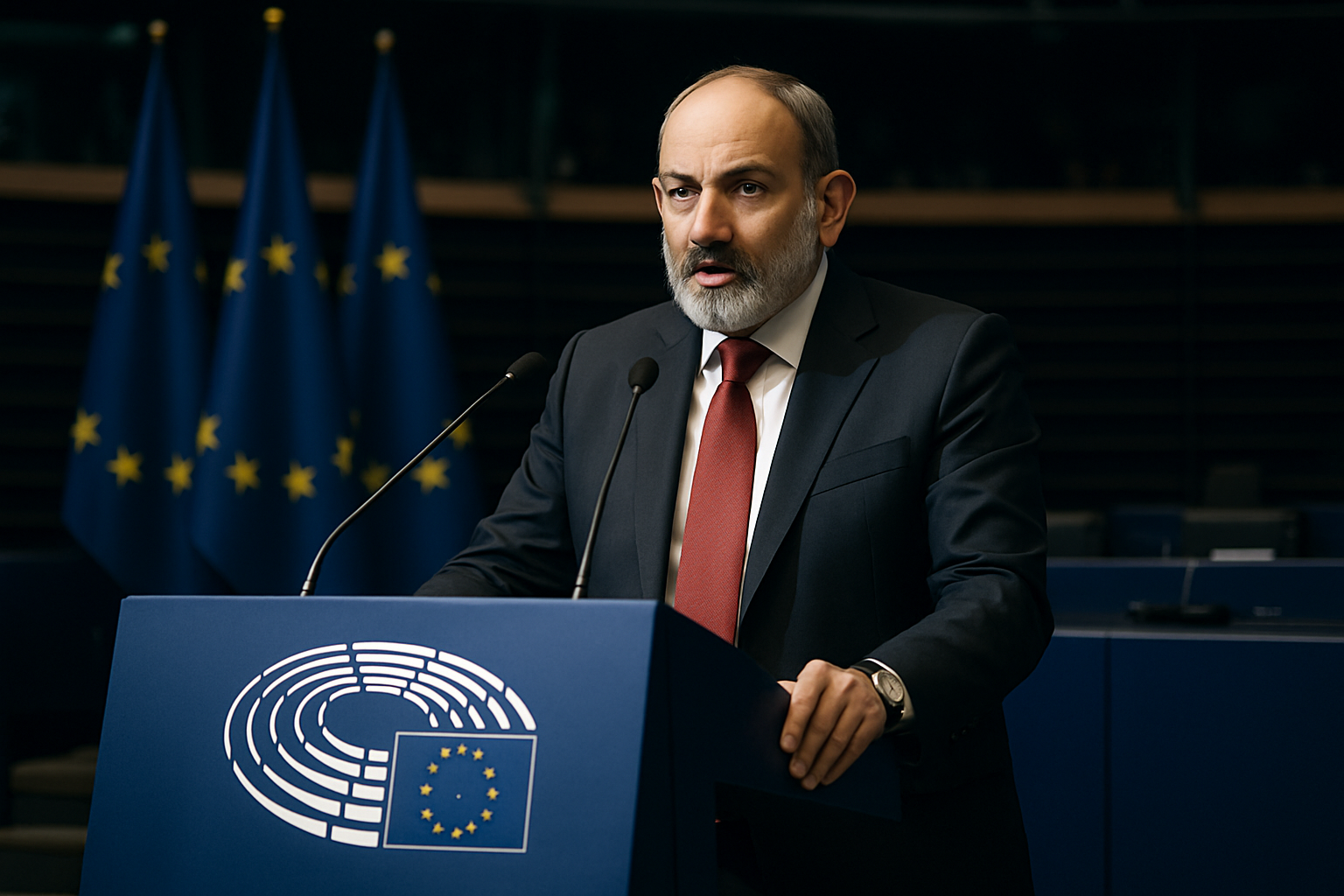
Armenian Prime Minister Nikol Pashinyan delivered a significant address to the European Parliament on March 11, 2026, highlighting his country's ongoing peace negotiations with Azerbaijan and Armenia's aspirations for European Union membership, while identifying the frozen EU-Georgia dialogue as a major obstacle to regional integration.
The Armenian leader's appearance in Strasbourg marked a crucial moment for South Caucasus diplomacy, as regional tensions continue to shape the post-conflict landscape following Azerbaijan's September 2023 military operation that ended decades of Armenian control over Nagorno-Karabakh.
Peace Process with Azerbaijan
During his address to Members of the European Parliament, Pashinyan emphasized Armenia's commitment to achieving lasting peace with Azerbaijan. The Prime Minister's diplomatic outreach comes at a critical juncture, with both nations working toward a comprehensive peace agreement following years of territorial disputes that have claimed thousands of lives.
The current peace efforts represent a significant shift from the decades-long conflict over Nagorno-Karabakh, a region internationally recognized as Azerbaijani territory but previously under Armenian control. The September 2023 Azerbaijani military operation effectively ended this de facto independence, leading to the displacement of ethnic Armenian populations and creating new diplomatic realities in the region.
Georgia as Gateway to Europe
In a particularly notable portion of his speech, Pashinyan identified what he called "the biggest problem" facing Armenia's European integration aspirations: the frozen political dialogue between the European Union and Georgia.
"The biggest problem on Armenia's EU integration path at the moment is the frozen state of the political dialogue between the EU and Georgia," Pashinyan told MEPs during the plenary session. He emphasized that Armenia views Georgia as a crucial "path to the European Union," noting that Armenia adopted legislation to launch its EU accession process after Georgia was granted candidate status.
This statement underscores the interconnected nature of South Caucasus politics and the regional implications of EU enlargement policies. Georgia's relationship with Brussels has been strained due to domestic political developments, including controversial legislation that critics argue undermines democratic governance and civil society.
Regional Diplomatic Context
Pashinyan's European Parliament address occurs against the backdrop of significant U.S. diplomatic engagement in the South Caucasus. In February 2026, Vice President JD Vance concluded a historic visit to both Azerbaijan and Armenia, signing a Strategic Partnership Charter with Azerbaijan President Ilham Aliyev while laying a wreath at Armenia's genocide memorial.
The visit demonstrated the Trump administration's commitment to regional engagement, with current U.S.-Azerbaijan trade valued at $74.9 million annually but holding potential for significant expansion given Azerbaijan's $27.2 billion in global exports. The U.S. Chamber of Commerce has positioned Azerbaijan as a key regional energy coordinator and strategic East-West hub.
However, the regional diplomatic landscape remains complex. Recent Iranian drone attacks on Azerbaijan's Nakhchivan Autonomous Republic in March 2026 highlighted ongoing security challenges, with international condemnation from Israel, Georgia, and other partners demonstrating the interconnected nature of regional security concerns.
Historical Context and Ongoing Challenges
The peace process between Armenia and Azerbaijan carries the weight of a conflict that began in 1991 and has resulted in approximately 30,000 deaths. The most recent escalation occurred in September 2020, followed by Russian-brokered ceasefire agreements that maintained an uneasy status quo until Azerbaijan's decisive 2023 operation.
Recent developments have added complexity to the peace process. In February 2026, an Azerbaijani court sentenced former Nagorno-Karabakh State Minister Ruben Vardanyan to 20 years in prison on war crimes charges, a verdict that Armenian sources characterized as politically motivated. The case highlighted ongoing challenges in post-conflict justice and reconciliation efforts.
European Integration Aspirations
Armenia's pursuit of EU integration represents a significant geopolitical realignment for a nation traditionally within Russia's sphere of influence. The country has been diversifying its international partnerships, including participation in France's Nuclear Energy Summit to explore civil nuclear power cooperation for energy security and decarbonization objectives.
Pashinyan's call for constructive EU-Georgia dialogue reflects a broader understanding that regional integration must proceed on multiple fronts. Armenia's leadership recognizes that isolation or bilateral approaches may prove insufficient for achieving meaningful European integration.
Energy and Economic Cooperation
The South Caucasus region has become increasingly important for European energy security, particularly following Russia's invasion of Ukraine. Azerbaijan's role as an energy supplier to Europe through the Southern Gas Corridor has gained strategic significance, with projects like the Shah Deniz investment worth $3.4 billion demonstrating international confidence in regional energy infrastructure.
Armenia's integration into these regional energy networks could provide economic opportunities while reducing dependence on traditional energy suppliers. The country's participation in discussions about green energy corridors connecting Europe and Central Asia suggests recognition of these opportunities.
Looking Forward
Pashinyan's European Parliament address represents more than symbolic diplomacy; it signals Armenia's strategic intent to anchor itself within European institutions and values. However, the path forward requires navigating complex regional relationships, ongoing peace negotiations with Azerbaijan, and the broader geopolitical competition between Western institutions and traditional regional powers.
The Prime Minister's emphasis on the EU-Georgia relationship highlights how regional integration cannot be achieved in isolation. Success in Armenia's European aspirations may depend not only on domestic reforms and bilateral agreements but on broader regional stability and cooperative frameworks that include all South Caucasus nations.
As Armenia continues to balance its historical relationships with new partnerships, Pashinyan's Strasbourg appearance marks a significant diplomatic milestone in the country's European journey, while underscoring the interconnected challenges facing the entire South Caucasus region in its post-Soviet transformation.