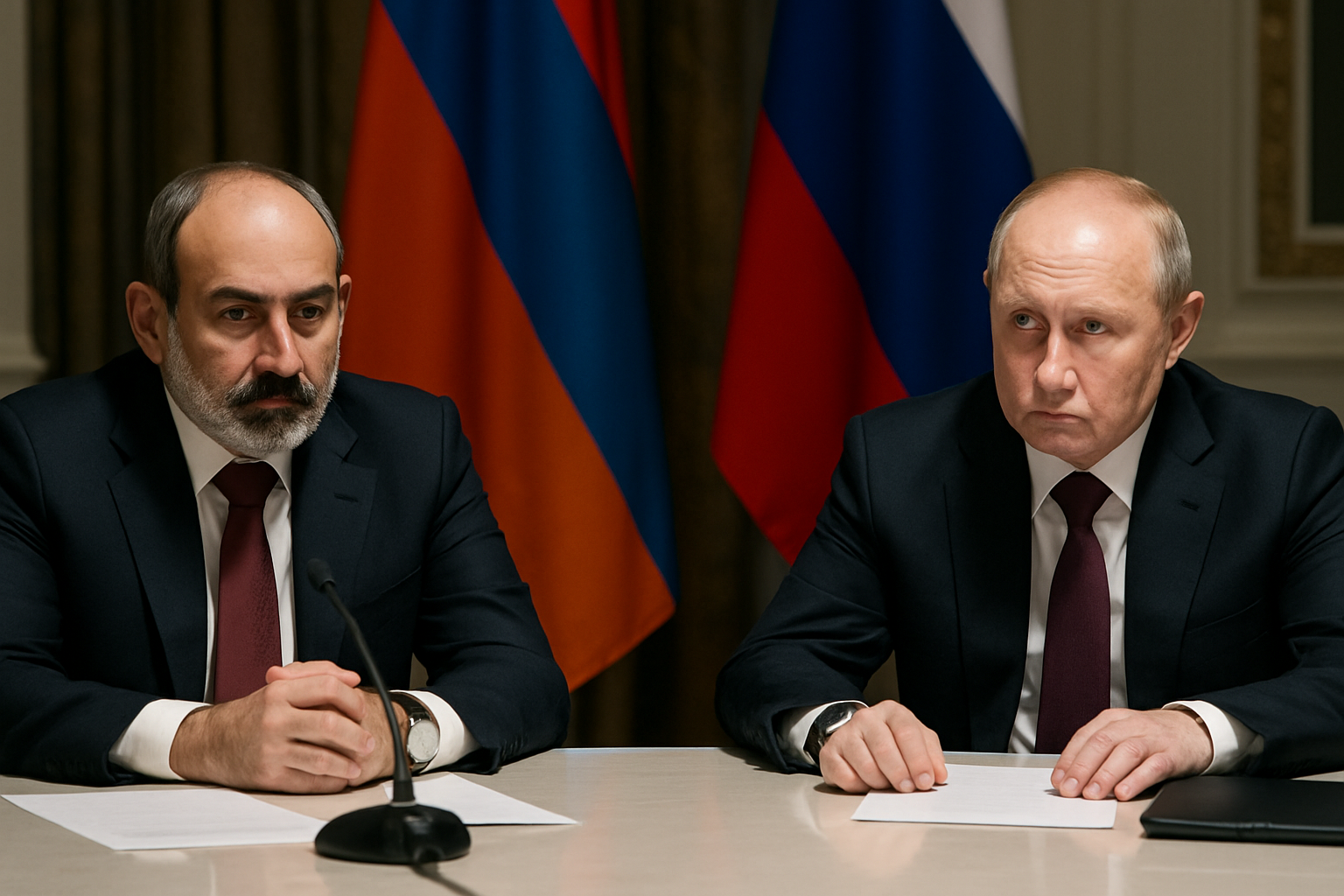
Armenian Prime Minister Nikol Pashinyan arrived in Moscow on March 31, 2026, for crucial diplomatic talks with Russian President Vladimir Putin, marking a pivotal moment in Armenia-Russia relations amid unprecedented regional tensions and Armenia's gradual pivot toward European integration.
The high-stakes meeting, confirmed by both Armenian and Azerbaijani media sources, comes as Armenia continues its strategic realignment away from traditional Russian influence while Moscow grapples with global isolation following its involvement in Ukraine. The timing appears particularly significant given current regional dynamics and Armenia's accelerated European integration efforts.
Shifting Regional Dynamics
The Pashinyan-Putin meeting occurs against a backdrop of profound geopolitical transformation in the South Caucasus. Recent memory reveals Armenia's complex journey from Russian sphere dependence toward European integration aspirations, highlighted by Pashinyan's historic March 11, 2026 address to the European Parliament in Strasbourg.
During that landmark speech, Pashinyan identified the "frozen" EU-Georgia political dialogue as the "biggest problem" for Armenia's EU integration path, stating Armenia views Georgia as its "path to the European Union." This strategic positioning reflects Armenia's broader diplomatic recalibration following decades-long conflicts and changing regional security dynamics.
"Armenia views Georgia as 'path to European Union,' pursuing EU membership represents geopolitical realignment from traditional Russian sphere."
— Nikol Pashinyan, March 2026 European Parliament Address
The regional context has been further complicated by recent Iranian drone attacks on Azerbaijan's Nakhchivan region in March 2026, demonstrating the volatile security environment that continues to shape South Caucasus politics. These attacks prompted strong condemnation from Georgia's Foreign Ministry, which declared them as actions that "blatantly violate international principles" while expressing "solidarity with fraternal Azerbaijan."
Armenia's European Integration Push
Armenia's strategic pivot has accelerated significantly since Pashinyan's 2018 rise to power. The country has participated in France's Nuclear Energy Summit for civil nuclear cooperation and has actively pursued broader European integration frameworks. However, this Western orientation has created friction with Moscow, which traditionally viewed Armenia as a key ally in the South Caucasus through frameworks like the Collective Security Treaty Organization (CSTO).
The recent memory of Armenia-Azerbaijan peace negotiations following the September 2023 Azerbaijani military operation that ended Armenian control over Nagorno-Karabakh has fundamentally altered regional dynamics. The February 2026 sentencing of former Nagorno-Karabakh State Minister Ruben Vardanyan to 20 years in prison by an Azerbaijan court highlights ongoing post-conflict justice challenges and regional reconciliation difficulties.
US Diplomatic Engagement and Strategic Competition
The Moscow meeting also comes in the context of increased US engagement in the South Caucasus. Vice President JD Vance's historic February 2026 visit to the region, which included signing a Strategic Partnership Charter with Azerbaijan and laying a wreath at the Armenian genocide memorial, demonstrated renewed American interest in the region.
Current US-Azerbaijan trade stands at $74.9 million annually with significant expansion potential from Azerbaijan's $27.2 billion in global exports. The US Chamber of Commerce has positioned Azerbaijan as a key regional energy coordinator and strategic East-West hub, particularly important for European energy security following Russia's actions in Ukraine.
Regional Energy and Security Considerations
Energy cooperation remains central to regional relationships, with Azerbaijan's positioning as an alternative to Russian energy supplies gaining increased importance. The BP investment of $3.4 billion in the Shah Deniz project exemplifies this strategic reorientation, as European markets seek alternatives to Russian energy dependency.
The South Caucasus has become increasingly important for European energy security, particularly following Russia's invasion of Ukraine. Azerbaijan's energy supply through the Southern Gas Corridor represents a crucial diversification strategy for European energy networks, while Armenia's potential integration into regional energy frameworks could provide economic opportunities and reduce traditional supplier dependence.
Complex Diplomatic Balancing Act
For Pashinyan, the Moscow meeting represents a delicate balancing act between maintaining necessary relationships with Russia while pursuing European integration goals. Armenia's geographic position, combined with ongoing security challenges and economic considerations, requires careful diplomatic navigation.
The broader context of the March 2026 global crisis environment, including ongoing tensions in the Middle East and suspended Ukraine peace talks, adds additional complexity to regional diplomatic calculations. Nations across the South Caucasus are reassessing their strategic partnerships and alliance structures amid this uncertain international environment.
Historical Context and Future Implications
The Armenia-Azerbaijan conflict, which began in 1991 and resulted in approximately 30,000 deaths, reached a decisive turning point with the September 2020 escalation followed by a Russian-brokered ceasefire until the decisive 2023 Azerbaijan operation. Post-conflict justice challenges, highlighted through cases like the Vardanyan sentencing, underscore the complex reconciliation efforts required for lasting regional stability.
Pashinyan's Strasbourg appearance represented a diplomatic milestone in Armenia's European journey while underscoring the interconnected South Caucasus challenges of post-Soviet transformation. Success in European integration will depend on domestic reforms, bilateral agreements, and broader regional stability involving all South Caucasus nations.
"Regional integration cannot be achieved in isolation - requires broader South Caucasus stability, cooperative frameworks."
— Diplomatic Analysis, March 2026
Implications for Regional Stability
The Pashinyan-Putin meeting will likely address several critical issues, including Armenia's CSTO membership status, regional security arrangements, and economic cooperation frameworks. Russia's capacity to maintain influence in the South Caucasus has been significantly tested by its involvement in Ukraine and broader international isolation.
The meeting's outcomes could influence broader regional dynamics, including Armenia-Azerbaijan peace negotiations, Georgia's European integration path, and the overall balance of power in the South Caucasus. The region's strategic importance as a corridor between Europe and Asia makes these diplomatic developments significant for international stakeholders.
As Armenia continues its complex diplomatic evolution, the Moscow meeting represents a crucial test of whether traditional partnerships can adapt to contemporary geopolitical realities or whether fundamental realignments will reshape regional relationships for the coming decades.