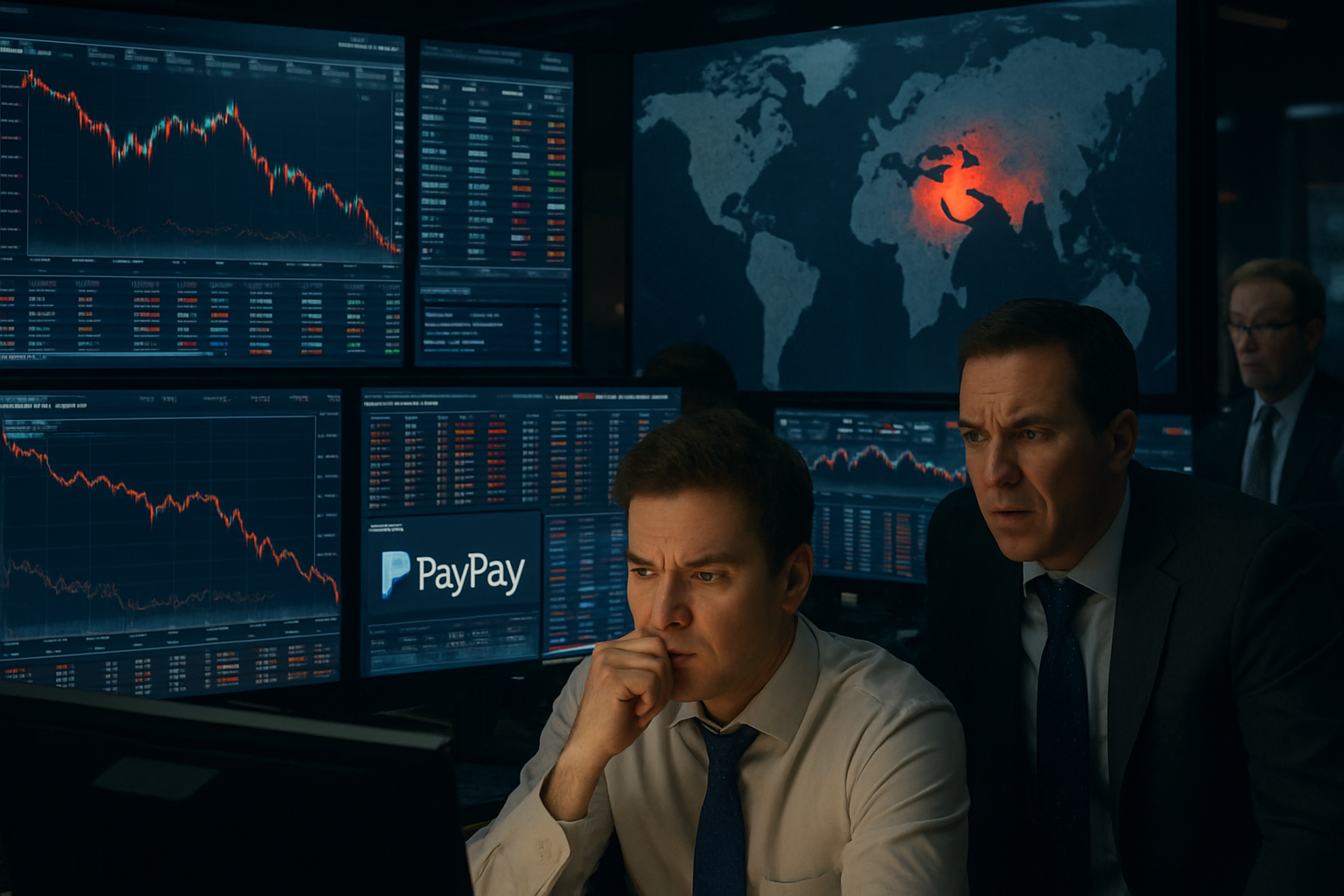
SoftBank's digital payments platform PayPay has postponed the launch of its highly anticipated US IPO roadshow as escalating tensions in the Middle East following the death of Iran's Supreme Leader Ali Khamenei have triggered severe volatility across global financial markets, sources familiar with the matter told Channel NewsAsia.
The Japanese fintech giant, originally targeting to raise approximately $1.1 billion in its Nasdaq debut, made the decision to delay its investor presentations as Middle East conflicts have created an unprecedented crisis affecting international aviation, energy markets, and investor confidence worldwide.
Operation Epic Fury Triggers Global Market Chaos
PayPay's postponement comes in the wake of "Operation Epic Fury," the largest coordinated US-Israeli military operation in the Middle East since the 2003 Iraq invasion, which resulted in the confirmed death of Iran's Supreme Leader Ali Khamenei on March 1-2, 2026. The operation utilized an unprecedented dual-carrier deployment of the USS Gerald R. Ford and USS Abraham Lincoln, representing approximately one-third of the active US Navy fleet.
The immediate Iranian retaliation, dubbed "Operation True Promise 4" by the Islamic Revolutionary Guard Corps (IRGC), has created massive disruptions across global markets. The IRGC declared "no red lines remain," targeting US and Israeli assets across the Gulf region and causing civilian casualties in the UAE, Kuwait, Qatar, and Bahrain.
Aviation Crisis Compounds Market Instability
Contributing to PayPay's decision is the unprecedented global aviation crisis, with over 18,000 flights cancelled worldwide as Iran, Iraq, Israel, UAE, and Qatar simultaneously closed their airspace. Dubai International Airport, the world's busiest by international passenger traffic, remains completely shut down due to missile damage.
Major carriers including Emirates, Air France-KLM, Wizz Air, and Bulgaria Air have suspended Middle East operations, creating the most comprehensive regional disruption since the COVID-19 pandemic. This aviation chaos would have severely impacted PayPay's planned investor roadshow, which typically requires extensive international travel.
"The current geopolitical situation has created an environment where conducting a successful IPO roadshow is simply not feasible,"
— Industry source familiar with the matter
Energy Market Volatility Affects Investor Sentiment
The crisis has created significant energy market volatility, with oil prices surging over 10% to $80 per barrel as Iran effectively closed the Strait of Hormuz, through which 40% of global oil transit passes. Natural gas prices have jumped 24% in Europe and 78% in the United States, while major shipping companies Maersk and MSC have suspended operations in the Persian Gulf.
Over 150 oil and LNG tankers are currently stranded in the Persian Gulf, representing billions of dollars in cargo and creating supply chain disruptions that extend far beyond the Middle East region. These developments have created the kind of market uncertainty that typically leads to IPO postponements.
PayPay's Strategic Context and Market Position
PayPay, Japan's leading mobile payments platform, had been preparing for its US market debut as part of its international expansion strategy. The company, backed by SoftBank Group, has dominated the Japanese digital payments market and was seeking to leverage its success for growth in international markets.
According to previous reports from February 2026, SoftBank had reported $19.8 billion in investment gains from OpenAI, validating the group's AI investment strategy. PayPay's IPO was seen as part of SoftBank's broader portfolio optimization amid the global technology transformation.
Nuclear Diplomacy Collapse Precedent
The current crisis stems from the complete breakdown of nuclear negotiations between the US and Iran, despite what had been described as the most significant diplomatic progress since the 2018 JCPOA collapse. Geneva talks had achieved "broad agreement on guiding principles," but fundamental scope disagreements proved insurmountable.
Iran's exclusion of ballistic missiles and regional proxies as "red lines" conflicted with US demands for comprehensive agreements addressing missiles, armed groups, and human rights. Iran had been enriching uranium at 60% purity, approaching the 90% weapons-grade threshold, with sufficient material for multiple weapons if weaponized.
Regional Coalition Strain and Global Implications
The crisis has severely strained an unprecedented regional coalition that had been supporting diplomatic solutions. Saudi Arabia, UAE, Qatar, and Egypt had formed an extraordinary Middle Eastern consensus backing diplomatic processes, but Iranian retaliation targeting member territories has threatened this coalition.
Egyptian President Abdel Fattah el-Sisi condemned attacks on "sisterly Arab countries," warning of "comprehensive chaos." Multiple countries have ordered embassy evacuations, with Sweden and Serbia ordering immediate evacuations of their citizens from Iran citing "extremely uncertain" security conditions.
Technology Sector Broader Context
PayPay's IPO delay occurs within a broader challenging environment for technology companies. The global technology sector has been experiencing what analysts term the "SaaSpocalypse" – massive market volatility that has erased hundreds of billions in tech stock value as artificial intelligence disrupts traditional software business models.
Additionally, a global memory chip crisis has driven semiconductor prices up sixfold, affecting companies like Samsung, SK Hynix, and Micron, creating supply chain constraints expected to continue through 2027. These technology infrastructure challenges compound the geopolitical uncertainties affecting IPO markets.
Market Timing and Strategic Considerations
Financial market experts note that IPO success heavily depends on stable market conditions and investor confidence. The current environment of global aviation disruptions, energy market volatility, and geopolitical uncertainty creates particularly challenging conditions for new public offerings.
The Strait of Hormuz closure threatens global energy security, while the aviation crisis affects international business operations. Pakistan's KSE-100 index has fallen 8.97%, and US Dow futures have dropped 400-570 points, reflecting widespread market anxiety.
Nuclear Governance Crisis Context
The broader context includes a nuclear governance crisis, with the New START treaty having expired on February 5, 2026 – marking the first time in over 50 years without US-Russia nuclear constraints. Combined with China's nuclear expansion and what UN Secretary-General António Guterres has called nuclear risks at their "highest in decades," the international security environment has become increasingly unstable.
This represents what experts describe as a "template-setting moment" for 21st-century diplomacy versus military confrontation, with implications extending decades beyond the current crisis and affecting international approaches to nuclear crisis resolution.
Looking Forward: Market Recovery Timing
PayPay has not announced a specific timeline for resuming its IPO process, with sources indicating the company will monitor global market conditions and geopolitical developments. The success of containing the Middle East escalation could provide a framework for nuclear crisis resolution, while failure might accelerate military solutions that could reshape regional geopolitics for decades.
The company's postponement reflects broader market realities where major financial decisions are increasingly influenced by geopolitical events. As the international community faces what many describe as the most dangerous moment since the Cold War ended, companies like PayPay must navigate unprecedented global uncertainties.
The situation underscores how modern financial markets are interconnected with global security developments, where events in the Middle East can directly impact technology companies' strategic plans in Asia and their access to US capital markets. PayPay's eventual IPO success will likely depend not just on company fundamentals, but on the broader resolution of international crises affecting global market stability.