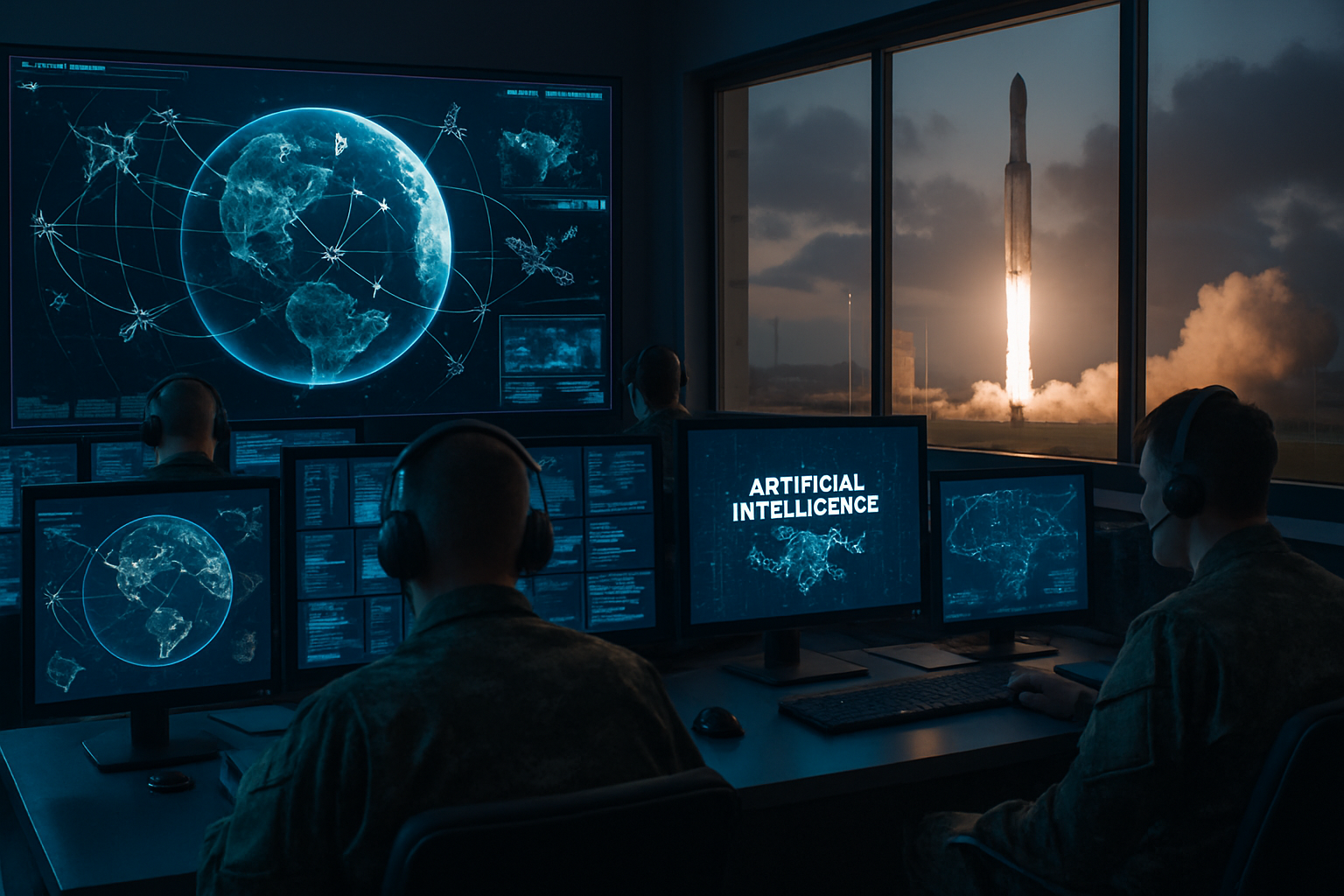
The convergence of artificial intelligence and space technology is transforming global defense capabilities as the Pentagon pushes leading AI companies to expand their tools into classified military networks while Jeff Bezos launches Amazon's satellite constellation to challenge Elon Musk's space monopoly.
US defense officials are actively urging major artificial intelligence companies to make their advanced models available across all military classification levels, according to emerging reports from defense circles. This unprecedented push represents a fundamental shift in how the Pentagon approaches AI integration within its most sensitive operational systems.
Defense AI Integration Accelerates
The Pentagon's initiative comes amid growing recognition that artificial intelligence capabilities have become essential rather than optional for maintaining strategic military advantage. The move follows successful AI deployments in various defense applications, including the historic NASA Mars rover missions that completed the first fully AI-planned operations in December 2025.
Recent developments show the US Department of Defense has already begun integrating ChatGPT into military artificial intelligence systems through collaboration with OpenAI, marking a historic expansion of AI into critical government infrastructure. OpenAI CEO Sam Altman reports exceptional growth with ChatGPT exceeding 800 million weekly users and experiencing over 10% monthly growth.
This military AI integration represents a strategic shift recognizing advanced AI capabilities as mission-critical technology. The timing is particularly significant amid global AI competition, with Chinese DeepSeek breakthroughs challenging US technological dominance and European initiatives like Deutsche Telekom's Industrial AI Cloud in Munich representing regional AI sovereignty efforts.
Bezos Challenges Musk's Space Dominance
In a parallel development that could reshape the commercial space landscape, Amazon has launched its first Leo satellite constellation from Kourou, French Guiana, directly challenging Elon Musk's Starlink monopoly. The deployment, managed by Arianespace, marks Amazon's entry into the strategic satellite internet market that has been dominated by SpaceX's extensive Starlink network.
The timing of Amazon's satellite deployment is particularly noteworthy given recent geopolitical tensions surrounding satellite communications. SpaceX has demonstrated strategic control capabilities by successfully blocking unauthorized Russian use of Starlink terminals for military drone operations in Ukraine, as confirmed by Ukrainian Defense Minister Rustem Umerov in collaboration with Musk.
Amazon's Leo constellation aims to break Musk's orbital monopoly while addressing the digital divide in underserved areas. However, the expansion raises concerns about space saturation and debris accumulation as more private companies and nations deploy satellite swarms in Earth's orbit.
Technological Infrastructure Challenges
Both developments occur against the backdrop of a global memory crisis affecting the technology sector. Semiconductor prices have increased sixfold, creating bottlenecks that affect Samsung, SK Hynix, and Micron operations. These infrastructure constraints are expected to persist until 2027 when new fabrication facilities come online.
The memory crisis adds urgency to space-based computing alternatives, with SpaceX's recent $1.25 trillion merger with xAI specifically targeting space-based data centers powered by solar energy. Elon Musk has predicted that space-based AI data centers will become the most cost-effective solution within 36 months, citing advantages including superior solar energy capture, no atmospheric interference, and elimination of day-night cycles.
Strategic Implications for Defense
The Pentagon's push for AI expansion into classified networks highlights the military's recognition that modern warfare increasingly depends on artificial intelligence capabilities. Ukrainian forces have already deployed AI-enhanced vision systems for drone operations in low-light and foggy conditions, demonstrating the practical battlefield applications of advanced AI technology.
The initiative also reflects broader concerns about maintaining technological superiority in an era of intensifying global competition. With approximately one-third of countries agreeing to AI warfare governance frameworks while major powers like the US and China abstain from comprehensive commitments, the race for AI military applications has become a critical strategic battleground.
Space Economy Transformation
The satellite competition between Amazon and SpaceX occurs during what analysts describe as a transition from the "AI revolution" to the "space economy golden age." This shift is characterized by massive private investment in orbital infrastructure, with SpaceX preparing a potential June 2026 IPO that could value the company at over $1 trillion.
The commercial space revolution extends beyond satellite internet services. Companies are exploring space-based data centers, orbital manufacturing, and resource extraction opportunities. Pakistan recently achieved a historic milestone with SUPARCO selecting astronaut candidates for China's Tiangong space station, while European companies like Germany's Isar Aerospace are building rocket testing facilities to achieve launch independence.
Geopolitical Ramifications
The developments carry significant geopolitical implications as nations recognize space-based infrastructure and AI capabilities as critical components of national security. China has successfully launched its fourth Shenlong reusable spacecraft, positioning itself as a potential rival to US space capabilities, while European nations pursue technological sovereignty through regional AI and space initiatives.
The Russian use of Starlink terminals for military operations in Ukraine, subsequently blocked by SpaceX, demonstrates how commercial space infrastructure has become entangled with international conflicts. This precedent raises questions about the neutrality and control of privately-owned satellite networks that provide critical communications infrastructure.
Future Outlook and Challenges
As the Pentagon expands AI integration into classified systems, several challenges emerge. The global memory crisis threatens to limit AI development capabilities, while regulatory frameworks struggle to keep pace with technological advancement. The UN has established an Independent International Scientific Panel with 40 global experts to assess AI's impact, while European nations implement increasingly stringent platform regulations.
The satellite competition between Amazon and SpaceX will likely intensify as both companies race to deploy comprehensive global coverage networks. Success in this competition could determine which company controls critical space-based infrastructure for the emerging space economy.
The convergence of AI advancement and space infrastructure development represents a pivotal moment in technological history. As the Pentagon pushes for expanded AI access and commercial companies compete for orbital dominance, the decisions made in 2026 will likely shape the balance of technological power for decades to come.
These developments underscore the critical importance of maintaining technological leadership in both artificial intelligence and space capabilities. The nation or alliance that successfully integrates these technologies while addressing infrastructure constraints and regulatory challenges will likely hold significant strategic advantages in the emerging technological landscape of the late 2020s and beyond.