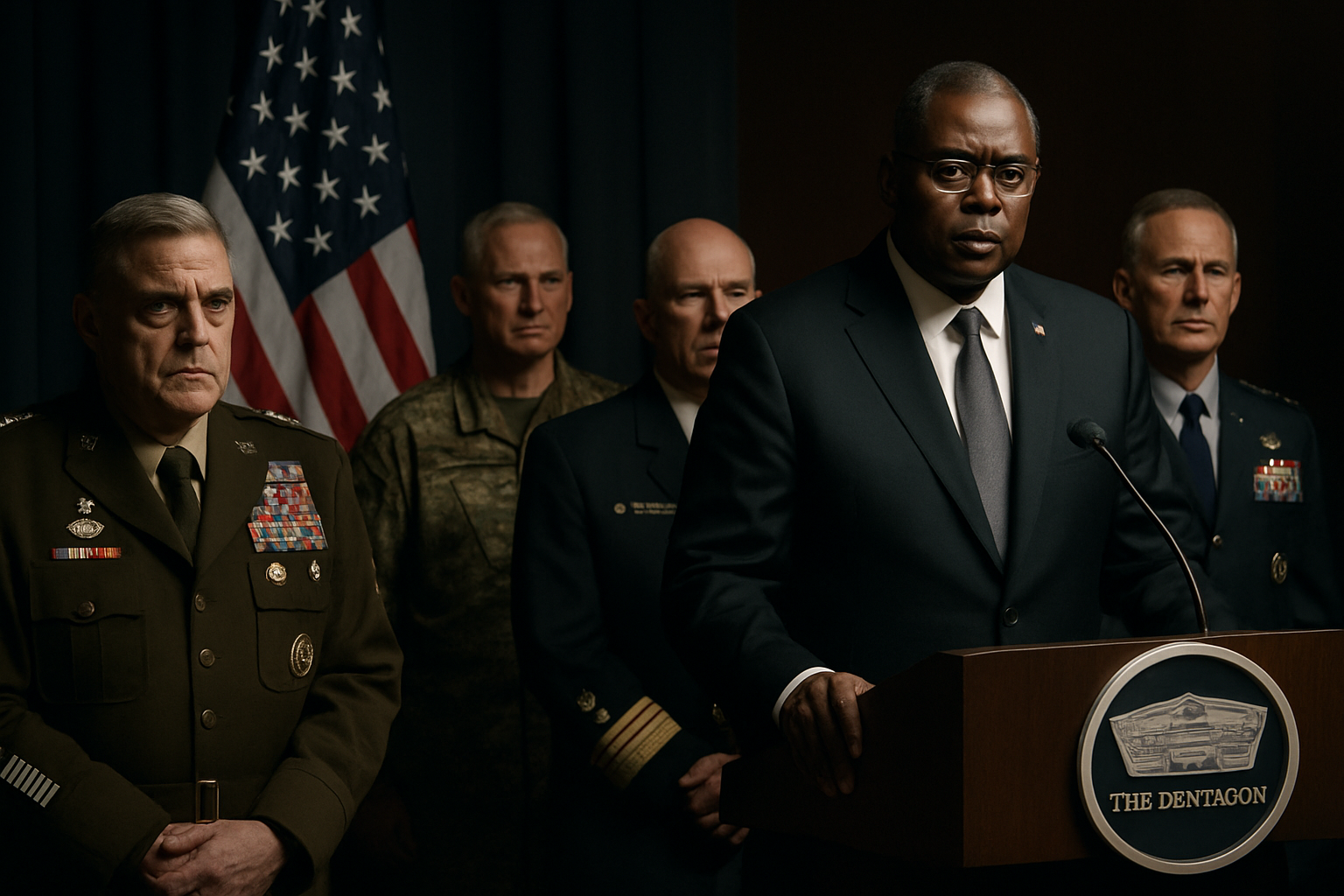
Defense Secretary Pete Hegseth on Thursday dismissed Army Chief of Staff General Randy George and two other senior generals during the ongoing Iran conflict, while President Trump announced a massive $1.5 trillion defense budget request—marking the most dramatic Pentagon leadership upheaval during wartime since World War II.
The unprecedented firings occurred as Operation Epic Fury enters its fourth week, with U.S. forces conducting sustained military operations against Iran following the death of Supreme Leader Ali Khamenei on March 1. Hegseth told General George to retire immediately, along with Major General William Green Jr., chief of chaplains, and General David Hodne, commander of Army Transformation and Training Command.
Historic Budget Request Amid War Costs
Trump's $1.5 trillion defense budget proposal represents a staggering 40-50% increase from current Pentagon spending, marking the largest such request since World War II. The President cited the mounting costs of the Iran war, which has already consumed $11.3 billion in its first week alone, with operations now extending through September 2026.
"The country faces rising costs from its war on Iran and mounting global security commitments," Trump told lawmakers Friday, according to congressional briefings reported by multiple sources. The request would lift Pentagon spending by more than 40% in a single year as Washington seeks to sustain military operations and rebuild depleted weapons stockpiles.
"It takes money to kill bad guys."
— Pete Hegseth, Defense Secretary
The proposal comes as the Iran conflict, now costing an estimated $2 billion per day according to closed-door congressional briefings, has created unprecedented financial pressure on military resources. The dual-carrier deployment of USS Gerald Ford and Abraham Lincoln represents approximately one-third of the active U.S. Navy fleet concentrated in the region.
Unprecedented Wartime Leadership Purge
The dismissal of General George—who had over a year remaining in his four-year term as the 41st Chief of Staff—has sent shockwaves through the Pentagon. According to multiple sources, Hegseth's move reflects his desire for military leaders more aligned with Trump's military vision and approach to the Iranian conflict.
George, a career military officer and West Point graduate, was nominated for the role in 2023 by former President Joe Biden. His removal, along with Generals Green and Hodne, represents the most significant Pentagon leadership purge during active military operations in decades.
Pentagon spokesman Sean Parnell confirmed the departures but declined to provide specific reasons for the dismissals. However, sources familiar with the decision indicate Hegseth sought leaders who would more aggressively support the administration's expanded military objectives in Iran.
Congressional Opposition Mounting
The leadership changes and budget request face unprecedented congressional scrutiny, with bipartisan lawmakers demanding answers about strategy, costs, and the potential for ground troop deployment. Senator Richard Blumenthal expressed being "more concerned than ever" about the possibility of boots on the ground in Iran.
The conflict enjoys historically low public support at just 25%, making it "almost unprecedented" for military operations at this scale. Financial markets have emerged as what analysts call the "ultimate constraint" on continued escalation, with Pakistan's KSE-100 index suffering its largest single-day decline in history at -8.97%.
Congressional sources report that Pentagon operations are planned to continue through September 2026, far beyond the initial 4-6 week timeline suggested by the administration. This extension has intensified demands for comprehensive strategy reviews and exit planning.
Global Crisis Escalates
The Pentagon upheaval comes amid the most dangerous international crisis since the Cold War. The Iran conflict has triggered:
- Over 18,000 flight cancellations worldwide—the most since COVID-19
- Oil prices surging past $100 per barrel for the first time since 2014
- Effective closure of the Strait of Hormuz, affecting 40% of global oil transit
- The first attack on European territory since WWII (Cyprus RAF Akrotiri)
- International evacuations on the scale of the Arab Spring 2011
Iran's systematic retaliation under "Operation True Promise 4" has struck U.S. allies across the region, with casualties in the UAE, Kuwait, Qatar, and Israel. The Revolutionary Guards declared that "no red lines remain" in their response to American and Israeli operations.
Iranian Leadership Transition
The crisis has been complicated by Iran's unprecedented leadership transition. Following Ali Khamenei's death, his son Mojtaba Khamenei has assumed power as Supreme Leader—the first hereditary succession in the Islamic Republic's 47-year history. CIA assessments suggest Revolutionary Guards have consolidated unprecedented control, marking a shift from clerical to military governance during active warfare.
Trump has explicitly rejected this succession, claiming the right to "personally choose next Iranian leader" and demanding Iran's "unconditional surrender"—the most direct assertion of American control over Iranian affairs since 1979.
Nuclear Diplomacy Collapsed
The military escalation emerged from the complete collapse of nuclear negotiations, despite achieving what diplomats called "broad agreement on guiding principles"—the most significant progress since the JCPOA collapse in 2018. The fundamental scope disagreement proved insurmountable, with Iran insisting on nuclear-only talks while the U.S. demanded comprehensive agreements including ballistic missiles, regional proxies, and human rights.
Iran continues uranium enrichment at 60% purity with over 400kg of weapons-grade material—sufficient for multiple weapons if weaponized. The crisis occurs against the backdrop of New START treaty expiration in February 2026, marking the first time in 50+ years without U.S.-Russia nuclear constraints.
Alliance Strain and International Response
The crisis has exposed deep fractures in traditional alliances. European allies have largely rejected Trump's requests for naval coalition support in the Persian Gulf, with German Defense Minister Boris Pistorius asking, "What does Donald Trump expect a handful of European frigates to do that the powerful U.S. Navy cannot?"
However, when Iran struck Cyprus—the first European territory attacked since WWII—an unprecedented naval coalition emerged with HMS Dragon leading Spanish, Italian, French, Dutch, and Greek vessels in defense of European territory.
"This represents the greatest test of multilateral cooperation in the crisis management of the modern era."
— UN Secretary-General António Guterres
Economic and Humanitarian Impact
The conflict has created severe global economic disruption. Natural gas prices have surged 24% in Europe and 78% in the U.S. Major shipping companies including Maersk and MSC have suspended Persian Gulf operations, with over 150 tankers stranded carrying billions in cargo.
Humanitarian casualties continue to mount, with Iran's Red Crescent reporting 787+ civilian casualties from U.S.-Israeli strikes. The Pentagon has confirmed responsibility for an elementary school attack that killed 165-185 students due to "outdated targeting data," prompting 46 Senate Democrats to demand swift investigations.
Template-Setting Crisis
Military experts and diplomatic observers view the current crisis as template-setting for 21st-century conflict resolution. The rapid transition from diplomatic breakthrough to military confrontation demonstrates what analysts call "multipolar era crisis management fragility."
Success in containing the conflict could provide a framework for future nuclear crisis resolution, while failure may accelerate military solutions for decades, encouraging proliferation globally and undermining diplomatic credibility worldwide.
The stakes include regional war prevention, global energy security, nuclear governance credibility, and international law enforcement—all tested simultaneously in what the UN Secretary-General has called the most dangerous moment since the Cold War's end.
As the Pentagon leadership crisis unfolds amid active military operations, the coming days will prove critical in determining whether escalation can be contained or whether the conflict expands into a broader regional war with global implications extending decades beyond current events.