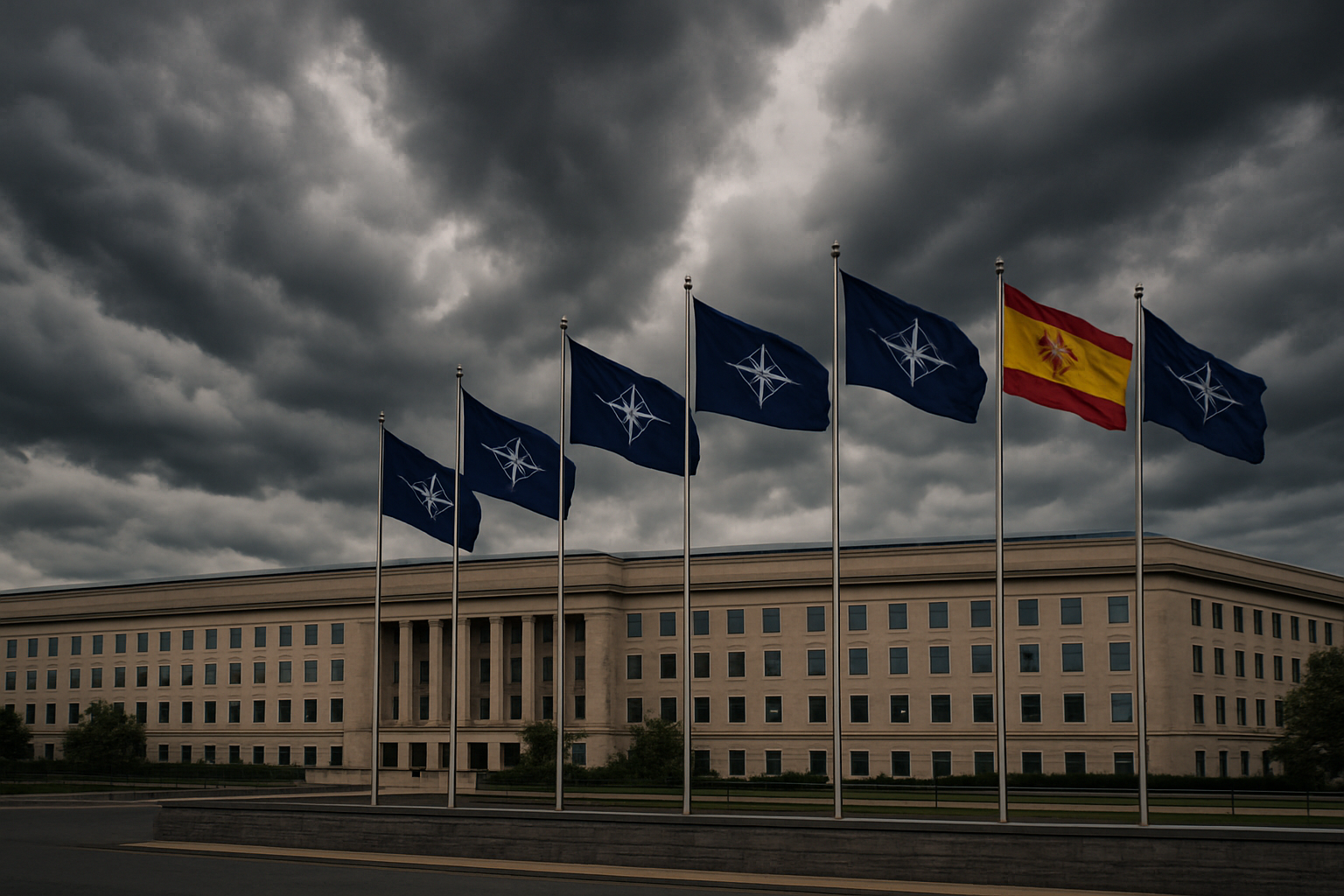
A leaked Pentagon email has revealed discussions about suspending Spain from NATO over disagreements about Iran policy, marking one of the most serious diplomatic rifts within the alliance in decades.
The internal Pentagon document, prepared by top policy adviser Elbridge Colby, outlines various options for punishing NATO allies who have failed to support U.S. operations in the ongoing war with Iran. According to sources familiar with the email, the options include suspending "difficult" countries from important positions within the alliance and reassessing American diplomatic support for longstanding European territorial claims, specifically mentioning Britain's sovereignty over the Falkland Islands.
Spain's Defiant Response
Spanish Prime Minister Pedro Sánchez responded to the leaked document with characteristic defiance, declining to comment directly but reaffirming Spain's commitment to NATO. Speaking at an EU summit in Cyprus, Sánchez stated unequivocally: "Spain is a reliable member within NATO" and emphasized that his country is "fulfilling all its obligations."
"As a result, I am absolutely not worried."
— Pedro Sánchez, Spanish Prime Minister
The Spanish government's position stems from its refusal to allow U.S. forces to use Spanish military bases for Iran operations, citing requirements for activities to be "consistent with UN Charter and international law." This stance has escalated into a comprehensive closure of Spanish airspace to U.S. military aircraft involved in Iran operations, forcing American planes to bypass Spain entirely for Middle East missions.
The Pentagon Email's Controversial Content
According to a U.S. official who spoke to Reuters on condition of anonymity, Colby's email expressed frustration at some allies' perceived reluctance or refusal to grant the United States access, basing and overflight rights – known as ABO – for the Iran war. The email reportedly stated that such rights are "just the absolute baseline for NATO" and was circulating at senior levels within the Pentagon.
The document represents an unprecedented level of formal consideration for punitive measures against NATO allies for foreign policy disagreements. One option outlined in the email envisions suspending countries deemed "difficult" from important or prestigious positions within the alliance, while another proposes reassessing U.S. diplomatic support for European territorial claims.
Historical Context and Alliance Tensions
The current crisis builds on months of escalating tensions between the Trump administration and European allies over Iran policy. Spain's position has been particularly firm, with Defense Minister Margarita Robles having previously denied U.S. access to Rota Naval Station and Morón Air Base, marking the first such denial since the 1950s defense agreements.
The broader context includes what many observers describe as the most serious NATO crisis since the alliance's founding in 1949. European allies, led by German Defense Minister Boris Pistorius, delivered a comprehensive rejection of Trump's requests for naval coalition support in the Strait of Hormuz, with Pistorius pointedly asking "What does a handful of European frigates do that the powerful U.S. Navy cannot?"
European Strategic Autonomy in Action
The crisis has demonstrated what European officials term "strategic autonomy" – the ability to make independent security decisions while maintaining alliance commitments. Notably, while Spain has refused to support U.S. Iran operations, it immediately joined a four-nation naval coalition (including HMS Dragon and Italian/French vessels) to protect Cyprus after Iranian attacks – the first attack on European territory since World War II.
This selective cooperation paradigm represents a fundamental shift in how European allies view their obligations to support American military operations, distinguishing between territorial defense and what they consider discretionary interventions.
NATO's Constitutional Framework
Legal experts note that NATO's founding treaty does not include provisions for suspending or expelling member states. The alliance's statutes focus on diplomatic solutions for resolving conflicts between members. Any attempt to suspend Spain would face significant procedural and legal obstacles, as such actions would require consensus among all 32 member states.
Spanish officials have expressed confidence in their legal standing, noting that unilateral U.S. trade embargos would violate World Trade Organization rules and existing EU-U.S. agreements. Spain maintains it has "necessary resources to contain impacts, help affected sectors, diversify supply chains" with backing from EU collective solidarity.
Broader Implications for Transatlantic Relations
The Pentagon email saga occurs against the backdrop of President Trump's repeated criticism of NATO, including his characterization of the alliance as a "paper tiger" after European rejection of Iran war support. Wall Street Journal reports suggest the administration is examining potential sanctions against NATO allies deemed insufficiently supportive, marking an unprecedented departure from traditional alliance management.
Congressional opposition to the Iran operations has been bipartisan and unprecedented, with only 25% American support for the conflict. Senator Richard Blumenthal has expressed being "more concerned than ever" about potential ground troop deployments, while Operation Epic Fury costs have exceeded $27 billion in the first month alone.
International Law vs. Alliance Obligations
The Spanish position reflects broader European concerns about the balance between alliance solidarity and adherence to international law. Spanish Economy Minister Carlos Cuerpo has justified the country's stance as refusing to "participate in or contribute to a war which was initiated unilaterally and against international law."
This principled stand has garnered support from EU leaders, with Council President António Costa expressing "full solidarity with Spain" and guaranteeing that "the interests of member states will be fully protected." French President Emmanuel Macron has also telephoned Sánchez to express support.
Nuclear Governance Crisis Context
The NATO crisis unfolds amid broader concerns about nuclear governance, with the New START treaty having expired in February 2026 – the first time in over 50 years without U.S.-Russia nuclear constraints. Iran continues uranium enrichment at 60% purity with over 400kg of weapons-grade material, while diplomatic efforts collapsed despite achieving "broad agreement on guiding principles" in Geneva talks.
UN Secretary-General António Guterres has described the current period as the "greatest test of multilateral cooperation in the modern era," emphasizing that nuclear risks are at their "highest in decades."
Template-Setting Precedent
The resolution of this crisis will have implications far beyond U.S.-Spain relations, potentially establishing precedents for how middle powers navigate pressure from major allies when core principles are at stake. Success in managing the dispute through diplomatic means could strengthen institutional cooperation frameworks, while failure might accelerate Western fragmentation at a critical moment for international stability.
The crisis represents a fundamental test of whether NATO's institutional resilience can accommodate restructuring while maintaining democratic principles, or whether the alliance faces its most serious existential challenge since the 1956 Suez Crisis.
Looking Forward
As this diplomatic crisis continues to unfold, observers note that the stakes extend well beyond immediate policy disagreements. The outcome will influence how alliance obligations are balanced against national sovereignty principles, setting templates for 21st-century international relations that could affect global governance mechanisms for decades to come.
Spain's firm stance on international law compliance, backed by EU solidarity, represents a significant test case for whether smaller NATO members can maintain independence on critical security issues when they conflict with the preferences of the alliance's dominant power.