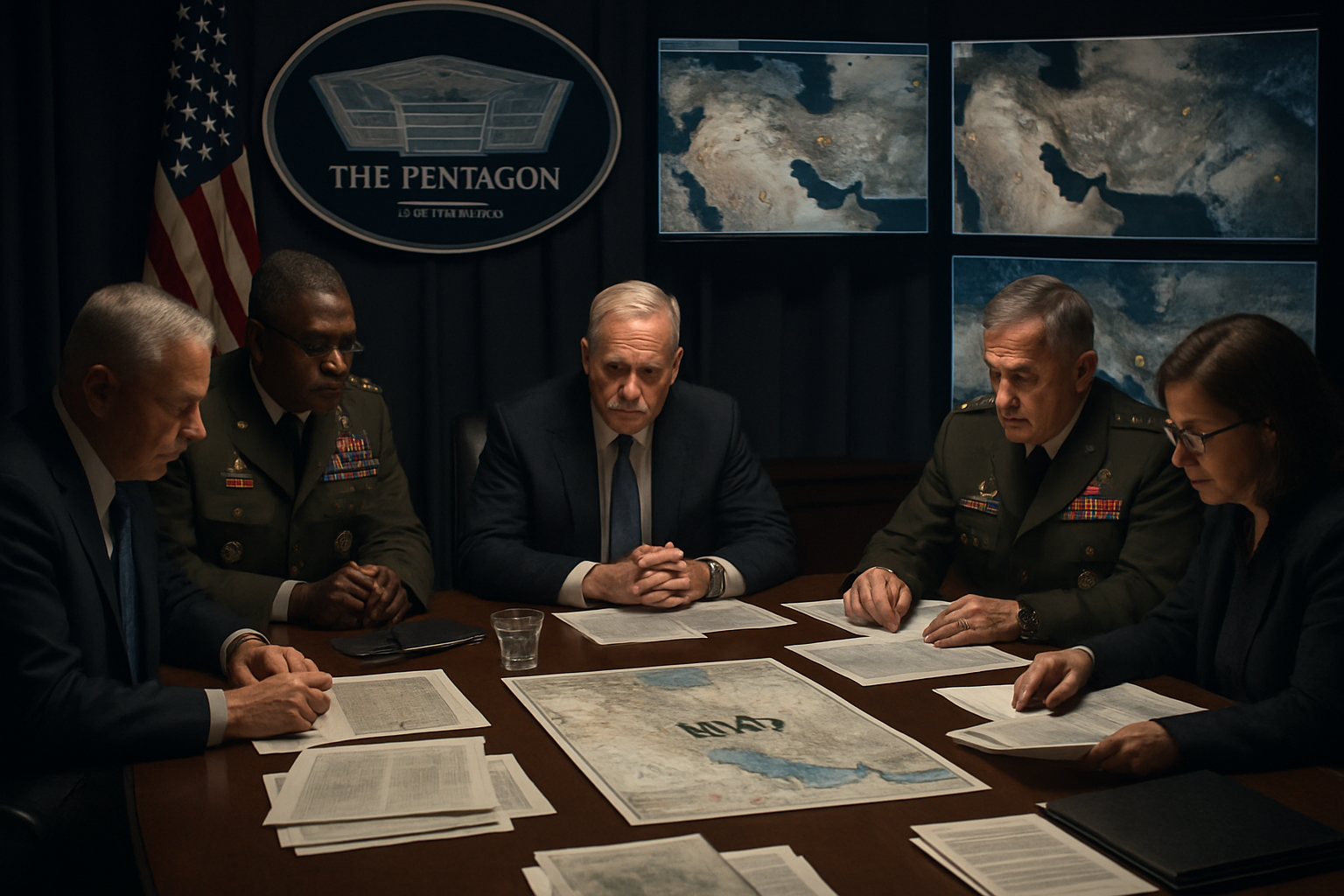
The Pentagon is reportedly preparing for weeks-long ground operations in Iran, including special forces deployment and conventional troop movements, according to multiple European media sources, as the most dangerous international crisis since the Cold War enters its fourth week with no signs of diplomatic resolution.
Reports from Finland's Helsingin Sanomat, Italy's ANSA, and Denmark's broadcasting services confirm Pentagon officials are developing comprehensive plans for limited ground incursions, though uncertainty remains whether President Trump has fully approved these operations or is considering partial implementation of the military recommendations.
Strategic Targets and Military Objectives
According to Washington Post sources cited by multiple international outlets, potential ground operations would focus on Iran's most strategic assets, particularly Kharg Island—which handles approximately 90% of Iran's crude oil exports—and critical positions along the Strait of Hormuz that Iran has been mining with an estimated 2,000-6,000 naval mines to block 40% of global oil transit.
The plans also reportedly include securing Iran's uranium stockpiles and capturing key coastal infrastructure to prevent further disruption of international shipping lanes that have already seen oil prices surge past $100 per barrel, with analysts warning of potential $200 oil if the crisis continues.
"The plans being discussed range from special operations raids to conventional infantry deployment, but none constitute a full-scale invasion like Iraq 2003,"
— European military analyst, speaking anonymously
Massive Military Buildup
The potential ground operations would build upon an already unprecedented military deployment in the region. Current U.S. forces include the dual-carrier battle groups USS Gerald Ford and USS Abraham Lincoln—representing approximately one-third of the active U.S. Navy fleet—plus 5,000 Marines aboard the USS Tripoli and an additional 3,500 Marines recently deployed.
Military sources suggest that if Trump approves additional deployments, including the rumored 82nd Airborne Division's 3,000 paratroopers, the United States could have over 17,000 troops positioned near "Iran's doorstep"—sufficient for limited territorial occupation but well below the 150,000-troop level used in the 2003 Iraq invasion.
Operation Epic Fury's Staggering Costs
The current air campaign, dubbed "Operation Epic Fury," has already cost $11.3 billion in its first week alone, making it one of the most expensive military operations in recent U.S. history. Pentagon planning documents reportedly extend operations through September 2026, far beyond the initial 4-6 week timeline promised by the White House.
The human cost continues mounting, with 150 U.S. troops wounded (8 in critical condition) and 3 confirmed killed—the first American combat deaths in the largest Middle East operation since 2003. The USS Charlotte submarine's historic sinking of the Iranian frigate IRIS Dena near Sri Lanka, killing over 80 crew members, marked the first enemy vessel sunk by a U.S. submarine since World War II.
Iranian Leadership Transition Under Fire
The conflict has fundamentally altered Iran's power structure following the confirmed death of Supreme Leader Ali Khamenei on March 1, the first day of Operation Epic Fury. His son, Mojtaba Khamenei, has been appointed as the first hereditary Supreme Leader in the Islamic Republic's 47-year history, representing an unprecedented shift from clerical to military governance as Revolutionary Guards consolidate control during wartime.
U.S. intelligence assessments suggest the new leadership structure, dominated by Revolutionary Guards commanders, may be more militarily aggressive and less open to diplomatic solutions than the previous clerical establishment.
Global Crisis Reaches Peak
The Iran conflict has triggered the most severe global disruption since the COVID-19 pandemic, with over 18,000 flights cancelled worldwide as eight Middle Eastern countries maintain simultaneous airspace closures. Dubai International Airport, the world's busiest with 86 million annual passengers, remains shuttered due to missile damage.
The energy crisis has reached historic proportions, with natural gas prices rising 24% in Europe and 78% in the United States. Qatar has halted LNG production representing 20% of global exports, while major shipping companies Maersk and MSC have suspended Persian Gulf operations, stranding over 150 oil tankers worth billions in cargo.
Congressional Opposition Intensifies
Bipartisan congressional opposition continues mounting, with Senator Richard Blumenthal stating he is "more concerned than ever" about potential ground troop deployment. The conflict's unpopularity—with only 25% public support according to recent polling—represents "almost unprecedented" opposition for early-stage military operations.
Lawmakers are demanding comprehensive briefings on long-term strategy, cost projections, and exit plans as the Pentagon's funding requests could reach $200 billion according to some estimates—one of the largest emergency military appropriations in recent history.
"The American people deserve answers about where this is heading and what the endgame looks like. We cannot repeat the mistakes of endless wars."
— Senator Richard Blumenthal, Armed Services Committee
Trump's Regime Change Demands
President Trump has escalated his rhetoric beyond military objectives to explicit regime change, demanding Iran's "unconditional surrender" and claiming the right to personally choose Iran's next Supreme Leader. This represents the most direct assertion of American control over Iranian internal affairs since the 1979 revolution and effectively eliminates near-term diplomatic solutions.
Trump's rejection of the new Supreme Leader Mojtaba Khamenei as a "lightweight" has drawn sharp Iranian responses, with Foreign Minister Abbas Araghchi categorically ruling out any negotiations with the Trump administration under current conditions.
European Territory Under Attack
The conflict has expanded beyond Middle Eastern boundaries with Iranian drone strikes on RAF Akrotiri in Cyprus—the first attack on European territory since World War II. This unprecedented escalation prompted an emergency naval coalition including HMS Dragon and frigates from Spain, Italy, France, the Netherlands, and Greece.
The European Union activated its ESTIA evacuation procedure for the first time in bloc history, underscoring how the regional conflict has evolved into a direct European security threat with global implications.
Nuclear Diplomacy Breakdown
The current military escalation emerged from the complete collapse of nuclear negotiations despite February's "broad agreement on guiding principles"—the most promising diplomatic breakthrough since the 2018 JCPOA collapse. The fundamental obstacle remains insurmountable: Iran insists on nuclear-only talks excluding ballistic missiles and regional proxies as "red lines," while the U.S. demands comprehensive agreements addressing Iran's missile program, armed groups, and human rights record.
Iran continues uranium enrichment at 60% purity with over 400 kilograms of weapons-grade material, sufficient for multiple nuclear weapons if further weaponized to 90% purity. This occurs amid the broader nuclear governance crisis following the New START treaty's expiration in February 2026—the first time in over 50 years without U.S.-Russia nuclear constraints.
Regional Coalition Under Severe Strain
The unprecedented diplomatic consensus among Saudi Arabia, UAE, Qatar, and Egypt supporting diplomacy has fractured as Iranian retaliation systematically targets coalition member territories. Egyptian President Abdel Fattah el-Sisi condemned attacks on "sisterly countries," warning of "comprehensive chaos" spreading throughout the region.
Iran's "Operation True Promise 4," with Revolutionary Guards declaring "no red lines remain," has caused casualties across the Gulf: one civilian killed in Abu Dhabi, 32 injured in Kuwait airport strikes, and 8 wounded in Qatar despite Patriot missile intercepts of 65 missiles and 12 drones.
Humanitarian Crisis and War Crimes Concerns
Iran's Red Crescent reports over 787 civilian casualties from U.S.-Israeli strikes, including Pentagon-confirmed responsibility for elementary school attacks killing 165-185 students due to "outdated targeting data." The Minab school strike, which killed 53-85 students and staff during regular hours, has prompted Geneva Conventions investigations into potential war crimes.
International evacuations have reached Arab Spring 2011 levels, with Australia reporting 115,000 nationals trapped and Germany evacuating 30,000 stranded tourists from the region.
Historical and Strategic Implications
UN Secretary-General António Guterres has called this crisis the "greatest test of multilateral cooperation and crisis management in the modern era." The rapid transition from diplomatic breakthrough to military confrontation demonstrates the fragility of crisis management in the multipolar era, with implications extending decades beyond current events.
The stakes include regional war prevention, global energy security, nuclear governance credibility, and international law enforcement—all testing post-World War II order principles simultaneously. Success in containment could provide a framework for nuclear crisis resolution, while failure may accelerate military solutions for decades, encouraging proliferation globally and undermining diplomatic credibility worldwide.
Template-Setting Moment for 21st Century
March 29, 2026, represents a watershed moment in international relations, potentially determining whether diplomatic or military solutions become the preferred approach to 21st-century territorial and nuclear disputes. The conflict's outcome will reverberate through global governance mechanisms, alliance structures, energy security architecture, and territorial sovereignty enforcement for generations.
As European sources confirm Pentagon preparation for weeks-long ground operations, the world watches whether the most dangerous international crisis since the Cold War can be contained or will spiral into a broader Middle Eastern conflagration with global implications that could fundamentally reshape the international order.
"We are at a critical juncture where decisions made in the coming days and weeks will determine the trajectory of international relations for decades to come."
— European Union Foreign Policy Chief
With uncertainty surrounding Trump's final authorization and Iran showing no signs of backing down from its Strait of Hormuz closure, the next phase of this crisis may prove the most consequential in determining whether diplomacy or military force becomes the dominant paradigm for resolving international disputes in the 21st century.