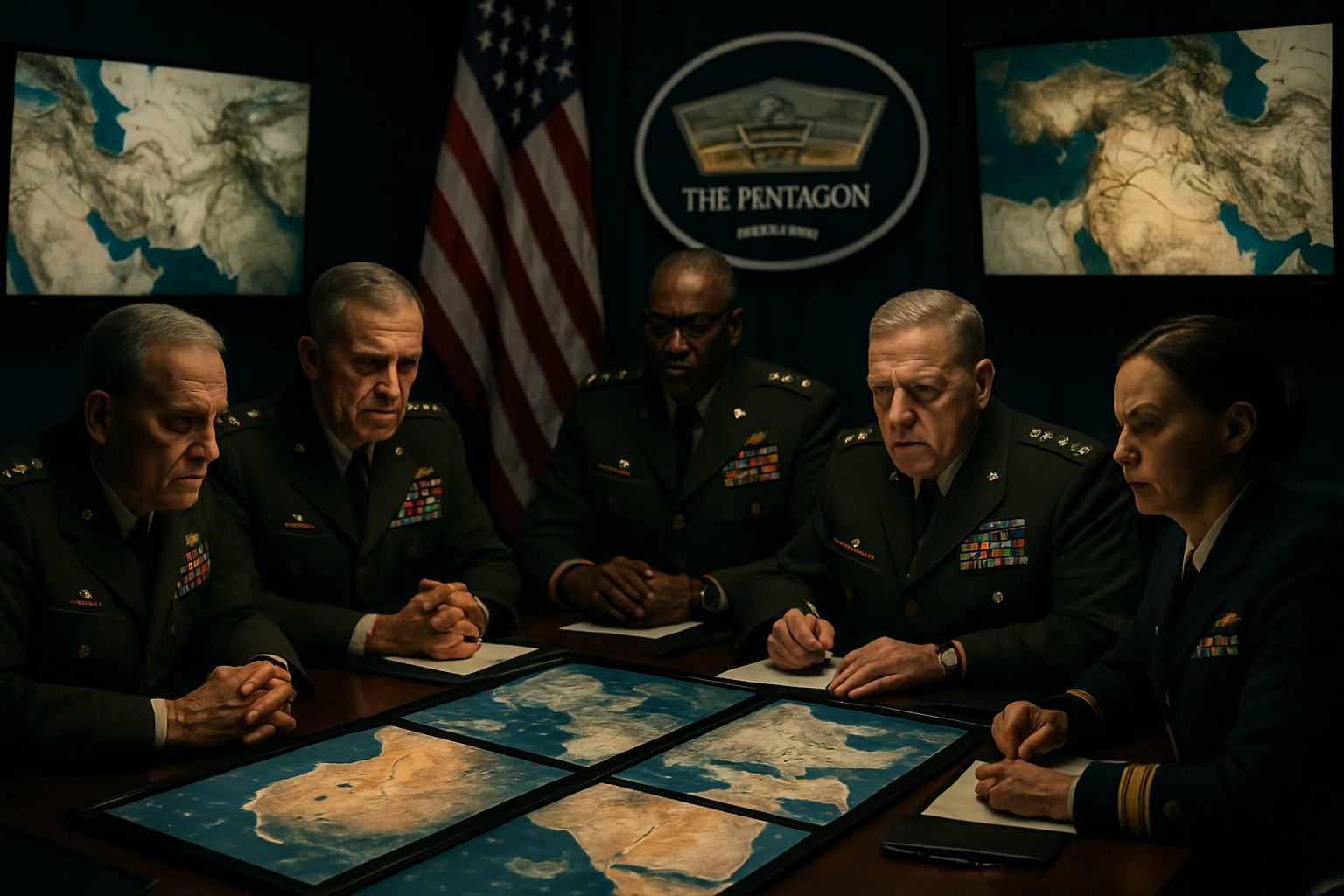
The Pentagon is reportedly preparing for weeks of ground operations in Iran as the month-long Middle East conflict escalates dramatically beyond aerial bombardment campaigns, according to multiple international reports emerging from Finland, Italy, and Denmark.
Sources across European media outlets confirm that advanced planning is underway for the potential deployment of special forces and other ground units to Iranian territory, marking what could become the most significant escalation in what is already being called the most dangerous international crisis since the Cold War.
Trump's Role in Ground Operations Decision
The reports indicate uncertainty over whether President Donald Trump has approved the comprehensive ground operation plans, with sources suggesting the decision could be partial or complete depending on battlefield developments. This comes as Trump has repeatedly demanded Iran's "unconditional surrender" while claiming the right to personally choose the next Iranian Supreme Leader.
The potential ground deployment would represent a massive escalation from Operation Epic Fury, the ongoing US-Israeli air campaign that has already cost $11.3 billion in its first week alone. Pentagon operations are currently planned through September 2026, far beyond the initial 4-6 week timeline originally projected by the White House.
Strategic Objectives and Targets
According to European intelligence assessments, potential ground operations could focus on several strategic objectives:
- Securing Iran's Kharg Island oil facility, which processes 90% of the country's crude oil exports
- Controlling strategic positions around the Strait of Hormuz, currently mined by Iranian forces
- Neutralizing Iran's uranium stockpiles at nuclear facilities
- Establishing control over key infrastructure to force diplomatic negotiations
The Strait of Hormuz has become a critical flashpoint, with Iran deploying an estimated 2,000-6,000 naval mines that have effectively closed the waterway carrying 40% of global oil transit. Over 150 tankers worth billions in cargo remain stranded in the Persian Gulf.
Current Military Deployment
The US has already deployed unprecedented military assets to the region, including:
- Dual-carrier deployment with USS Gerald Ford and Abraham Lincoln (representing one-third of the US Navy fleet)
- 5,000 Marines and sailors aboard amphibious assault ships
- 3,500 additional Marines recently deployed aboard USS Tripoli
- Preparation for potential deployment of the entire 82nd Airborne Division (3,000 elite paratroopers)
This represents the largest US Middle East military presence since the 2003 Iraq invasion, with costs already reaching historic levels.
Iranian Resistance and Regional Impact
Iran has responded to the escalating pressure through "Operation True Promise 4," with Revolutionary Guards declaring "no red lines remain" in their systematic targeting of US and allied assets across the region. The Iranian campaign has already resulted in:
- Attacks on UAE facilities killing one civilian in Abu Dhabi
- Kuwait airport strikes injuring 32 people
- Qatar intercepting 65 missiles and 12 drones, with 8 injured
- The first attack on European territory since WWII at RAF Akrotiri Cyprus
"Iran maintains the initiative to determine when this war ends, not the Americans,"
— Foreign Minister Abbas Araghchi, Iranian State Television
Historical Succession Crisis
The conflict has been dramatically complicated by Iran's constitutional crisis following the death of Supreme Leader Ali Khamenei on March 1. His son, Mojtaba Khamenei, has been appointed as the first hereditary Supreme Leader in the Islamic Republic's 47-year history, representing an unprecedented shift from clerical to military governance under Revolutionary Guards control.
This succession crisis has created additional complications for any potential ground operations, as US forces would be operating in a country undergoing fundamental political transformation during active warfare.
Congressional and Public Opposition
The prospect of ground operations faces severe domestic political constraints. Current polling shows only 25% American support for the conflict - described by analysts as "almost unprecedented" unpopularity for early-stage military operations.
Senator Richard Blumenthal has expressed being "more concerned than ever" about the deployment of ground troops, while bipartisan lawmakers are demanding comprehensive briefings on strategy, costs, and exit plans. The conflict's financial burden is already straining Pentagon budgets, with some estimates suggesting total costs could reach $200 billion if operations continue through September as currently planned.
Global Economic Consequences
The escalating crisis has created unprecedented global disruption:
- 18,000+ flights cancelled worldwide (most since COVID-19)
- Oil prices surging past $100/barrel, heading toward $200 warnings
- Natural gas prices up 24% in Europe and 78% in the US
- IEA releasing record 400 million barrels from strategic reserves
- Dubai International Airport completely shut down from missile damage
The International Energy Agency's reserve release represents the largest intervention in the agency's 50-year history, highlighting the severity of the global energy crisis created by the conflict.
NATO and Alliance Complications
Trump's demand for international military support has met with unprecedented rejection from traditional allies. Germany's Defense Minister Boris Pistorius led European resistance, asking "What does Donald Trump expect a handful of European frigates to do that the powerful US Navy cannot?"
France, Japan, and Australia have all explicitly declined to send naval vessels to support Strait of Hormuz operations, despite direct US requests. This represents the most comprehensive rejection of American military leadership since the 2003 Iraq War.
Nuclear Diplomacy Collapse
The current military escalation emerged from the complete breakdown of Geneva nuclear negotiations, despite what officials described as achieving "broad agreement on guiding principles" - the most progress since the 2018 JCPOA collapse.
The fundamental disagreement centered on scope: Iran insisted on nuclear-only discussions excluding ballistic missiles and proxy forces as "red lines," while the US demanded comprehensive terms including missiles, armed groups, and human rights issues.
Iran continues uranium enrichment at 60% levels with over 400kg of material sufficient for multiple weapons if weaponized to 90% weapons-grade levels.
Humanitarian Crisis
The conflict has created a mounting humanitarian crisis, with Iran's Red Crescent reporting over 787 civilian casualties from US-Israeli strikes. The Pentagon has confirmed responsibility for elementary school strikes that killed 165-185 students, attributed to "outdated targeting data."
International evacuations are proceeding on a scale not seen since the Arab Spring, with Australia reporting 115,000 nationals trapped and Germany evacuating 30,000 stranded tourists.
Template-Setting Global Implications
UN Secretary-General António Guterres has described the crisis as "the greatest test of multilateral cooperation and crisis management in the modern era." The rapid transition from diplomatic breakthrough to military confrontation demonstrates what experts call "multipolar era crisis management fragility."
The stakes extend far beyond the Middle East, with implications for:
- Nuclear governance credibility in a post-New START world
- Global energy security architecture
- International law enforcement mechanisms
- Diplomatic versus military solutions precedent for 21st-century disputes
Critical Decision Point
The potential authorization of ground operations represents what analysts describe as a watershed moment in international relations. Success in containing the conflict could provide a framework for future nuclear crisis resolution, while failure may accelerate military solutions for decades, encouraging global proliferation and undermining diplomatic credibility worldwide.
With Trump's administration reportedly considering the deployment of up to 17,000 troops to "Iran's doorstep" according to Romanian analysis, the coming days may determine whether this remains a contained regional confrontation or expands into the broader Middle Eastern war that experts have warned could reshape global order for decades to come.
As European sources indicate, the question is no longer if ground operations are being planned, but rather when and to what extent President Trump will authorize what could become the most consequential military deployment since the Iraq War, with implications extending far beyond the current administration and deep into the 21st century's approach to international conflict resolution.