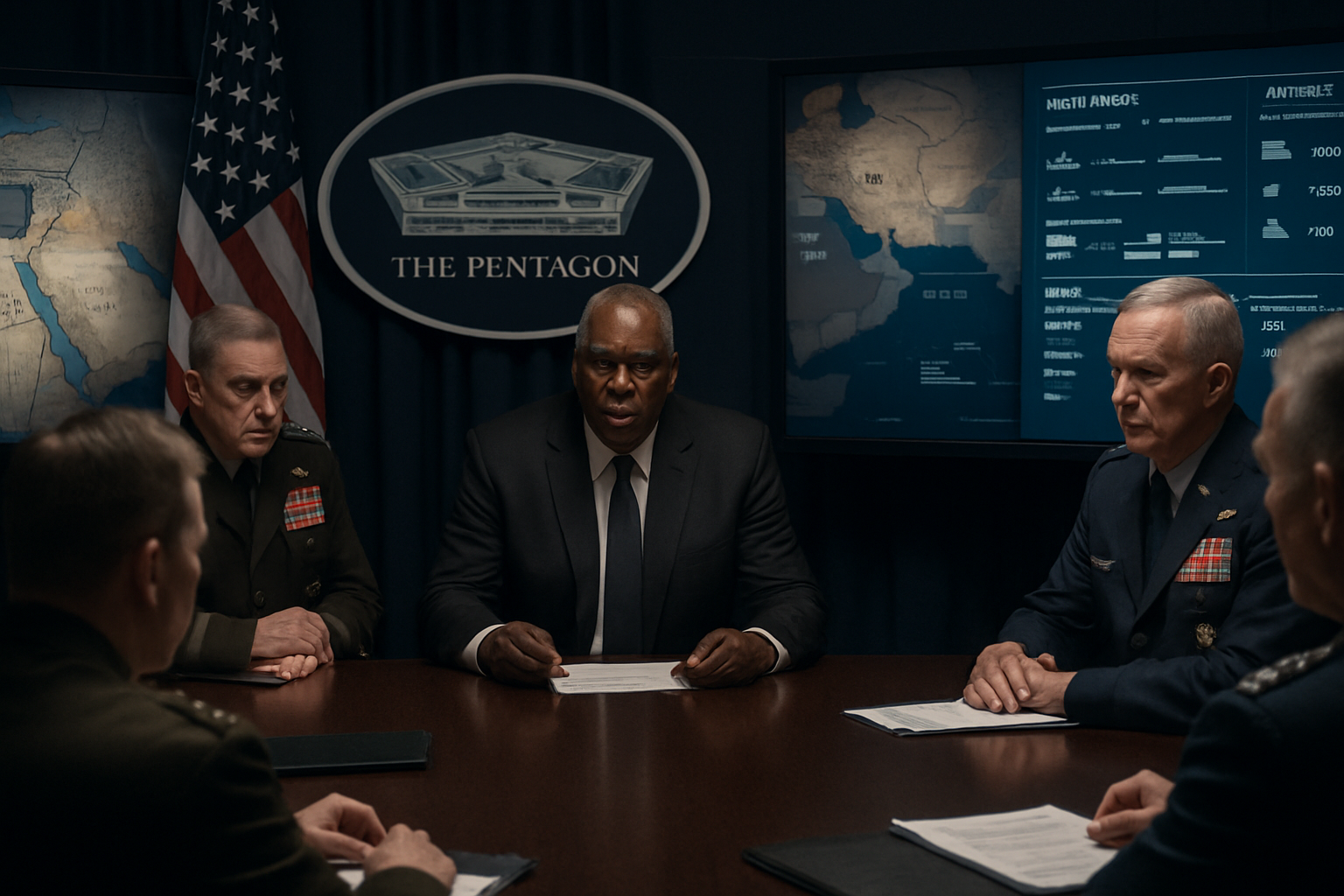
The Pentagon is seeking $200 billion in emergency funding from Congress as the Iran war enters its most dangerous phase, with President Trump's administration considering the deployment of thousands of additional US troops to the Middle East to secure critical oil routes through the Strait of Hormuz.
According to sources familiar with the matter, the Trump administration is actively discussing sending thousands of American soldiers to Iran's Kharg Island and strategic positions along the Persian Gulf coastline to ensure safe passage for oil tankers through the waterway that carries 40% of global seaborne oil transit.
The dramatic escalation under consideration comes as Operation Epic Fury—the largest US-Israeli military campaign since the 2003 Iraq invasion—has already cost American taxpayers $11.3 billion in its first week alone, with Pentagon officials preparing for operations to continue through September, far beyond the initial 4-6 week timeline outlined by the White House.
Critical Energy Chokepoint Under Threat
Iran's Revolutionary Guard Corps has deployed an estimated 2,000-6,000 naval mines throughout the Strait of Hormuz, effectively closing the critical waterway and stranding more than 150 oil tankers worth billions of dollars in cargo. Oil prices have surged past $100 per barrel for the first time since 2014, with energy analysts warning of potential spikes toward $200 per barrel if the crisis continues.
Sources indicate that any deployment of US ground forces could include securing Kharg Island, Iran's primary oil export terminal that handles 90% of the country's crude shipments. The strategic island, located 300 miles northwest of the Strait of Hormuz, processes approximately 1.6 million barrels per day and represents one of the world's most critical petroleum chokepoints.
"The deployments could help provide Trump with additional options as he weighs expanding US operations, with the Iran war well into its third week," according to officials familiar with the planning.
Congressional Opposition Mounting
The massive funding request and potential ground troop deployment face fierce resistance on Capitol Hill, where bipartisan lawmakers are demanding comprehensive strategy answers from the administration. Senator Richard Blumenthal has expressed being "more concerned than ever" about boots on the ground, while the conflict maintains historically low public support at just 25% approval among Americans.
"Any use of US ground troops could pose significant political risks for Trump, given low support among Americans for the Iran campaign and his own campaign promises to avoid entangling the US in new Middle East conflicts"
— Congressional Source
The Pentagon's $200 billion funding request would represent one of the largest single military appropriations in recent history, coming as the administration faces growing scrutiny over Operation Epic Fury's expanding scope and timeline. Pentagon officials have reportedly prepared operations through September 2026, suggesting a prolonged engagement far exceeding initial projections.
Global Crisis Intensifies
The Iran conflict has triggered the most severe global aviation crisis since COVID-19, with over 18,000 flights cancelled worldwide. Eight Middle Eastern countries maintain simultaneous airspace closures, while Dubai International Airport—the world's busiest—remains completely shuttered due to missile damage.
Major international carriers including Emirates, Air France-KLM, and Wizz Air have suspended Middle Eastern operations indefinitely, affecting hundreds of thousands of passengers and severing critical Asia-Europe flight corridors.
Natural gas prices have surged 24% in Europe and 78% in the United States, while Qatar has halted LNG production representing approximately 20% of global exports. The International Energy Agency has authorized the largest strategic petroleum reserve release in its 50-year history, deploying 400 million barrels from 32 countries in an effort to stabilize markets.
European Territory Attacked for First Time Since WWII
Iranian drones successfully struck RAF Akrotiri in Cyprus last week, marking the first attack on European territory since World War II. The unprecedented assault prompted an emergency naval coalition response, with HMS Dragon and Spanish frigates joining Italian, French, Dutch, and Greek vessels to protect European waters.
The European Union activated its ESTIA evacuation plan for Cyprus for the first time in the bloc's history, while multiple countries have ordered the immediate evacuation of their nationals from the region. Australia reports 115,000 nationals trapped in the region, while Germany is evacuating 30,000 stranded tourists.
Iranian Leadership Succession Crisis
The conflict began following the confirmed death of Iranian Supreme Leader Ali Khamenei on March 1, triggering the first constitutional succession crisis in the Islamic Republic's 47-year history. Mojtaba Khamenei, the deceased leader's son, has emerged as the favored successor in what would mark the first hereditary succession in Iranian history.
US intelligence assessments suggest that Revolutionary Guards members are likely to gain unprecedented control over Iranian governance, marking a fundamental shift from clerical to military leadership during active warfare conditions.
Diplomatic Breakdown
The military escalation follows the complete collapse of nuclear negotiations despite achieving "broad agreement on guiding principles" in Geneva talks—the most promising diplomatic progress since the 2018 JCPOA collapse. The breakdown centered on insurmountable scope disagreements, with Iran demanding nuclear-only discussions while excluding ballistic missiles and proxy forces as "red lines," while the US insisted on comprehensive agreements addressing missiles, armed groups, and human rights.
President Trump has demanded Iran's "unconditional surrender" and claimed the right to personally choose the country's next Supreme Leader, representing the most direct assertion of American control over Iranian affairs since the 1979 revolution.
Regional Coalition Under Strain
The previously unprecedented diplomatic consensus among Saudi Arabia, UAE, Qatar, and Egypt supporting negotiated solutions has come under severe strain as Iranian retaliation operations have directly targeted member territories. Egyptian President Sisi condemned attacks on "sisterly Arab countries," warning of "comprehensive chaos" spreading across the region.
Recent Iranian strikes have caused casualties across the Gulf: one civilian killed in Abu Dhabi, 32 injured in Kuwait airport strikes, and eight wounded in Qatar despite successful Patriot missile intercepts of 65 missiles and 12 drones.
Nuclear Governance Crisis
The crisis occurs within the broader context of global nuclear governance breakdown. The New START treaty expired in February 2026, marking the first time in over 50 years without US-Russia nuclear constraints. Iran continues uranium enrichment at 60% purity with over 400 kilograms of material approaching weapons-grade threshold, sufficient for multiple nuclear weapons if weaponized.
UN Secretary-General António Guterres has called the current situation "the greatest test of multilateral cooperation in crisis management in the modern era," warning that nuclear risks are at their "highest level in decades."
Economic and Strategic Implications
Global supply chains dependent on Gulf logistics networks are experiencing severe disruption, affecting automotive, electronics, and textile manufacturing worldwide. Major shipping companies Maersk and MSC have suspended Persian Gulf operations, while airlines are implementing emergency fuel surcharges as jet fuel costs have jumped from $85-90 per barrel to $150-200.
Financial markets have crashed globally, with Pakistan's KSE-100 index recording its largest single-day decline in history at -8.97%. The Persian Gulf's role as a critical Asia-Europe trade hub has been completely compromised, exposing fundamental vulnerabilities in global economic systems.
Template-Setting Crisis
March 2026 represents a watershed moment in international relations, with the rapid transition from diplomatic breakthrough to military escalation demonstrating the fragility of crisis management in the multipolar era. The outcome will establish precedents for 21st-century conflict resolution, determining whether future territorial and nuclear disputes are resolved through diplomatic or military means.
Stakes include regional war prevention, global energy security, nuclear governance credibility, and international law enforcement, with post-World War II order principles being tested simultaneously for the first time since the Cold War's end.
As the administration weighs the deployment of thousands of additional troops while seeking unprecedented congressional funding, the Iran crisis continues to evolve into what many analysts consider the most dangerous international confrontation since the Cuban Missile Crisis, with implications extending far beyond the Middle East and affecting global stability mechanisms for decades to come.