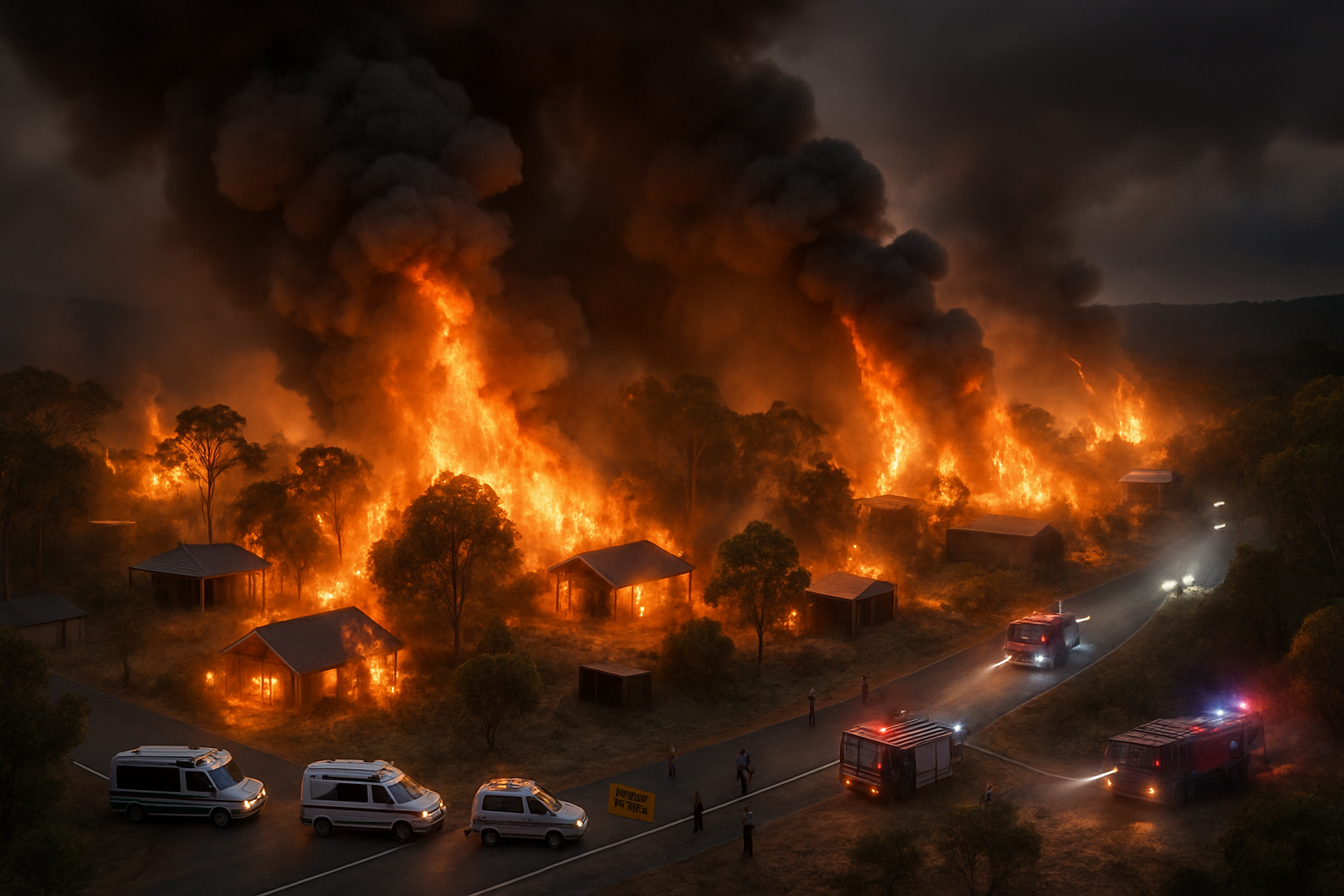
A devastating bushfire emergency has swept through Perth's eastern hills, blocking evacuation routes and destroying buildings as multiple blazes threaten communities across Mundaring, Beechina, Chidlow, and Wooroloo in what authorities are calling a dangerous escalation of Australia's ongoing fire crisis.
The Perth Hills blaze erupted around 2:00 PM local time on March 11, 2026, rapidly escalating to emergency warning levels as dangerous winds and extreme fire conditions created a perfect storm for destruction. Vision from the scene shows an abandoned house and large shed completely engulfed in flames, with the fire spreading rapidly across approximately 70 hectares of bushland.
Critical Infrastructure Under Threat
The Great Eastern Highway, a vital transport corridor connecting Perth to regional Western Australia, has been forced to close as the fire jumped across major roadways. Emergency services report that evacuation routes have been compromised, leaving some residents trapped in their communities as emergency crews work desperately to establish safe corridors.
"Buildings have been destroyed in the Perth Hills as a raging bushfire blocks evacuation routes," confirmed emergency authorities, highlighting the unprecedented nature of this crisis where traditional escape paths have become impassable.
"The fire broke out about 2pm and quickly jumped to an emergency level, impacting areas including Beechina, Chidlow and Wooroloo."
— Emergency Services Spokesperson
Climate Crisis Context
This emergency occurs during Australia's 20th consecutive month of global temperatures exceeding 1.5°C above pre-industrial levels, creating what climate experts are calling "compound extreme events" where multiple environmental stressors overwhelm traditional emergency response capabilities.
The Australian Fire and Emergency Services Council (AFAC) has previously warned of "increased significant bushfires" despite recent record precipitation, as bone-dry vegetation from two years of accumulation has created tinderbox conditions. This represents a significant departure from traditional seasonal fire behavior, requiring communities to prepare for previously unimaginable scenarios.
Emergency Response Challenges
Emergency services are facing unprecedented challenges as the shift from sequential to concurrent disasters strains traditional mutual aid mechanisms. The Perth Hills crisis comes as other parts of Australia simultaneously battle flooding in Queensland and the Northern Territory, demonstrating how climate change is creating multiple emergency fronts that stretch response capabilities beyond historical parameters.
The geographic isolation of some affected areas has complicated evacuation efforts, with emergency crews forced to establish alternative routes through rugged terrain. Some residents have reported being unable to leave their properties due to blocked roads and dangerous fire conditions surrounding their communities.
Community Resilience and Coordination
Local community groups, including the "Bargara Facebookers" network that has proven vital in other recent Australian emergencies, are providing crucial coordination for rescue communications and community support. Social media platforms have become essential tools for real-time emergency information sharing when traditional communication systems are overwhelmed.
Mental health services across Western Australia report increased demand as communities face repeated extreme weather psychological trauma. Families are potentially losing generational properties for the second time in a decade, placing enormous strain on community support systems and emergency services.
Infrastructure Vulnerabilities Exposed
The Perth Hills emergency has exposed critical vulnerabilities in Australia's emergency infrastructure, designed for historical weather patterns rather than current climate conditions. Power grids, communication networks, and transportation systems are operating beyond their intended design parameters as extreme weather frequency and intensity increases.
Traditional flood defenses and fire management strategies are proving inadequate for the scale and unpredictability of current weather systems. Driest regions are simultaneously recording their wettest conditions in decades, creating complex management scenarios that challenge conventional emergency planning.
Economic and Social Impact
The broader Wide Bay-Burnett agricultural region faces significant crop losses during critical growing seasons, with the sugar industry and tourism sectors experiencing substantial disruption. Recovery timelines are expected to extend months to years beyond the immediate emergency period, as infrastructure damage requires comprehensive reconstruction.
Smaller businesses lack the resources for rapid recovery, with many questioning their ability to withstand repeated disasters. The economic impact extends beyond immediate fire damage to include disrupted supply chains, transportation networks, and regional commerce patterns.
Climate Adaptation Imperative
Emergency management experts emphasize that this crisis represents a critical juncture between reactive crisis management and proactive ecosystem service management. The Perth Hills emergency underscores the urgent need for "building back better" climate-resilient infrastructure rather than traditional reconstruction approaches.
Enhanced early warning systems, community preparedness programs, and emergency response capabilities are essential for adapting to what scientists warn could become routine 2030s conditions without significant climate adaptation investment.
"This emergency emphasizes the urgent need for transformative vs reactive approaches for permanent climate volatility era."
— Climate Adaptation Specialist
International Context
The Perth bushfire crisis occurs within a broader pattern of global environmental challenges that have tested international emergency response systems throughout 2026. From European storm systems claiming dozens of lives to unprecedented Middle Eastern crises straining evacuation capabilities, the Perth emergency represents part of an interconnected global climate volatility pattern.
Australia's experience provides crucial lessons for other nations preparing for similar compound extreme weather events as traditional emergency response frameworks prove inadequate for simultaneous disasters across multiple regions.
Recovery and Resilience
As emergency crews continue battling the Perth Hills blazes, authorities stress that recovery will require unprecedented coordination between government agencies, infrastructure providers, and communities. Success demands sustained political commitment and adequate funding allocation for transformative adaptation rather than simple restoration.
The crisis tests Australia's emergency management evolution toward addressing permanent climate volatility, with the outcome providing templates for other nations facing similar challenges. Early warning systems and community preparedness remain essential components of effective climate adaptation strategies.
The Perth Hills emergency serves as a stark reminder of the accelerating pace of climate change impacts, requiring immediate transformative responses across all sectors of society. With emergency services at operational limits and infrastructure vulnerabilities exposed, the choice between proactive climate resilience building and reactive crisis management becomes increasingly critical for community survival in an era of unprecedented environmental volatility.