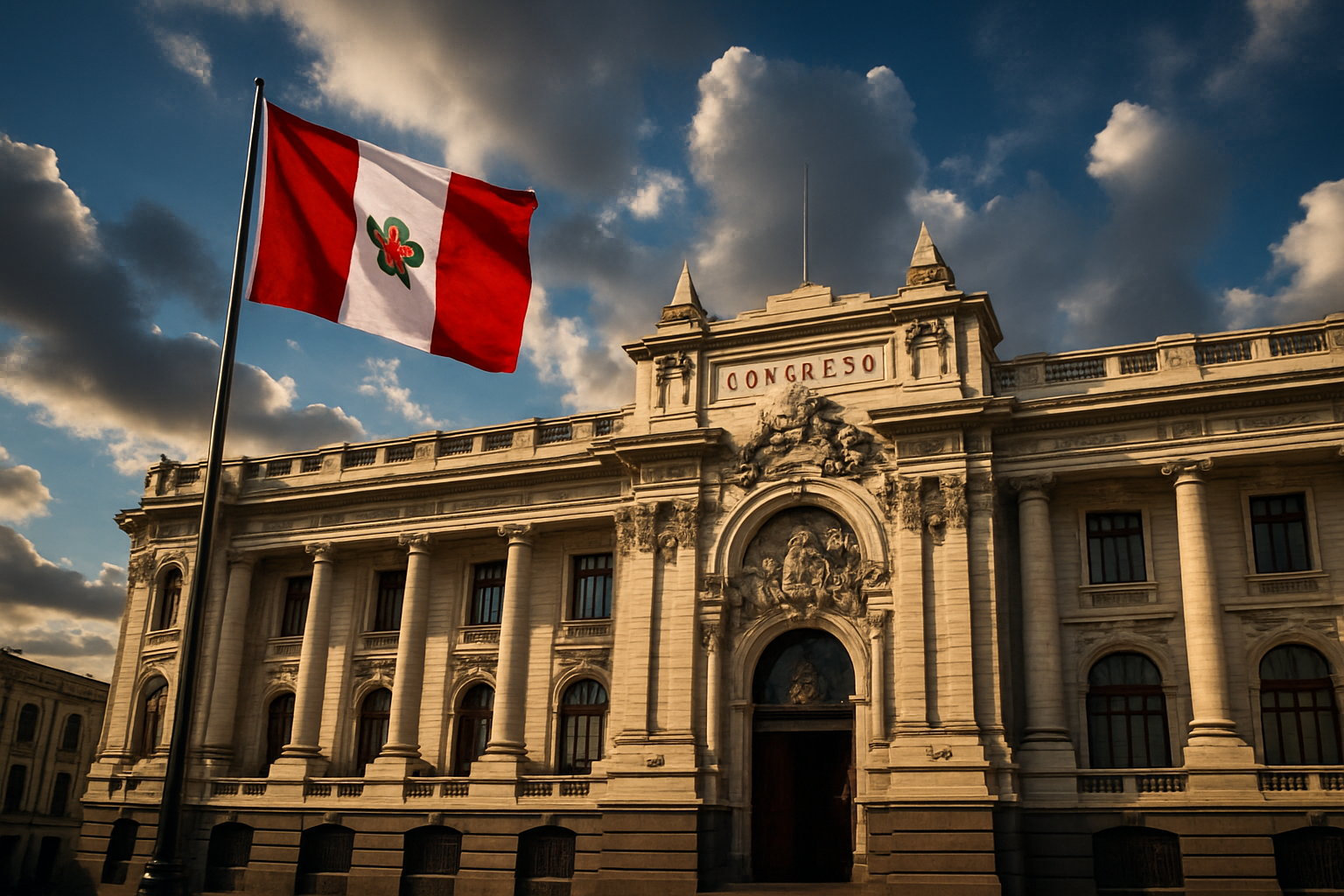
José María Balcázar, an 83-year-old lawyer and former judge from the left-wing Perú Libre party, was elected as Peru's new interim president on Wednesday, marking the country's eighth presidential change in just ten years and underscoring the South American nation's chronic political instability.
The veteran legislator secured 60 votes against 46 for his rival María del Carmen Alva from Acción Popular in the decisive congressional runoff, following a grueling four-hour session that captivated the nation. The vote brings to an end an unprecedented 24-hour power vacuum that had left the country without a head of state after former President José Jerí was removed from office earlier this week over corruption allegations.
A Pattern of Chronic Instability
Balcázar's ascension to the presidency represents a continuation of Peru's troubling pattern of political dysfunction that has plagued the nation since 2016. The country has experienced systematic governance failure with the average presidential mandate duration decreasing by 70% since the Pedro Pablo Kuczynski period.
The cycle of instability includes the removal of President Martín Vizcarra in 2020, Pedro Castillo's failed coup attempt in 2022, and Dina Boluarte's removal in 2025. The constitutional "vacancy" procedure has been repeatedly weaponized by Congress against weak executives, creating a pattern where the legislative branch dominates over an increasingly fragile executive.
"No es tiempo para pelear, no hay derechas ni izquierdas" (This is not a time to fight, there are no left or right wings)
— José María Balcázar, in his first address as President
The new president's conciliatory message contrasts sharply with the polarized political environment that has characterized recent Peruvian politics. However, critics question whether such rhetoric can bridge the deep institutional divisions that have made the country increasingly ungovernable.
The Chifagate Scandal and Jerí's Downfall
Balcázar's predecessor, José Jerí, served only 130 days in office—among the shortest presidential terms in Peru's democratic history. His downfall came through the "Chifagate" scandal, involving secret nighttime meetings with Chinese contractor Zhihua Yang at a Chinese restaurant, conducted outside the official government agenda.
Security footage showed the president arriving hooded at the restaurant for undisclosed meetings, raising serious questions about Chinese influence channels in Peru. The scandal was particularly concerning given China's control over critical infrastructure projects, including the Chancay Port, through the Belt and Road Initiative.
The Congressional vote to remove Jerí was overwhelming, with 75 lawmakers supporting impeachment against just 24 opposing, demonstrating the complete breakdown of legislative support for the executive branch.
Balcázar's Controversial Background
The new president's election has drawn criticism from various sectors. Constitutional expert Gabriel Ortiz de Zevallos warned about economic instability, stating that Balcázar "has serious accusations against him and belongs to a political group that is not democratic."
Political analyst Víctor Andrés García Belaunde described the congressional decision as "a very serious error," reflecting broader concerns about the quality of leadership emerging from Peru's fragmented political system.
Despite these criticisms, Balcázar struck a unifying tone in his inaugural address, emphasizing the need for democratic transition and electoral transparency. He specifically ruled out any pardons for imprisoned former president Pedro Castillo, who remains in U.S. custody on drug trafficking charges.
International Concerns and Economic Impact
The Confederation of Private Business Institutions (CONFIEP) has repeatedly warned that Peru "cannot afford a new stage of uncertainty" just weeks before the April presidential and congressional elections. The business community fears that continued political instability will undermine economic confidence and international investment.
Remarkably, despite the political turbulence, Lima's stock exchange and the sol currency have maintained relative stability, demonstrating the market's adaptation to Peru's chronic volatility. However, this resilience masks deeper structural problems that continue to undermine democratic governance.
International observers have characterized Peru's situation as an "endless crisis" that affects broader Latin American democratic stability. The regional implications are significant, as Peru's experience provides a cautionary tale about the fragility of democratic institutions in the face of persistent political polarization and institutional breakdown.
The Challenge of Democratic Consolidation
Balcázar faces the daunting challenge of governing for approximately five months until the April elections while managing electoral integrity, institutional continuity, and public confidence restoration. His limited timeline restricts substantive policy implementation while requiring focus on ensuring free and fair democratic processes.
The repeated activation of constitutional succession mechanisms has become routine rather than exceptional, suggesting that Peru's democratic framework is being stretched beyond its intended limits. The country's institutions have maintained constitutional continuity but at the cost of effectiveness and public trust.
"Va a haber una transición democrática y electoral pacífica y transparente" (There will be a peaceful and transparent democratic and electoral transition)
— José María Balcázar, pledging institutional stability
Regional and Global Context
Peru's crisis unfolds against a broader backdrop of democratic challenges across Latin America. The systematic governance failure represents more than individual leadership problems—it reflects deeper structural issues including the intersection of executive-legislative conflicts, party system fragmentation, and the inability to form durable governing coalitions.
The international community faces difficult questions about how to support democratic consolidation in countries experiencing such chronic instability. While Peru maintains democratic forms, the substance of effective governance has been severely compromised by the endless cycle of political transitions.
Looking Ahead: Critical Tests
The success of Balcázar's brief presidency will be measured not by policy achievements but by his ability to oversee credible elections and facilitate a smooth transition to Peru's next government. The April elections represent a critical opportunity for the country to break its cycle of political instability and establish more sustainable governance arrangements.
However, the underlying structural problems that have produced eight presidential changes in a decade remain unaddressed. These include the weaponization of constitutional procedures for political objectives, the weakness of party systems, and the absence of basic political consensus about democratic governance rules.
For Peru's 33 million citizens, the chronic political instability has real consequences in terms of policy implementation, economic development, and institutional credibility. The challenge facing Balcázar and future leaders is whether Peru can transition from crisis management to genuine democratic consolidation and effective governance.
As Peru prepares for yet another presidential transition, the fundamental question remains: can the country's democratic institutions adapt to provide the stability and effectiveness that its people deserve, or will the cycle of political crisis continue indefinitely? The coming months will prove crucial in determining whether Peru can finally break free from its pattern of institutional dysfunction and achieve sustainable democratic governance.