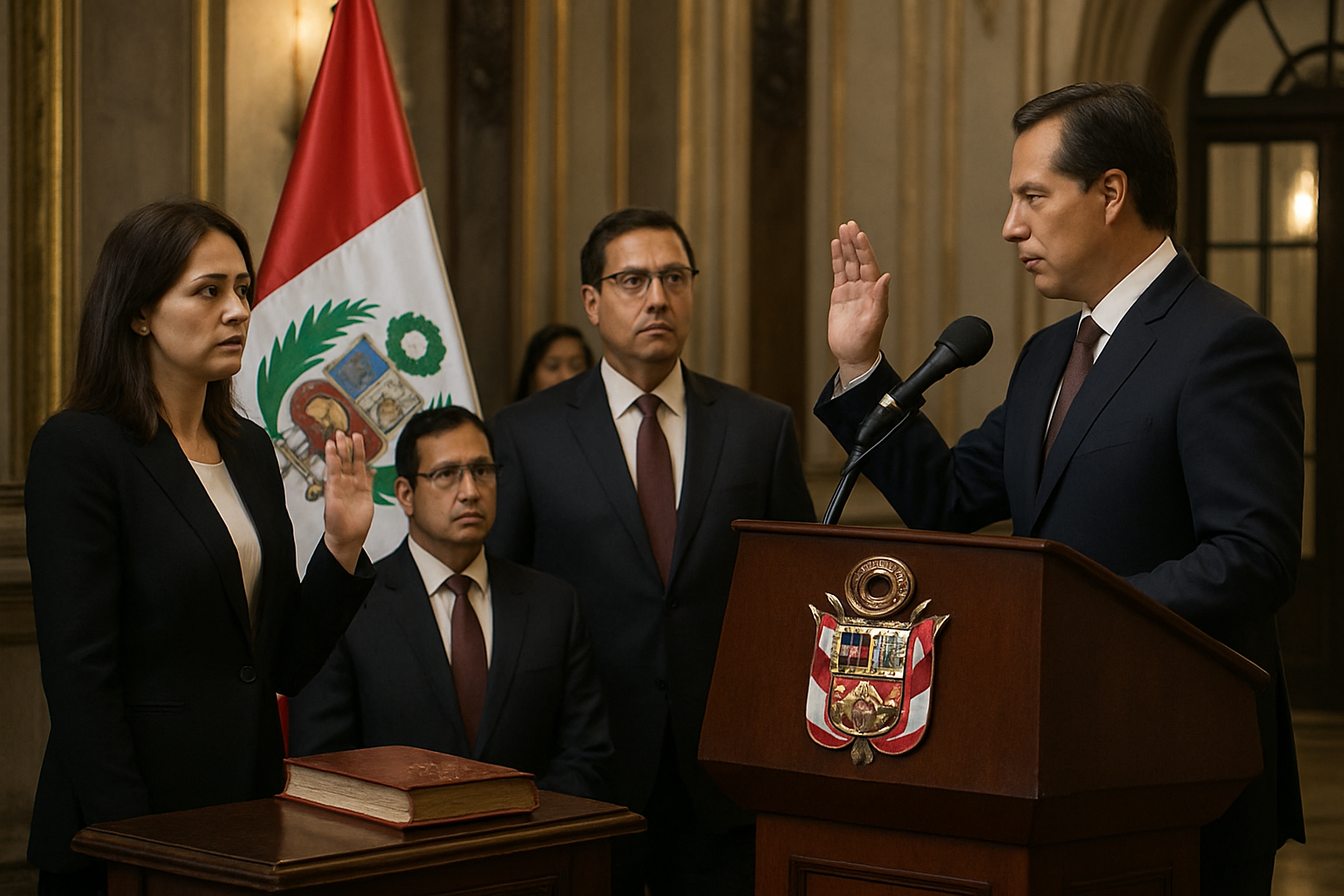
President José María Balcázar swore in a new cabinet Tuesday evening at Palacio de Gobierno, appointing economist Denisse Miralles as Peru's new Prime Minister in a major government restructuring aimed at stabilizing the country ahead of April elections.
The ceremony, which took place at 6:18 PM local time, saw Miralles take the oath of office as president of the Council of Ministers, marking her return to high-level government service after previously serving as Economy and Finance Minister under the censured government of José Jerí.
The appointment represents a significant shift in Peru's turbulent political landscape, as Balcázar seeks to restore confidence in government institutions following a period of unprecedented instability that has seen the country change presidents eight times in the past decade.
Political Context of the Appointment
Miralles's appointment comes at a critical juncture for Peru's democratic institutions. The 83-year-old Balcázar, who assumed the presidency in February following the Congressional removal of José Jerí over the "Chifagate" scandal, has been governing with a mandate focused on ensuring free and fair elections in April.
According to sources from the President's office, the new cabinet was designed to bring stability and technical expertise to key government portfolios, with particular emphasis on economic management and the ongoing restructuring of state-owned enterprises like Petroperú.
The selection of Miralles, an experienced economist who previously held the Economy portfolio, signals Balcázar's intention to maintain continuity in economic policy while addressing the governance challenges that have plagued recent administrations.
Hernando de Soto's Expected Role
Initial reports had suggested that renowned economist Hernando de Soto would lead the new cabinet, with extensive media coverage preceding the ceremony about his potential appointment. De Soto, internationally recognized for his work on property rights and informal economics, was widely expected to take the Prime Minister role.
However, the evening's developments confirmed Miralles as the chosen candidate, though the exact reasons for this change remained unclear at press time. Government sources suggested that multiple scenarios had been considered before the final cabinet composition was announced.
"The new government team represents a combination of technical expertise and political experience necessary to guide Peru through this transitional period,"
— Government Source
Peru's Pattern of Political Instability
The cabinet reshuffle occurs against the backdrop of Peru's chronic political instability, which has seen the country struggle to maintain governmental continuity since 2016. The pattern has included the removal of Martín Vizcarra in 2020, Pedro Castillo's coup attempt in 2022, Dina Boluarte's departure in 2025, and most recently José Jerí's censure after just 130 days in office.
This systematic governance failure has repeatedly disrupted policy implementation and eroded public confidence in democratic institutions. The constitutional "vacancy" procedure has been weaponized by Congress against successive executives, creating a cycle of instability that has hampered Peru's development and international standing.
Business confederation CONFIEP has warned that the country "cannot afford a new uncertainty stage" so close to the April elections, emphasizing the need for stable governance during the transitional period.
Economic Challenges and Petroperú Restructuring
Miralles takes office facing significant economic challenges, including the ongoing restructuring of Petroperú, Peru's troubled state oil company. Her previous experience as Economy Minister positions her to lead efforts at financial stabilization and the implementation of fiscal accords aimed at sustainable growth.
The new Prime Minister will need to balance immediate economic pressures with longer-term structural reforms, while ensuring that government functions continue smoothly during the pre-electoral period.
International observers and markets have generally maintained stability despite Peru's political volatility, though the repeated changes in government have created uncertainty about policy continuity and implementation capacity.
Ensuring Electoral Integrity
Perhaps the most critical challenge facing the new cabinet will be overseeing the April elections to ensure they are free, fair, and transparent. With Balcázar's mandate limited to approximately five months, the primary focus must be on electoral integrity rather than ambitious policy implementation.
The success of the April elections will be crucial in determining whether Peru can finally break its cycle of political crisis and establish the stability necessary for effective governance and economic development.
The new government inherits a complex situation requiring careful management of institutional continuity, public confidence restoration, and democratic process oversight, all while managing the ongoing pressures that have destabilized previous administrations.
International and Regional Implications
Peru's political stability has broader implications for regional cooperation and international partnerships. The country's chronic instability has been characterized by international media as an "endless crisis" affecting Latin American democratic stability more broadly.
Regional observers are monitoring the transition as a test of democratic resilience, while international partners await signs that Peru can establish the governmental stability necessary for effective cooperation on trade, security, and development initiatives.
The appointment of an experienced economist like Miralles may signal to international observers that Peru is prioritizing technical competence and continuity over political maneuvering, though the proof will be in the government's performance over the coming months.
As Peru prepares for what many hope will be a decisive election in April, the new cabinet under Miralles's leadership faces the formidable task of restoring confidence in democratic institutions while managing the day-to-day challenges of governing a country that has experienced profound political turbulence for nearly a decade.