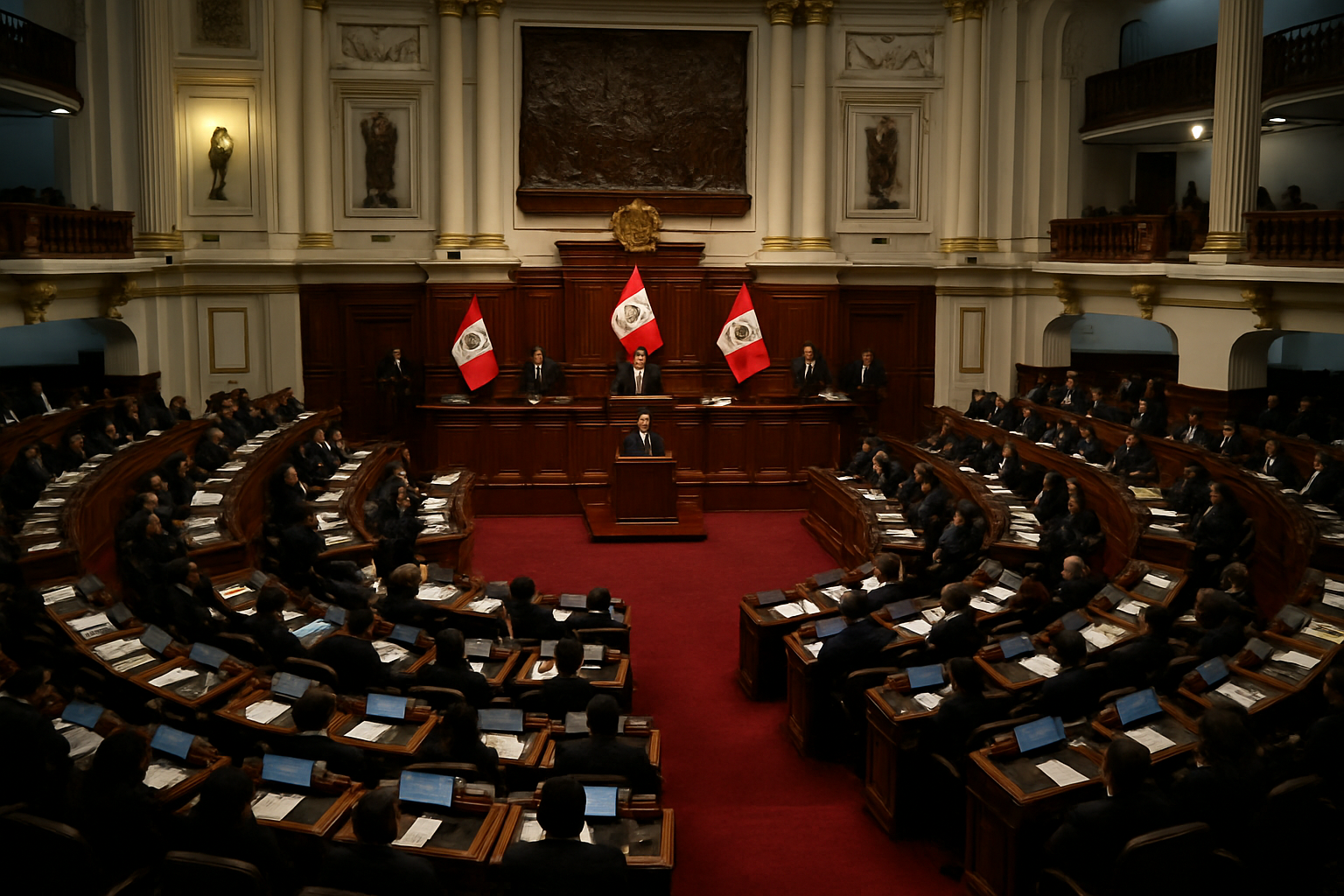
Peru's Congress has entered a critical second-round vote to select the nation's next interim president, with experienced legislators María del Carmen Alva and José María Balcazar emerging as the final candidates after Tuesday's censure of José Jerí Oré ended his brief 130-day presidency.
The congressional session, presided over by Acting Speaker Fernando Rospigliosi, represents yet another chapter in Peru's ongoing political crisis, as lawmakers prepare to choose the country's ninth interim president in just over a decade. The vote follows the overwhelming 75-24 margin that removed Jerí from office amid the "Chifagate" scandal involving undisclosed meetings with Chinese contractor Zhihua Yang.
The Final Candidates
María del Carmen Alva Prieto, a 58-year-old lawyer and former Congress President (2021-2022), brings significant legislative experience to the contest. Representing the Acción Popular party, Alva previously served as the first woman to hold the congressional presidency and has maintained a prominent role in Peruvian politics throughout the current period of instability.
Her opponent, José María Balcazar, represents the left-wing faction and has positioned himself as an alternative to the traditional political establishment. The competition between these candidates reflects the broader ideological divisions within Peru's fragmented political landscape.
According to sources from El Comercio and other Peruvian media outlets, the voting process requires a simple majority for victory, with provisions for additional rounds if no candidate achieves the necessary threshold in the initial ballot.
Political Maneuvering and Party Dynamics
The selection process has exposed significant tensions within Peru's political parties. Fuerza Popular, led by Keiko Fujimori, has reportedly decided to support Alva, despite earlier indications that the party might abstain from the vote. This backing could prove crucial in securing Alva's victory, given the fragmented nature of congressional support.
"The legislators are voting for the interim leader who will govern until July. Four candidates are competing, and a second vote is not ruled out if none achieves a simple majority."
— Perfil, Argentine news outlet
The inter-party negotiations have intensified in recent hours, with social media disputes emerging between Renovación Popular and Fuerza Popular regarding candidate qualifications and political strategies. These tensions reflect the deeper institutional challenges facing Peru's democratic system.
Historical Context of Political Instability
José Jerí's removal marks the continuation of a devastating pattern of political instability that has plagued Peru since 2016. His 130-day presidency ranks among the shortest in Peruvian democratic history, exceeded in brevity only by Manuel Merino's five-day tenure in 2020.
The data reveals a stark reality: since the crisis began during Pedro Pablo Kuczynski's administration, the average duration of presidential mandates has decreased by nearly 70%. This systematic governance failure has affected multiple administrations, including the removals of Martín Vizcarra in 2020, Pedro Castillo's coup attempt in 2022, and Dina Boluarte's departure in 2025.
The constitutional "vacancy" procedure, originally designed as a democratic safeguard, has been repeatedly weaponized by Congress against executives, creating a cycle of instability that has undermined effective governance and international credibility.
Economic and International Implications
Despite the political turbulence, Peru's financial markets have shown remarkable resilience, with the Lima stock exchange and the sol currency maintaining relative stability. This market adaptation to political volatility demonstrates institutional strength in the economic sphere, even as political institutions struggle.
The Confederation of Private Business Institutions (CONFIEP) has warned that the country "cannot afford a new stage of uncertainty" just weeks before the scheduled April presidential and congressional elections. This business community concern reflects broader anxieties about Peru's ability to maintain economic confidence amid continued political transitions.
International observers continue to monitor Peru's democratic resilience as a template for addressing similar challenges across Latin America. The successful management of constitutional transitions during public scrutiny serves as a critical test of democratic institutions' capacity to function under extraordinary pressure.
The Path Forward
The incoming interim president will inherit significant challenges, including the management of the upcoming April elections, ensuring electoral integrity, and maintaining institutional continuity. With approximately five months until the general elections, the limited timeline restricts substantive policy implementation while requiring focus on democratic process management.
The vote represents more than a simple leadership change—it tests Peru's democratic capacity for managing political transitions during intense public scrutiny. The successful candidate must navigate not only the immediate challenges of governance but also the broader task of restoring public confidence in democratic institutions.
"This is a decisive day for Congress after José Jerí's departure. José María Balcazar and Maricarmen Alva compete to lead Parliament in a second crucial vote for governability."
— El Diario, Ecuador
Constitutional and Democratic Implications
The congressional vote occurs within Peru's constitutional framework, where the legislative president automatically assumes the national presidency during transitions. This succession mechanism, while maintaining constitutional continuity, has been activated repeatedly during the current period of instability.
The process demonstrates both the resilience and limitations of Peru's democratic institutions. While the constitutional framework has prevented complete institutional collapse, the repeated use of these emergency mechanisms suggests deeper structural problems requiring comprehensive reform.
As Peru's Congress prepares to select its ninth interim president in a decade, the stakes extend far beyond individual leadership. The vote represents a critical test of whether the country can break its cycle of political crisis and establish the stability necessary for effective democratic governance serving its 33 million citizens.
The outcome will significantly influence Peru's trajectory toward the April elections and determine whether the country can finally achieve the political stability that has eluded it for nearly a decade. For a nation that has experienced systematic governance failure, this congressional vote may prove pivotal in charting a path toward democratic consolidation and institutional strengthening.