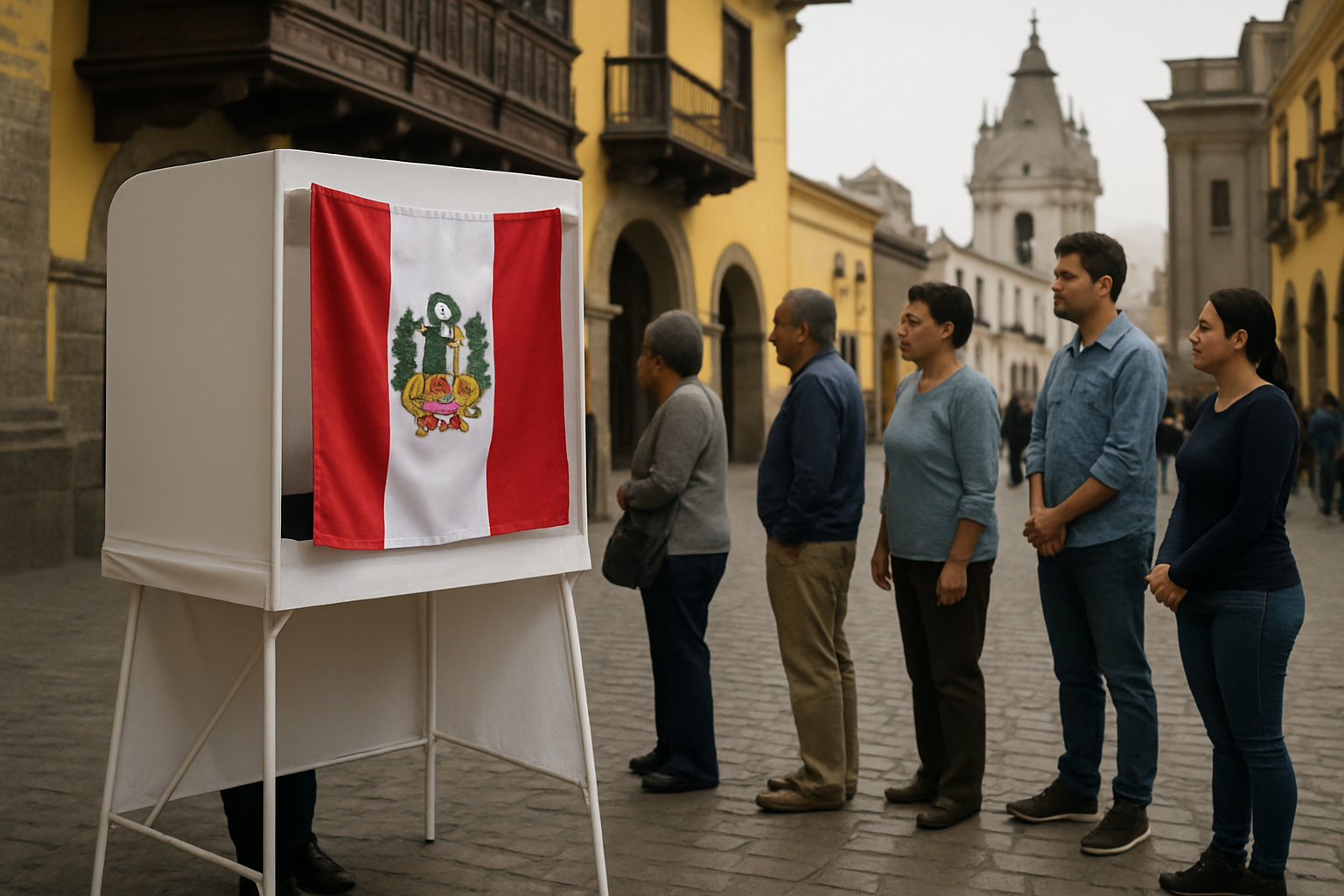
Peru approaches Sunday's presidential elections on April 12th in the midst of its most severe political crisis in decades, as the Andean nation prepares to select its eighth leader in ten years amid chronic institutional instability and deep democratic fragmentation.
The election comes just two months after Congress removed President José Jerí from office through an impeachment vote, continuing a pattern of political volatility that has paralyzed governance in Latin America's third-largest economy. With over 30 candidates competing for the presidency, the fragmented political landscape points to an inevitable runoff that could further delay institutional stability.
A Nation in Perpetual Crisis
Peru's political crisis has reached unprecedented depths since 2016, with the country experiencing eight presidential changes in a decade. The constitutional "vacancy" procedure has been repeatedly weaponized by Congress against sitting presidents, creating a cycle of institutional breakdown that has reduced average presidential tenure by 70%.
The most recent upheaval occurred in February when President José Jerí was removed after just 130 days in office—among the shortest terms in Peruvian democratic history. His removal followed the "Chifagate" scandal, involving secret nighttime meetings with Chinese contractor Zhihua Yang, whose companies hold state contracts worth millions of dollars.
"We cannot afford a new stage of uncertainty," warned CONFIEP, Peru's leading business confederation, highlighting the economic toll of constant political turmoil.
— CONFIEP Statement, February 2026
The pattern of instability includes the removal of Martín Vizcarra in 2020, Pedro Castillo's failed coup attempt in 2022, and Dina Boluarte's exit in 2025. Each transition has further eroded public trust in democratic institutions while international observers express growing concern about Peru's governance capacity.
Multiple Candidates, Fragmented Politics
The April 12th election features a crowded field of candidates representing Peru's deeply fractured political spectrum. According to recent polling data, no single candidate appears capable of securing the 50% threshold needed to avoid a runoff, setting the stage for weeks of additional political uncertainty.
The campaign has been marked by debates over Peru's relationship with China, particularly regarding the Belt and Road Initiative and Chinese infrastructure investments that some critics argue compromise national sovereignty. The Jerí scandal involving undisclosed meetings with Chinese contractors has intensified these concerns.
Economic issues dominate voter concerns, with Peru facing the dual challenge of maintaining fiscal stability while addressing widespread poverty and inequality. The constant political transitions have hindered long-term policy implementation, contributing to economic uncertainty that affects Peru's 33 million citizens.
International Stakes and Regional Implications
Peru's political instability has attracted significant regional attention, with neighboring countries and international partners closely monitoring the election outcome. The country's strategic position in South America and its role in regional cooperation mechanisms make governmental stability crucial for continental politics.
The Lima stock exchange and national currency have shown remarkable resilience despite political volatility, suggesting that markets have adapted to chronic instability. However, business leaders warn that continued uncertainty threatens long-term investment and economic growth prospects.
"Peru heads into elections marked by political fragmentation, uncertainty, and a fatigued democracy that points to a decisive runoff."
— Regional Analysis, Havana Times
Electoral Mechanics and Expectations
The election will determine not only the presidency but also senators, deputies, and representatives to the Andean Parliament. An electoral threshold system has been implemented for party registration and seat distribution, aimed at reducing political fragmentation that has contributed to governance paralysis.
International observers are monitoring the electoral process closely, viewing it as a critical test of Peru's democratic resilience. The ability to conduct free and fair elections amid institutional crisis will be closely scrutinized as a measure of the country's democratic health.
Given the crowded candidate field and voter dissatisfaction with traditional political options, election analysts predict high volatility in vote distribution. This uncertainty makes predicting runoff participants extremely difficult, adding another layer of complexity to Peru's political future.
Breaking the Crisis Cycle
The fundamental question facing Peru extends beyond candidate selection to whether the country can break its cycle of political crisis and achieve sustainable governance. Constitutional procedures designed to ensure democratic accountability have instead become tools for political warfare, undermining institutional effectiveness.
Structural reforms addressing the weaponization of impeachment procedures, party system fragmentation, and the absence of political consensus about governance rules remain urgently needed. However, implementing such reforms requires precisely the kind of political stability that has eluded Peru for years.
Success in establishing governmental continuity will depend not only on electoral outcomes but on the ability of political actors to prioritize institutional stability over short-term partisan advantages. The stakes extend far beyond Peru's borders, as the country's experience offers lessons about democratic fragility in an era of global institutional challenges.
Economic and Social Consequences
The human cost of Peru's political instability extends beyond institutional dysfunction to real impacts on citizens' daily lives. Policy implementation has been severely hampered by constant leadership changes, affecting everything from healthcare delivery to infrastructure development.
Peru's position as a major regional economy means that political instability has ripple effects throughout Latin America. International cooperation on issues ranging from drug trafficking to climate change has been complicated by the country's inability to maintain consistent governmental leadership.
The upcoming election represents more than a routine democratic exercise—it is a critical test of whether Peru can transition from crisis management to democratic consolidation. The success or failure of this electoral process will determine whether the country continues its downward spiral of institutional dysfunction or begins the difficult work of rebuilding democratic effectiveness.
As voters prepare to cast their ballots on Sunday, the choice extends beyond individual candidates to fundamental questions about Peru's democratic future and its capacity for stable, effective governance in the 21st century.