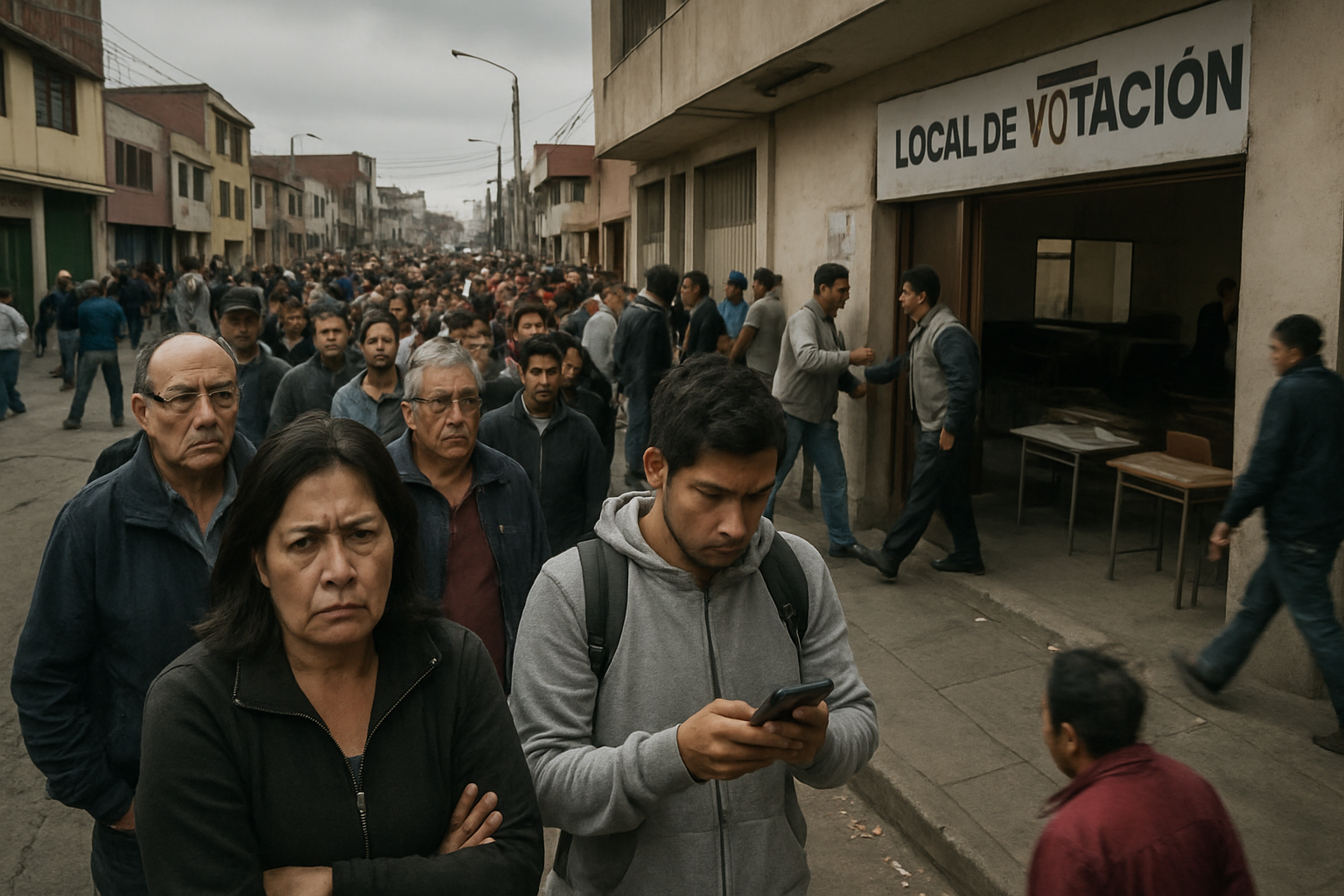
Peru's presidential election on April 12, 2026, descended into unprecedented chaos as massive organizational failures prevented thousands of voters from casting their ballots, forcing electoral authorities to extend voting hours and delaying final results until at least Monday.
The National Office of Electoral Processes (ONPE) faced widespread criticism as systematic delays plagued polling stations across the country, particularly in Lima, where voters endured hours-long waits due to missing electoral materials and delayed setup procedures. The crisis prompted business leaders and political parties to demand immediate explanations and accountability from electoral authorities.
Systematic Electoral Failures Expose Deep Institutional Problems
According to multiple business confederations, the electoral chaos reflected fundamental organizational failures that went beyond simple logistical problems. The Confederation of Private Business Institutions (CONFIEP) expressed grave concern over "serious incidents" in the installation of voting tables, which "directly impacted citizens who came to exercise their right to vote."
The problems were particularly severe in Lima districts including Rímac, San Borja, and Villa El Salvador, where voters faced missing ballot boxes, voting records, and other essential electoral materials. ComexPeru, the country's exporters' association, attributed the failures to "logistical shortcomings" that compromised the normal development of the electoral process.
"The electoral process must guarantee that voting is exercised without obstacles or uncertainty throughout the country"
— ComexPeru Statement
The Lima Chamber of Commerce (CCL) went further, characterizing the problems as evidence of "structural failures in the organization of the electoral process" rather than isolated incidents. The chamber demanded clear accountability and described the need to extend voting hours as "proof of the failure of a preparation that should have been irreproachable."
Early Results Show Fragmented Political Landscape
Despite the organizational chaos, early unofficial results from the Japan Times and other international sources indicated former congresswoman Keiko Fujimori narrowly leading the fractured field with approximately 16.5% of the vote. Right-wing former Lima mayor Rafael López Aliaga followed closely with around 12.8%, while other candidates including Jorge Nieto and Ricardo Belmont captured smaller but significant vote shares.
The fragmented results virtually guarantee a runoff election, extending Peru's political uncertainty well into June. With 35 candidates competing for the presidency, no single candidate approached the 50% threshold needed for an outright victory, reflecting the deep divisions within Peruvian society after years of political instability.
Fujimori's performance marks her fourth presidential attempt, having previously reached runoffs in 2011, 2016, and 2021 without achieving victory. Her security-focused platform resonated with voters concerned about rising violence, extortions, and homicides that have reshaped daily life, particularly in Lima.
International Observers Express Concerns
International election observers praised the National Elections Jury (JNE) for its "timely" decision to extend voting hours but raised serious questions about ONPE's competence. The Organization of American States mission noted the unprecedented nature of the extension while emphasizing the importance of protecting fundamental voting rights.
The electoral extension affected an estimated 52,000+ voters across 187 polling stations that failed to open on time, primarily in Lima's southern districts of San Juan de Miraflores, Lurín, and Pachacámac. This represents a serious failure in democratic governance affecting tens of thousands of citizens' constitutional rights.
Historical Context: Nine Presidents in a Decade
The electoral chaos unfolds against Peru's unprecedented political instability, with the country seeking its ninth president in less than a decade. The pattern includes the removal of José Jerí in February 2026 over the "Chifagate" scandal involving secret meetings with Chinese contractors, continuing a cycle that has included Pedro Pablo Kuczynski, Martín Vizcarra, Pedro Castillo, and Dina Boluarte.
This constitutional "vacancy" procedure has been repeatedly weaponized by Congress against executives, reducing average presidential tenure by 70% since 2016. The chronic instability has severely damaged institutional trust and created what business leaders describe as a "governance failure" affecting Peru's 33 million citizens.
The stakes of this election extend beyond Peru's borders, with regional observers characterizing the situation as an "endless crisis" affecting Latin American democratic stability. China's Belt Road Initiative involvement through infrastructure projects like the Chancay Port has raised sovereignty questions that became electoral issues following the Chifagate scandal.
Business Community Demands Accountability
Peru's business community united in demanding immediate explanations for the electoral failures. CONFIEP warned that the country "cannot afford a new stage of uncertainty," while the Association of Exporters (ADEX) called the organizational problems evidence of "weaknesses in the planning and logistical execution of the process."
The private sector's concerns reflect broader economic implications of continued political instability. While the Lima stock exchange and Peruvian sol have maintained relative stability despite repeated political upheavals, showing market adaptation to chronic volatility, business leaders emphasize the urgent need for effective governance.
"Extending the voting schedule is not management: it is proof of the failure of a preparation that should have been irreproachable"
— Lima Chamber of Commerce Statement
Security and Violence Shape Campaign Discourse
The electoral campaign was dominated by security concerns as organized crime, drug trafficking, and daily violence reshaped public discourse. Candidates across the political spectrum emphasized law enforcement and public safety as primary issues, reflecting the deterioration of security conditions that affect millions of Peruvians daily.
Keiko Fujimori's campaign particularly focused on these concerns, promising migrant expulsion and enhanced border security from her Amazon stronghold. Her approach represents continuity with her political dynasty despite her father Alberto Fujimori's imprisonment, capitalizing on public frustration with crime and violence.
The security focus reflects broader concerns about Peru's institutional capacity to address fundamental challenges facing the nation, including economic development, social inequality, and governance effectiveness that have contributed to the political crisis cycle.
Regional and International Implications
The outcome of Peru's election carries significant implications for Latin American democratic stability and regional integration. Success in breaking the political crisis cycle could provide a positive model for other nations facing institutional challenges, while failure risks cementing a permanent instability pattern with regional consequences.
International partners, including the United States and European Union, are closely monitoring developments as indicators of democratic resilience in the hemisphere. The election's conduct and aftermath will influence regional cooperation patterns and international relations frameworks.
The Chinese influence concerns raised by Chifagate have affected candidate positions on foreign policy, with implications for Peru's relationships with major powers and its role in regional integration initiatives. The election outcome will determine how Peru navigates these complex international relationships while addressing domestic governance challenges.
Path Forward: Coalition Building and Governance Challenges
With no candidate expected to achieve an outright majority, the fragmented results will require extensive coalition building and negotiations. The eventual winner will inherit multiple crises requiring competent leadership and systematic institutional changes to make Peru governable.
The new president will face the immediate challenge of restoring confidence in electoral institutions while addressing the deeper structural problems that have created chronic political instability. This includes constitutional reforms, party system development, and consensus building about basic governance rules.
Success will be measured not just by completing a presidential term, but by establishing stability necessary for effective democracy and economic development. The stakes are maximum for Peru's 33 million citizens, who face consequences through policy failures, economic uncertainty, and institutional credibility crises.
The coming weeks will test whether Peru can transition from crisis management to democratic consolidation, providing a template for other Latin American nations facing similar institutional challenges. The international community continues monitoring as Peru's experience influences broader discussions about democratic resilience and governance effectiveness in the 21st century.