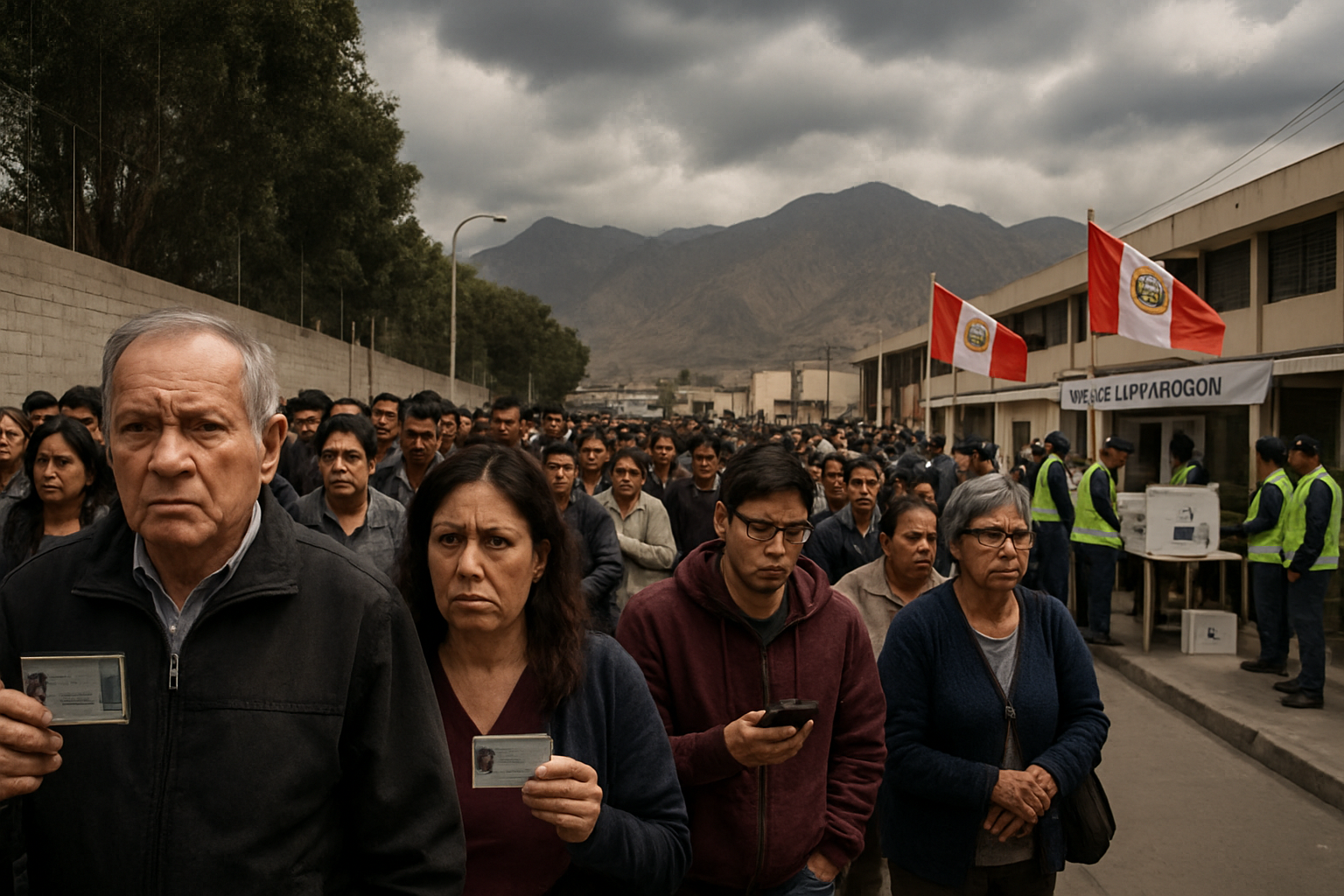
Peru conducted its most crucial presidential election in decades on Sunday April 12, 2026, as voters chose from 35 candidates to select what will be the country's ninth president in less than ten years, amid widespread organizational failures that forced electoral authorities to extend voting hours until 6:00 PM.
The National Office of Electoral Processes (ONPE) announced the unprecedented extension after severe delays in polling station setup, with thousands of voters facing lengthy queues and missing electoral materials across multiple districts in Lima and beyond. ONPE chief Piero Corvetto initially stated no extensions would be granted, but mounting pressure from political parties and frustrated voters forced the reversal.
Electoral Chaos Mars Democratic Process
Long lines formed outside polling stations that failed to open on time, with reports of missing materials, delayed transportation of electoral equipment, and overwhelmed staff struggling to manage the process. Lima mayor Renzo Reggiardo denounced delays in installation of voting tables across districts including Rímac, San Borja, Villa El Salvador, San Juan de Miraflores, and Comas, demanding the resignation of ONPE leadership.
Fuerza Popular, the party of presidential candidate Keiko Fujimori, demanded voting hours be extended until 7:00 PM, denouncing what they characterized as "chaos" due to "deficient organization of the electoral process." The party's complaints reflected broader frustrations among voters and candidates about the handling of this critical election.
Despite the organizational failures, millions of Peruvians ultimately participated in the democratic process, with over 25 million eligible voters registered to select not only a president but also senators, deputies, and representatives to the Andean Parliament.
The Deepest Political Crisis in Decades
The election takes place against the backdrop of Peru's most severe political instability since the return to democracy. The country has experienced eight presidential changes since 2016, with the most recent being the removal of José Jerí in February 2026 after just 130 days in office due to the "Chifagate" scandal involving secret meetings with Chinese contractor Zhihua Yang.
This pattern of institutional breakdown has seen presidents removed through the controversial "constitutional vacancy" procedure that Congress has repeatedly weaponized. The cycle includes Martín Vizcarra's removal in 2020, Pedro Castillo's attempted coup in 2022, Dina Boluarte's exit in 2025, and Jerí's recent departure. Average presidential tenure has decreased by 70% since 2016.
The CONFIEP business confederation has warned that Peru "cannot afford a new stage of uncertainty," reflecting deep concerns about the economic impact of chronic political instability. Despite this instability, the Lima stock exchange and the sol currency have maintained relative stability, suggesting markets have adapted to the country's political volatility.
No Clear Frontrunner in Fragmented Field
With 35 candidates competing, the election features an unprecedented level of fragmentation that virtually guarantees a runoff election. The diverse field includes political veterans, newcomers, and candidates from across the ideological spectrum, reflecting the deep divisions in Peruvian society.
Among the notable candidates is Keiko Fujimori, making her fourth attempt at the presidency and calling for "serenity, wisdom, and prudence in these moments." Other candidates include media figures, regional politicians, and representatives of various ideological currents, all competing in an environment where no clear frontrunner has emerged.
The fragmented political landscape points to the inevitable need for a second round of voting, as no candidate appears positioned to secure the absolute majority required for direct election. This runoff would likely take place in the coming weeks, extending the period of electoral uncertainty.
Security and Governance Challenges
The electoral process unfolds amid rising security concerns and questions about democratic governance. Rising violence, daily extortions, and increased homicides have reshaped daily life, particularly in the capital Lima, making security a dominant campaign theme across party lines.
The "Chifagate" scandal that brought down the previous government raised serious questions about Chinese influence in Peru, particularly regarding the Belt and Road Initiative's infrastructure control including the strategic Chancay Port. These sovereignty concerns have become a significant electoral issue, with candidates offering different approaches to managing Peru's relationship with major powers.
International observers are closely monitoring the elections as a critical test of democratic resilience in Latin America. The outcome will affect not only Peru's internal stability but also regional integration, Chinese and American interests in South America, and broader hemispheric democratic governance.
Constitutional Framework Under Stress
While Peru's constitutional framework has maintained formal continuity, its effectiveness has been severely compromised by repeated institutional crises. The systematic use of impeachment procedures for political purposes has undermined the balance of power between the executive and legislative branches.
The current electoral system, including an electoral threshold mechanism for party registration and seat distribution, was implemented to address some of these challenges. However, the fundamental problems of party system fragmentation and the absence of political consensus about governance rules remain unresolved.
Congressional elections held simultaneously with the presidential contest will be crucial for determining the next government's capacity for effective governance. The composition of Congress will significantly influence whether the new president can implement policies or will face the same institutional paralysis that has plagued recent administrations.
International Implications and Regional Impact
The stakes of this election extend far beyond Peru's borders. As a template for democratic resilience testing in Latin America, the outcome will influence regional stability and international cooperation patterns. Success in establishing governance stability would provide a positive model for other Latin American nations facing institutional challenges.
The election occurs during a period of significant geopolitical competition, with China's growing influence through infrastructure investment and the United States' continued security and economic interests in the region. The next president's approach to these relationships will have lasting implications for Peru's international positioning.
European and other international observers are monitoring the process as an indicator of democratic consolidation support in developing nations. The ability to conduct free and fair elections despite organizational challenges demonstrates institutional resilience, though the underlying political crisis requires fundamental structural reforms.
The Road Ahead
As vote counting began Sunday evening, Peru faces a critical choice between continuing the cycle of institutional breakdown or establishing the governance stability necessary for effective democracy and economic development. The coming weeks of campaigning before an expected runoff will test whether political forces can transcend their divisions to offer voters genuine alternatives for national renewal.
The international community's continued support for democratic institutions, combined with domestic demands for accountability and effectiveness, creates both pressure and opportunity for the next president to break the pattern of chronic instability that has defined Peruvian politics for nearly a decade.
Success will be measured not just by electoral legitimacy, but by the new government's ability to restore public confidence in democratic institutions while addressing the underlying structural problems that have made Peru seemingly ungovernable in recent years. The stakes could not be higher for the 33 million Peruvians whose lives and futures depend on their democracy's capacity for renewal and effective governance.