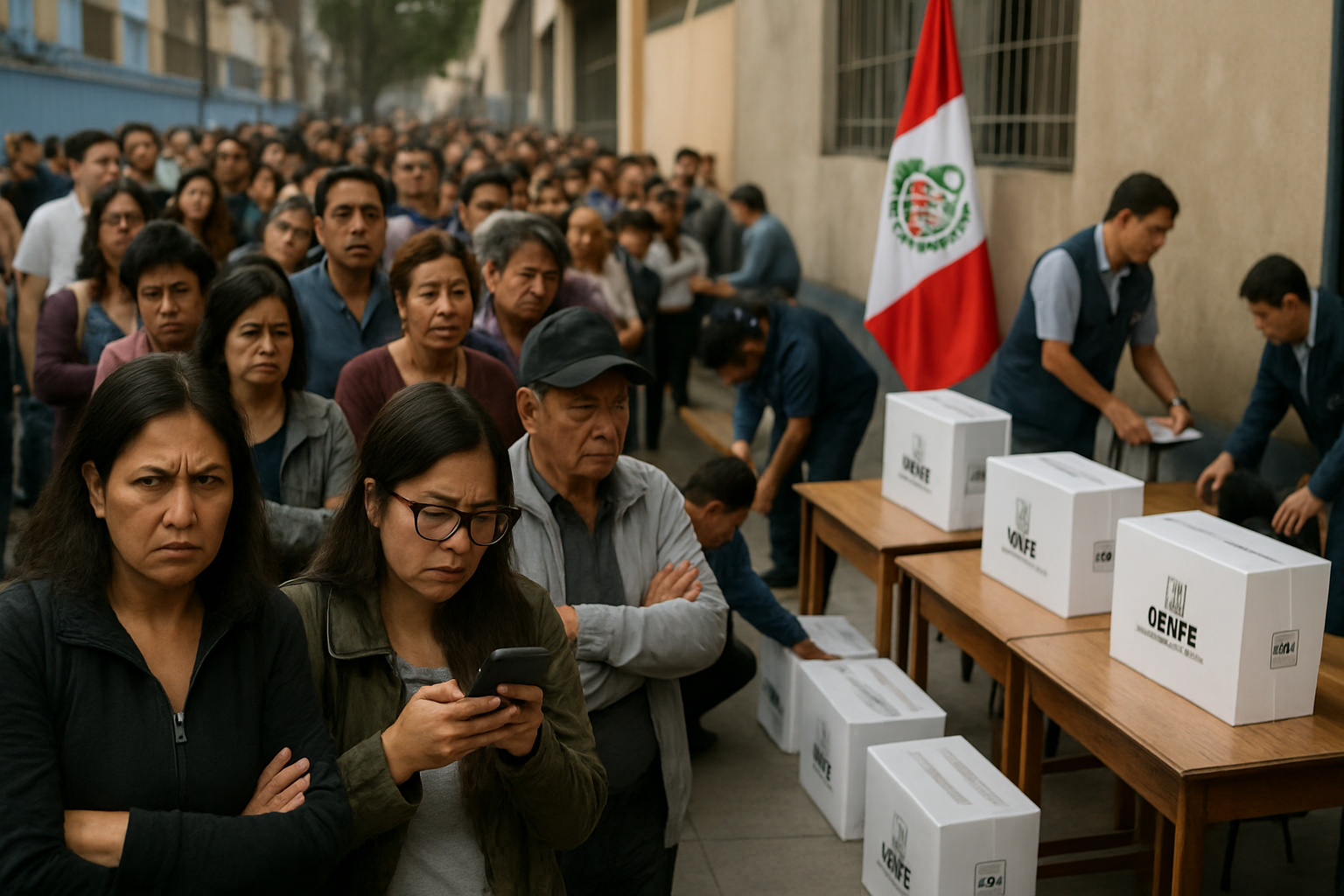
Peru's critical presidential elections on Sunday, April 12, 2026, were marred by massive organizational failures that forced electoral authorities to extend voting hours and prompted investigations into systemic delays that prevented tens of thousands of citizens from exercising their democratic rights.
The elections, which will determine Peru's ninth president in less than a decade, faced unprecedented challenges as over 25 million eligible voters attempted to select from 35 presidential candidates amid what has become the country's deepest political crisis in modern democratic history.
Electoral Chaos Unfolds
Voting was scheduled to begin at 7:00 AM local time but faced immediate complications when 15 polling locations failed to open as scheduled, affecting more than 60,000 voters. The National Office of Electoral Processes (ONPE) was forced to extend voting hours until 6:00 PM after initially refusing such measures.
Long lines formed across Lima's districts, including the tourist area of Miraflores, where voter Elva Ramos, 49, expressed her frustration to AFP: "There are elderly people, people who have come with babies in their arms, and they haven't opened the polling stations."
The delays sparked immediate political controversy, with presidential candidates condemning the organizational failures and demanding urgent intervention from the National Elections Jury (JNE). Some candidates alleged electoral fraud, though these claims remained unsubstantiated as the voting process continued.
Political Crisis Context
The electoral difficulties come at a time when Peru has experienced unprecedented political instability. Since 2016, the country has seen eight presidents, with the average presidential tenure decreasing by 70%. Most recently, José María Balcázar assumed the presidency in February 2026 following the removal of José Jerí after just 130 days in office over the "Chifagate" scandal involving secret meetings with Chinese contractor Zhihua Yang.
This pattern of instability has been characterized by the repeated weaponization of constitutional "vacancy" procedures by Congress against executive leaders. Previous removals include Martín Vizcarra in 2020, Pedro Castillo's attempted coup in 2022, and Dina Boluarte's exit in 2025.
"Peru cannot afford a new stage of uncertainty."
— CONFIEP Business Confederation
The CONFIEP business confederation had warned before the elections that the country "cannot afford a new stage of uncertainty," highlighting the economic stakes involved in achieving political stability.
Electoral Investigation Launched
In response to the widespread delays, Peruvian police and prosecutors descended on the election headquarters to investigate how the failure to deliver electoral materials prevented voting at numerous polling stations. The investigation aims to determine whether the organizational failures were due to incompetence or deliberate interference.
The South China Morning Post reported that the delays particularly affected polling stations in certain areas, with some voters waiting hours without being able to cast their ballots. The investigation will examine the logistics chain and decision-making processes that led to the systematic failures.
International and Regional Implications
International observers are closely monitoring Peru's elections as a test of democratic resilience in Latin America. The successful completion of the electoral process despite organizational challenges is seen as crucial for regional stability and democratic consolidation.
The political instability in Peru has broader implications for the Andean region and international cooperation. China's Belt and Road Initiative involvement, highlighted by the Chifagate scandal, has raised questions about foreign influence and sovereignty that are being debated in the current electoral cycle.
Regional media coverage has characterized Peru's situation as an "endless crisis" affecting Latin American democratic stability, with international observers viewing the election as a critical test case for democratic institutions under pressure.
Electoral System Under Strain
Peru's electoral system includes new threshold requirements and involves selecting not only a president but also senators, deputies, and Andean Parliament representatives. The complexity of the electoral process, combined with organizational failures, has highlighted the need for institutional reforms.
The fragmented political landscape with 35 presidential candidates virtually guarantees a runoff election, extending the period of electoral uncertainty. No clear frontrunner has emerged from the campaign, reflecting the deep divisions and lack of consensus in Peruvian politics.
Looking Forward
Despite the organizational chaos, millions of Peruvians participated in what many view as a critical democratic test. The ability to conduct elections, even with significant challenges, demonstrates the formal continuity of Peru's democratic institutions.
However, the systemic problems revealed by Sunday's vote underscore the need for comprehensive electoral reforms and institutional strengthening. The next president will inherit not only the immediate challenge of governing amid political fragmentation but also the longer-term task of rebuilding institutional trust and democratic effectiveness.
The results of Peru's election will determine whether the country can break its cycle of political crisis and establish the governance stability necessary for addressing the pressing economic and social challenges facing its 33 million citizens. The international community continues to watch as Peru's democratic resilience faces its ultimate test.