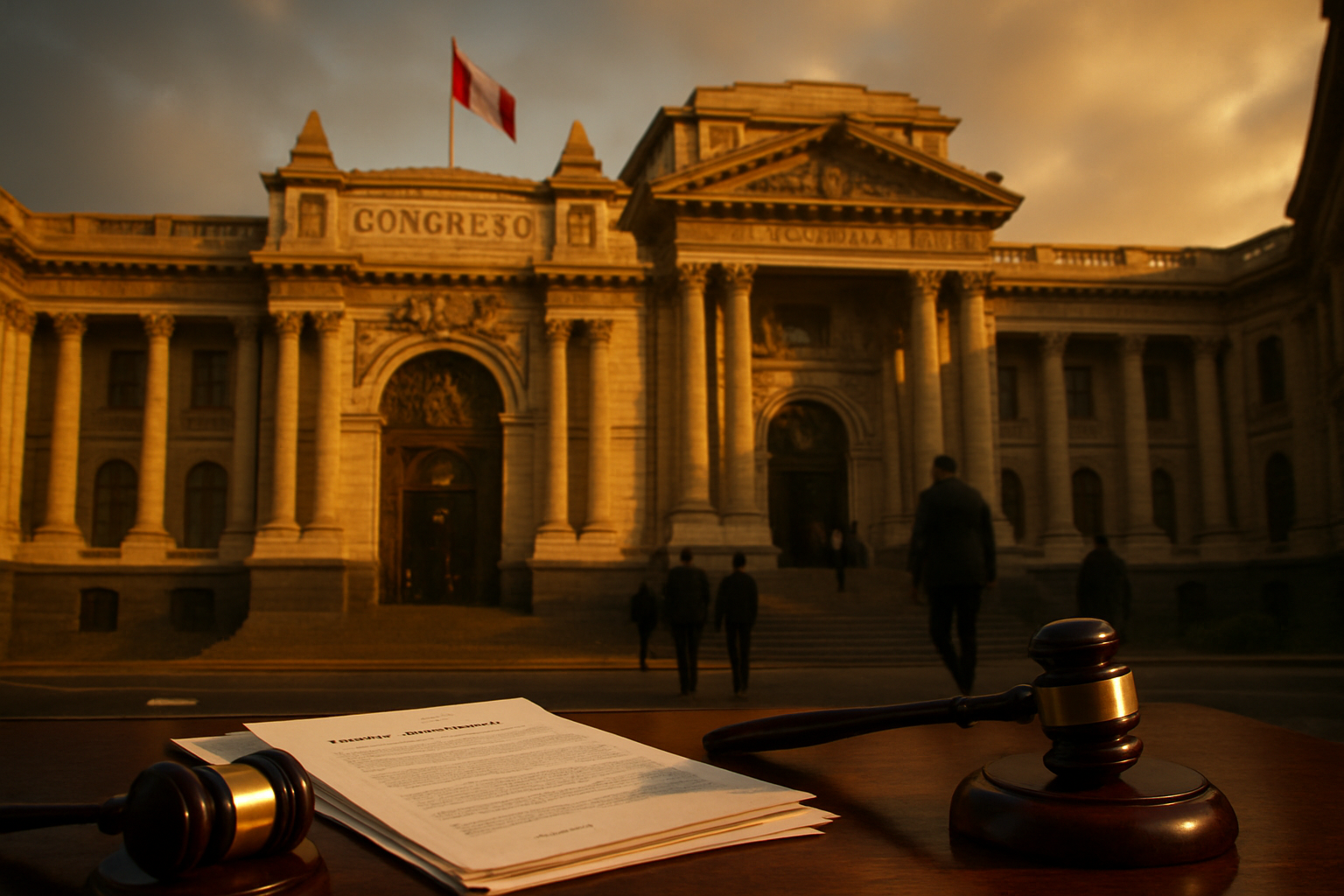
Peru's political establishment faces unprecedented scrutiny as multiple scandals converge, with a judge set to decide on congressman Adrián Villar's preventive prison while separate investigations expose President José María Balcázar's role in promoting legislation that directly benefited his family members.
The dual crises illustrate the depth of institutional challenges facing Peru's democracy, as the country's 8th president in a decade grapples with corruption allegations while the justice system processes high-profile cases involving influence peddling and tragic consequences of reckless behavior.
Villar Case: From Fatal Accident to Influence Networks
Congressman Adrián Villar stands at the center of a complex scandal that began with the tragic death of athlete Lizeth Marzano, whom he struck and killed while driving in San Isidro. The case has evolved beyond a simple vehicular homicide investigation into a broader examination of how political connections and influence networks operate in Peru's capital.
The victim's family is pushing prosecutors to elevate charges from culpable homicide to intentional murder, arguing that Villar's actions after the accident demonstrate callous disregard for human life. Their demands reflect broader public frustration with perceived impunity among Peru's political class.
"This tragedy has exposed how people in positions of power believe they can escape consequences through connections and manipulation,"
— Family representative of Lizeth Marzano
The investigation took a dramatic turn when WhatsApp conversations revealed that influencer Francesca Montenegro, Villar's former partner, offered to connect him with "big fish" contacts who could help manage the legal fallout. These messages, obtained by prosecutors, show Montenegro promising access to high-level legal and political connections immediately after Marzano's death.
Montenegro's public statements have created additional complications for Villar's defense. Initially offering support and promising to leverage her network of contacts, she later distanced herself from the congressman, stating she was ending their relationship due to the "values he demonstrated in this tragedy." Her contradictory positions have raised questions about the authenticity of her public persona and the reality of influence peddling in Peru's elite circles.
Balcázar's Legislative Conflicts of Interest
While Villar faces criminal proceedings, President José María Balcázar confronts allegations that strike at the heart of democratic governance: using legislative power for personal family benefit. Investigations reveal that Balcázar promoted Law 32171 that directly advantaged his son, José Balcázar Quiroz, creating clear conflicts of interest.
The scandal extends beyond individual legislation to encompass systematic abuse of congressional authority. Reports indicate that as a congressman before assuming the presidency, Balcázar promoted eight separate laws creating new universities in Peru's regions without ensuring adequate financing. These institutions, lacking proper budgetary foundation, have been criticized by the Executive Branch for fiscal irresponsibility.
The pattern suggests a broader problem with legislative oversight in Peru, where individual lawmakers can advance projects with significant public cost implications without robust review mechanisms. The situation reflects institutional weaknesses that have plagued Peru's democracy for over a decade.
Security and Institutional Connections
The scandals extend into Peru's security apparatus, with revelations that José Jerí's former bodyguard faces trial for alleged membership in a prostitution network known as "Las bebés de Lima Norte." The case demonstrates how corruption networks can penetrate multiple levels of government, from local law enforcement to the highest executive offices.
These interconnected scandals occur against Peru's backdrop of chronic political instability, where the country has seen eight presidents in a decade. The pattern of institutional breakdown has created an environment where personal interests frequently override public duties, and accountability mechanisms prove inadequate to address systematic problems.
Democratic Institutions Under Strain
The convergence of these scandals highlights critical vulnerabilities in Peru's democratic framework. Constitutional procedures designed to ensure accountability have been repeatedly weaponized for political purposes, while the justice system struggles to maintain independence amid intense political pressure.
President Balcázar, who assumed office following the removal of José Jerí over the "Chifagate" scandal involving secret meetings with Chinese contractors, promised to address "deep-rooted" corruption within Peru's political system. However, the allegations against him suggest that the problems may be more systemic than any single leader can address.
"These cases demonstrate that corruption in Peru operates through networks that span political parties, business interests, and even entertainment figures. The challenge is breaking these cycles of impunity."
— Constitutional law expert familiar with Peru's institutional crisis
The international community has watched Peru's political instability with growing concern. The repeated use of constitutional "vacancy" procedures to remove presidents, combined with ongoing corruption scandals, has undermined confidence in Peru's democratic institutions and complicated the country's international relationships.
Justice System Response and Challenges
The judicial system's handling of these cases will test Peru's commitment to rule of law during a critical period. The decision on Villar's preventive detention, expected soon, will signal whether Peru's courts can operate independently of political pressure when dealing with high-profile cases involving current legislators.
Prosecutors face the challenging task of pursuing investigations that may implicate multiple levels of government while maintaining professional standards and avoiding political interference. The cases require careful coordination between different judicial agencies and may test the capacity of Peru's reformed justice system.
The Balcázar investigation presents particular challenges given his current presidential status. Constitutional protections for sitting presidents create complex legal questions about how and when such investigations can proceed, while public pressure for accountability continues to mount.
Broader Implications for Democratic Governance
These scandals occur as Peru prepares for general elections in April 2026, adding electoral pressures to an already volatile political environment. The ability of democratic institutions to process these cases fairly and transparently will influence public confidence in the electoral system and Peru's broader democratic trajectory.
The cases also highlight the role of social media and influencer culture in Peru's political scandals. Montenegro's involvement demonstrates how contemporary political influence networks extend beyond traditional power brokers to include social media personalities and their audiences, creating new dynamics in political accountability.
Regional observers note that Peru's struggles reflect broader challenges facing Latin American democracies, where institutional fragility, economic pressures, and social inequality create environments conducive to corruption and political instability.
Path Forward
Addressing these scandals requires more than individual prosecutions or political changes. Peru needs systematic reforms to strengthen institutional checks and balances, improve transparency in legislative processes, and create more robust accountability mechanisms for public officials.
The coming weeks will prove crucial as judicial decisions on preventive detention, legislative investigations, and electoral preparations converge. Success in managing these challenges transparently and fairly could help restore confidence in Peru's democratic institutions, while failure risks deepening the country's institutional crisis.
For Peru's 33 million citizens, these scandals represent more than political theater—they reflect fundamental questions about whether democratic institutions can provide effective governance while ensuring accountability for those who hold power. The resolution of these cases will shape Peru's democratic trajectory for years to come.