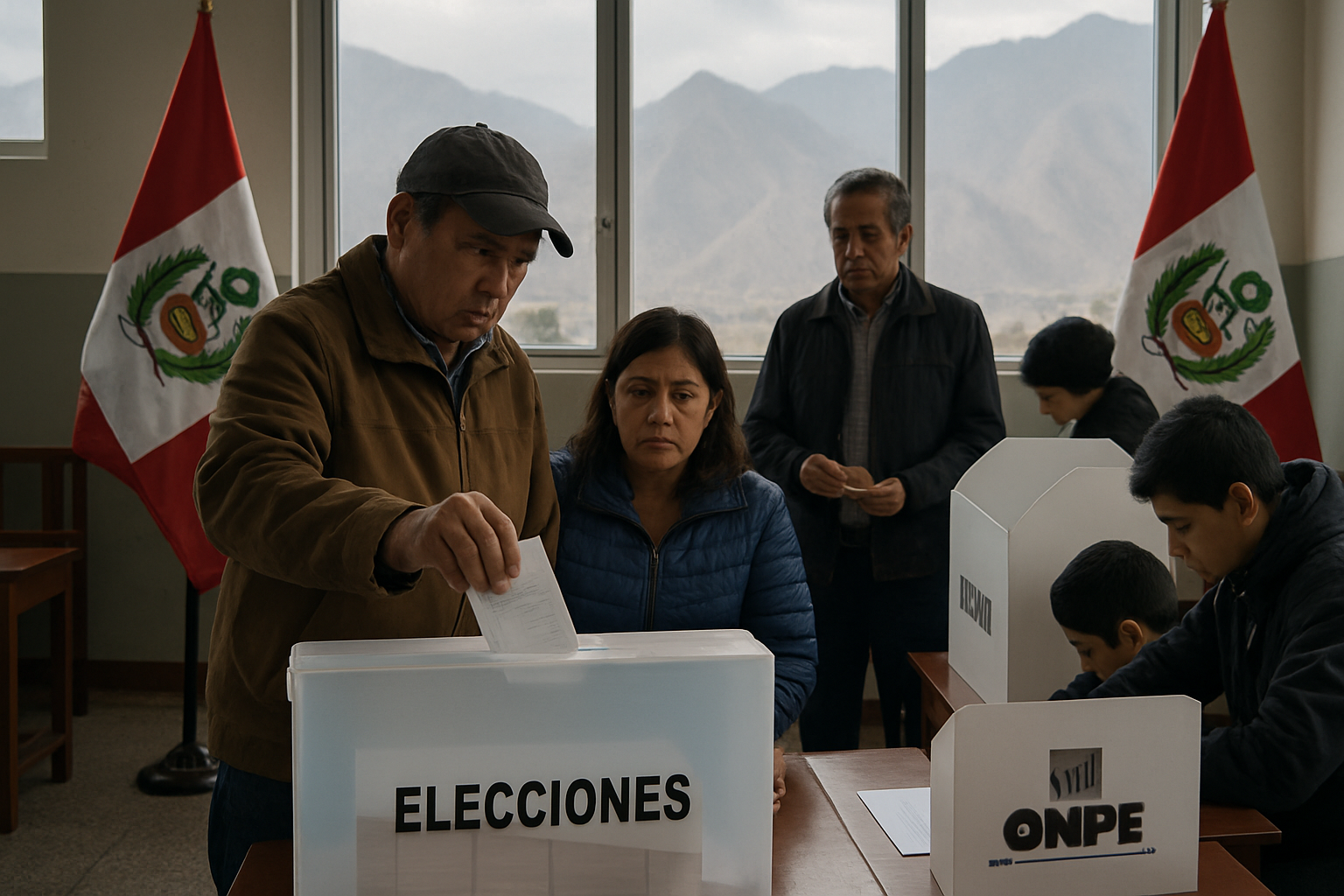
Peru holds its most consequential presidential election in decades on Sunday, April 12, 2026, as over 25 million eligible voters choose from 35 candidates amid the country's deepest political crisis, with eight presidential changes occurring in just ten years.
The election comes at a critical juncture for the South American nation, which has experienced unprecedented political instability since 2016. The most recent upheaval occurred in February when President José Jerí was removed after serving only 130 days following the "Chifagate" scandal involving secret meetings with Chinese contractor Zhihua Yang.
According to multiple international sources, no candidate appears positioned for an outright victory, making a runoff election virtually inevitable. The fragmented political landscape reflects deep voter frustration with traditional governance and persistent institutional breakdown.
Security Dominates Campaign Discourse
Rising violence and criminal activity have emerged as the central campaign issue, with candidates wrapping up their campaigns Friday with strong focus on security measures. Daily extortions, increased homicides, and expanding criminality have fundamentally reshaped daily life, particularly in Lima, the capital.
Conservative candidate Keiko Fujimori, leading in some polls, has made immigration control a cornerstone of her campaign, vowing to expel migrants and strengthen border security. This marks her fourth presidential attempt, capitalizing on support from her Amazon region stronghold.
The security crisis has given ammunition to law-and-order candidates across the political spectrum, as citizens increasingly prioritize public safety over other policy considerations in what experts describe as a "fear-driven" electoral environment.
Pattern of Institutional Breakdown
Peru's current crisis extends far beyond individual leadership failures, representing what analysts characterize as systematic governance failure. The country has witnessed nine presidents come and go within a decade, with the average presidential tenure decreasing by 70% since the Pedro Pablo Kuczynski period.
The cycle of instability includes major removals: Martín Vizcarra in 2020, Pedro Castillo's coup attempt in 2022, Dina Boluarte's removal in 2025, and most recently José Jerí in 2026. Constitutional "vacancy" procedures have been repeatedly weaponized by Congress against executives, creating a pattern of legislative-executive confrontation that has paralyzed effective governance.
"In the span of a decade, Peru has seen nine presidents come and go. How has that affected this year's presidential race?"
— Al Jazeera analysis of Peru's political tumult
The business confederation CONFIEP has repeatedly warned that Peru "cannot afford a new uncertainty stage" before these elections, highlighting the economic consequences of chronic political instability that affects the country's 33 million citizens.
International Implications and Chinese Influence
The election occurs against the backdrop of growing concerns about Chinese influence in Peru's infrastructure and politics. The "Chifagate" scandal that brought down President Jerí involved undisclosed meetings with Chinese contractor Zhihua Yang, whose companies hold significant state contracts including control of strategic infrastructure like the Chancay Port.
These developments have raised sovereignty concerns, particularly given China's Belt and Road Initiative presence in Peru. The US has previously warned about national autonomy risks from extensive Chinese infrastructure control, making foreign policy orientation a significant electoral issue.
The Lima stock exchange and sol currency have maintained relative stability despite the political turbulence, demonstrating market adaptation to chronic volatility. However, international investors and regional partners are closely monitoring the election outcome for signs of continued democratic governance and policy predictability.
Democratic Resilience Under Test
Despite the institutional crisis, Peru's democratic framework has maintained constitutional continuity while facing severe effectiveness challenges. The electoral process itself represents a critical test of whether the country's institutions can facilitate peaceful power transitions and break the cycle of political crisis.
International observers are monitoring the elections as a template for democratic resilience in Latin America during a period of regional political stress. The successful conduct of free and fair elections would strengthen arguments for institutional capacity, while irregularities or disputed results could accelerate democratic fragmentation.
The election determines not only the president but also senators, deputies, and Andean Parliament representatives, with an electoral threshold system implemented for party registration and seat distribution. These congressional elections will be crucial for determining the next government's legislative support and ability to implement policies.
Regional and Global Stakes
Peru's electoral outcome carries implications extending far beyond its borders. As a key player in regional integration efforts and a strategically important nation for both Chinese and American interests in South America, the country's political direction affects broader hemispheric stability.
The election results will influence Peru's role in addressing regional challenges including migration, drug trafficking, and economic integration. Success in establishing stable governance could provide a positive model for other Latin American nations facing similar institutional challenges.
For the international community, Peru represents a test case for supporting democratic consolidation in developing nations facing complex governance challenges. The country's ability to break its political crisis cycle and achieve sustainable democratic governance will be closely studied as a precedent for institutional reform and democratic resilience.
Critical Weeks Ahead
The coming weeks will be decisive not only for Peru's 33 million citizens but for broader questions about democratic governance in the 21st century. The election represents a fundamental choice between continuing the cycle of institutional breakdown or establishing the stability necessary for effective governance and economic development.
With multiple candidates competing and no clear frontrunner, coalition-building and alliance negotiations will prove crucial for both the likely runoff and subsequent governance. The next president will inherit challenges including electoral integrity management, institutional credibility restoration, and public confidence rebuilding during a limited timeline before potential further political transitions.
Success in this electoral process could mark the beginning of Peru's transition from crisis management to democratic consolidation. Failure could cement a pattern of permanent instability that would have consequences extending throughout Latin America and serving as a cautionary tale for democratic development globally.