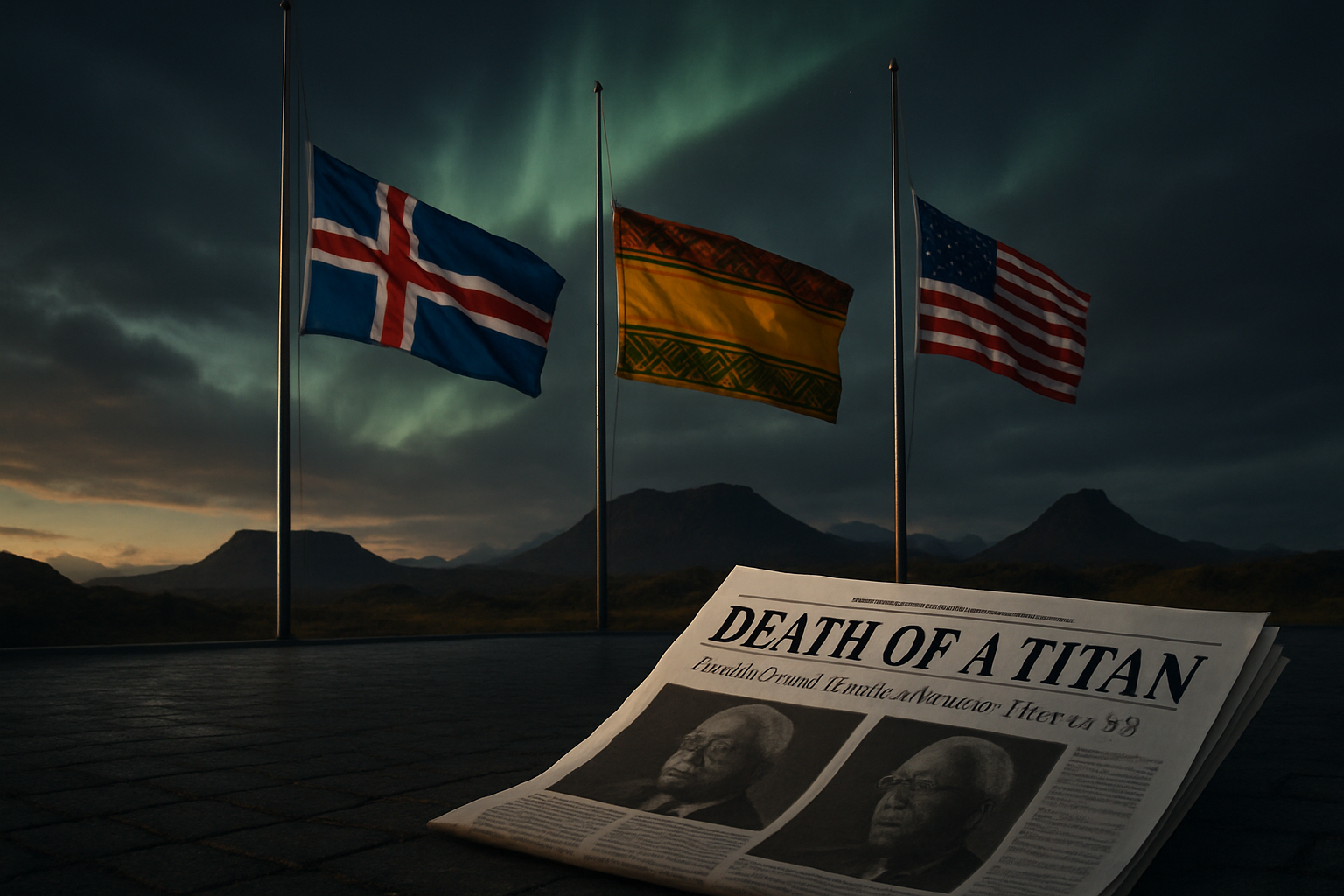
The passing of two influential figures from vastly different spheres—former Icelandic Prime Minister Davíð Oddsson and celebrated West African musician Boncana Maïga—has marked March 2026 as a month of significant leadership transitions, highlighting the end of an era in both political governance and cultural representation.
Iceland Mourns Its Longest-Serving Prime Minister
Davíð Oddsson, who died at his home on March 1, 2026, at the age of 78, leaves behind a complex political legacy as Iceland's most influential politician of recent decades. Born in Reykjavík on January 17, 1948, Oddsson's political career spanned over three decades, fundamentally shaping modern Iceland's political and economic landscape.
Oddsson's political ascent began in local government, where he was elected to the Reykjavík City Council in 1974, serving until 1994. His tenure as Mayor of Reykjavík from 1982 to 1991 established him as a formidable political force, setting the stage for his national political career. In 1991, he was elected chairman of Sjálfstæðisflokkurinn (Independence Party), the same year he entered Parliament and assumed the role of Prime Minister.
His tenure as Prime Minister from 1991 to 2004 makes him the longest-serving PM in Iceland's history, a record that underscores his political durability and influence. During this period, Oddsson oversaw significant economic reforms and Iceland's integration into broader European structures, though his policies often proved controversial. Following his resignation as Prime Minister in 2004, he served briefly as Foreign Affairs Minister until 2005, before leaving active politics.
"With his passing, Iceland loses one of its most influential politicians of the past decades."
— Iceland Monitor
After leaving politics in 2005, Oddsson transitioned to media, becoming editor of Morgunblaðið, Iceland's newspaper of record. This career shift demonstrated his continued engagement with public discourse and his desire to influence Icelandic society beyond the political arena. His work in journalism allowed him to maintain a public voice on national issues while operating outside the constraints of electoral politics.
West African Music Loses a Cultural Ambassador
Simultaneously, the West African cultural community mourns the loss of Boncana Maïga, whose death represents a significant loss for the continent's musical heritage. Described as a "legend of African music" and an "icon of Mandingue salsa," Maïga's passing has prompted widespread tributes across francophone Africa and beyond.
Maïga's musical career epitomized the cultural bridge-building that characterizes much of contemporary African music. His work in "salsa mandingue"—a fusion of Latin American salsa with traditional West African Mandingue musical elements—demonstrated the global reach and adaptability of African musical traditions. This genre, which Maïga helped popularize, represents the kind of cultural synthesis that has become increasingly important in Africa's engagement with global musical markets.
The timing of Maïga's death during what cultural observers have termed the "February 2026 Cultural Renaissance"—a period of unprecedented global cultural activity—underscores the enduring relevance of his contributions to world music. His work served as a cultural ambassador for West Africa, introducing international audiences to the rich musical traditions of the Mandingue people while creating new forms of artistic expression.
Leadership Transitions in Context
These deaths occur against a backdrop of significant political transitions globally, as documented in recent months. The political landscape of early 2026 has been marked by historic electoral victories, leadership changes, and institutional challenges across multiple continents. From Japan's Sanae Takaichi achieving an unprecedented electoral mandate to Bangladesh's democratic transformation following student-led uprisings, the current period represents a moment of significant political flux.
The passing of figures like Oddsson and Maïga represents more than individual losses—it signifies the end of particular eras in their respective domains. Oddsson's death removes one of the last direct links to the political transformations that shaped modern Iceland during the post-Cold War period. Similarly, Maïga's passing represents the loss of a generation of African musicians who pioneered the integration of traditional African music with global musical forms.
Impact on Institutional Memory
The significance of these losses extends beyond their immediate contexts to questions of institutional memory and continuity. Oddsson's 13-year tenure as Prime Minister provided Iceland with unprecedented political stability during a crucial period of economic development and international integration. His experience navigating Iceland's relationship with European institutions, while maintaining the country's distinctive political culture, represents knowledge that cannot easily be replaced.
For West African music, Maïga's death represents the loss of experiential knowledge about the development of pan-African musical forms. His work in salsa mandingue was not merely artistic but represented a form of cultural diplomacy, demonstrating how African musical traditions could engage with and influence global musical developments while maintaining their distinctive characteristics.
"L'Afrique pleure une icône de la salsa mandingue"
— Journal du Niger
Legacy and Future Implications
The deaths of both Oddsson and Maïga raise important questions about succession and continuity in their respective fields. In Iceland, Oddsson's passing removes a significant voice from the country's ongoing political debates, particularly regarding European integration and economic policy. His transition from politics to journalism had allowed him to maintain influence on public discourse, and his absence will likely be felt in Iceland's media landscape.
For African music, Maïga's death highlights the ongoing challenge of preserving and transmitting cultural knowledge across generations. The fusion genres he helped create require not only musical skill but also deep cultural understanding of both African traditions and global musical forms. The question of whether younger musicians can maintain and develop these traditions remains crucial for the future of African cultural expression.
Broader Significance for Democratic Governance
These leadership transitions occur during a period when democratic institutions worldwide face unprecedented challenges. As documented in recent political developments across Europe, Asia, and the Americas, established political orders are experiencing significant stress from technological disruption, economic pressures, and changing social expectations.
The loss of experienced political figures like Oddsson, who successfully navigated multiple electoral cycles and policy challenges, represents a depletion of institutional knowledge precisely when such experience might prove most valuable. Similarly, cultural figures like Maïga, who successfully bridged different cultural traditions, offer models for cross-cultural engagement that remain relevant to contemporary global challenges.
Commemorating Complex Legacies
Both figures leave complex legacies that will require careful historical assessment. Oddsson's economic policies and political style generated significant controversy during his career, and his true historical significance will likely be debated for years to come. His supporters credit him with modernizing Iceland's economy and strengthening its international position, while critics argue that his policies contributed to economic instability and social inequality.
Maïga's musical legacy, while less politically controversial, represents broader questions about cultural authenticity and global cultural exchange. His work in fusion genres raises important questions about how traditional cultures can engage with global markets while maintaining their distinctive characteristics—a challenge that remains relevant across the developing world.
As March 2026 progresses, these deaths serve as reminders of the ongoing transitions affecting political and cultural leadership globally. The challenge for institutions in both Iceland and West Africa will be maintaining continuity while adapting to changing circumstances and new leadership generations. The successful navigation of these transitions will likely influence the broader success of democratic governance and cultural preservation in their respective regions.
The simultaneous loss of these influential figures underscores the interconnected nature of contemporary global challenges, where political leadership and cultural representation intersect in ways that shape both local communities and international relationships. Their deaths mark not just individual transitions, but moments of broader institutional and cultural transformation that will influence their respective societies for years to come.