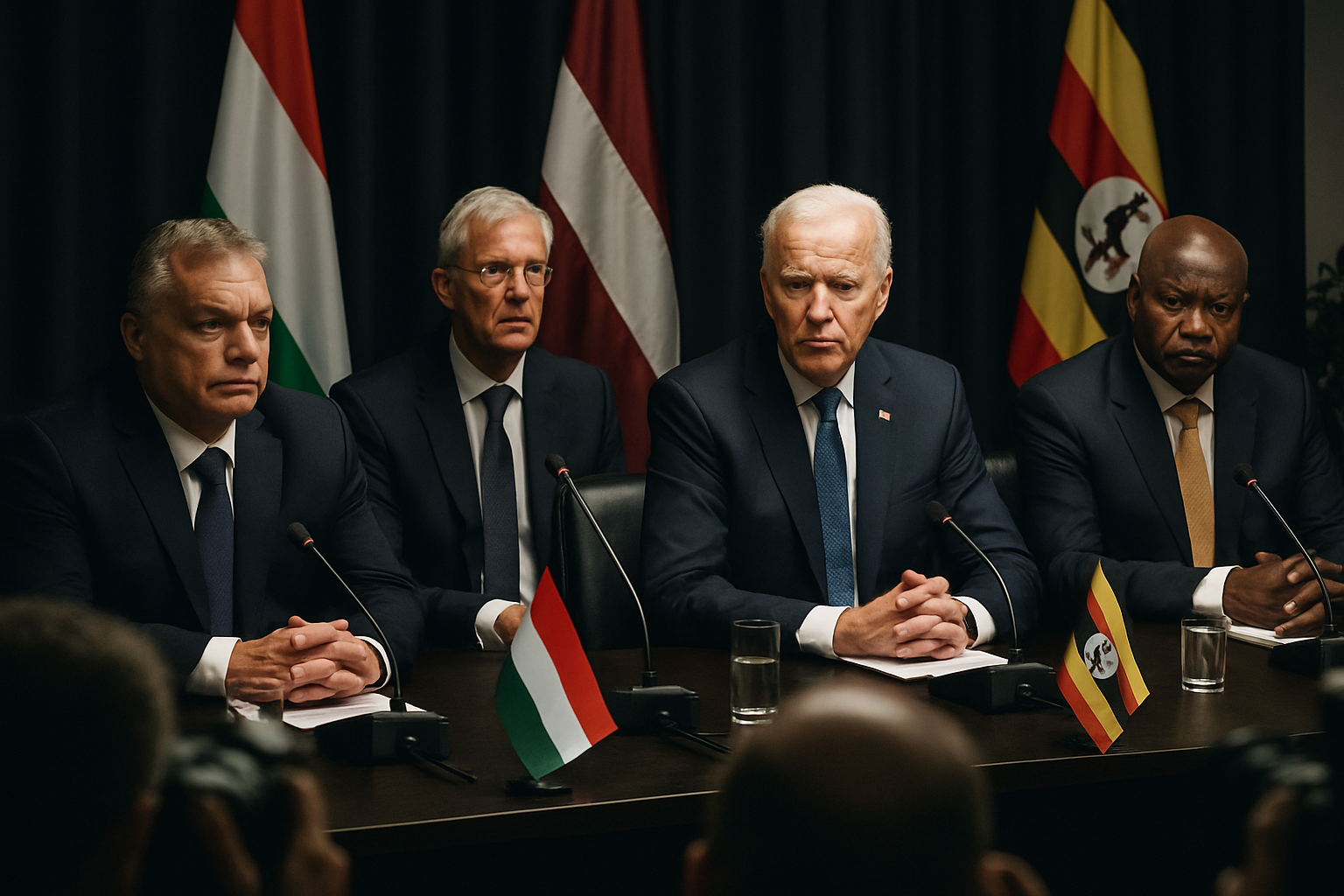
As April 2026 unfolds, three nations across different continents face defining moments in political leadership that could reshape democratic governance and international relations for years to come, with Hungary's Viktor Orbán facing his most serious electoral challenge in over a decade while opposition movements in Uganda and democratic transitions in Latvia demonstrate the evolving nature of 21st-century political leadership.
Hungary's Democratic Crossroads: Orbán's Greatest Challenge
Viktor Orbán's political system faces unprecedented electoral vulnerability as Hungary approaches its April 12, 2026 parliamentary elections, marking the most serious challenge to his rule since returning to power in 2010. For the first time in over a decade, multiple polling organizations show opposition coalitions leading, creating genuine electoral uncertainty that has sent shockwaves through European political circles.
The Hungarian opposition has crystallized around Péter Magyar's Tisza Party, which has organized massive demonstrations including the "Greatest National March" that drew an estimated 500,000 participants to Budapest—the largest opposition demonstration since 2010. Magyar, a former government insider, represents a credible alternative with his 240-page electoral program promising wealth taxes, euro adoption, and stronger EU/NATO ties, contrasting sharply with Orbán's nationalist sovereignty approach.
"In 1848 and 1956, our revolutions continued in blood. The Russians came, but they could never defeat us. Orbán cannot do this either, who in his final desperation has called upon the KGB tsar."
— Péter Magyar, Tisza Party Leader
The electoral stakes extend far beyond domestic politics. Investigative journalist Szabolcs Panyi's reporting through VSquare has revealed concrete evidence of Russian interference teams operating in Budapest supporting Fidesz, representing the first documented case of Kremlin operatives actively participating in European electoral campaigns. This foreign interference combines with American political backing through Trump administration endorsements and Secretary of State Marco Rubio's diplomatic visits, creating an unprecedented international dimension to Hungary's domestic election.
Orbán's challenges have been compounded by the ongoing Druzhba pipeline crisis, where Hungary maintains its blockade of the EU's historic €90 billion Ukraine aid package over oil transit disputes. This confrontation with Brussels has created the deepest institutional crisis within the EU since the bloc's formation, with European Council President António Costa issuing an unprecedented direct letter demanding Hungary honor its commitments.
Latvia's Democratic Vigilance Amid Regional Pressures
Latvia's political landscape reflects the broader challenges facing Eastern European democracies as they navigate between Western integration and regional security concerns. The country's media coverage of Hungary's electoral developments demonstrates the interconnected nature of democratic governance across the region, with Latvian sources closely monitoring how Orbán's potential defeat could reshape EU dynamics.
The Latvian perspective on Hungary's crisis reveals deep concerns about democratic backsliding in neighboring EU member states. As Lithuanian Foreign Minister Kestutis Budrys declared, "EU cannot become Budapest's hostage," reflecting broader Baltic state concerns about institutional manipulation within European frameworks.
Latvia's own democratic institutions have shown resilience through peaceful transitions and continued commitment to European integration, even as the country faces complex geopolitical pressures from Russia and internal challenges related to economic modernization and demographic changes.
Uganda's Opposition in Exile: Bobi Wine's Strategic Dilemma
Robert Kyagulanyi, known as Bobi Wine, finds himself at a critical juncture as Uganda's most prominent opposition leader operates from exile in the United States. His current lobbying efforts with American leaders to impose sanctions on President Yoweri Museveni and Chief of Defence Forces General Muhoozi Kainerugaba represent a significant escalation in opposition tactics, moving beyond domestic resistance to international advocacy.
Bobi Wine's exile strategy involves meeting with American officials to build pressure for accountability over what he characterizes as denial of electoral victory in Uganda's January 2021 elections. However, commentary from Ugandan observers suggests that this international approach may have limited effectiveness, with some arguing that returning home represents the best option for maintaining political relevance and continuing opposition work.
"Bobi Wine will enjoy camera for a few months; then it will be business as usual"
— Obed K Katureebe, Ugandan Commentator
The challenges facing Uganda's opposition movement reflect broader patterns of authoritarian governance across Africa, where traditional opposition strategies face systematic repression while international advocacy provides limited immediate relief. Bobi Wine's family's departure from Uganda citing safety concerns under what they describe as a "violent military dictatorship" illustrates the personal costs of political opposition in increasingly restrictive environments.
The opposition leader's situation demonstrates the complex calculations facing democracy advocates in authoritarian contexts—balancing the safety of exile against the political effectiveness of domestic presence, international advocacy against grassroots mobilization, and immediate security concerns against long-term democratic transformation goals.
Global Democratic Governance Under Pressure
These three cases—Hungary's electoral crossroads, Latvia's democratic vigilance, and Uganda's opposition in exile—represent different facets of the contemporary challenges facing democratic governance worldwide. The convergence of foreign interference, institutional manipulation, and authoritarian pressure creates a complex environment where traditional democratic mechanisms face unprecedented strain.
The Hungarian election scheduled for April 12, 2026, serves as a critical test case for European democratic resilience. Success for the opposition would remove Brussels' most persistent internal critic and restore Hungary to mainstream EU alignment on rule of law and foreign policy coordination. Conversely, Orbán's victory amid documented foreign interference could embolden similar operations continent-wide and further strain European unity.
Latvia's position as a democratic anchor in the Baltic region becomes increasingly important as regional security concerns intersect with domestic governance challenges. The country's continued commitment to European integration and democratic norms provides stability amid broader regional turbulence.
Uganda's situation illustrates the global dimension of democratic struggles, where opposition movements must navigate between domestic resistance and international advocacy while facing systematic repression. The effectiveness of exile-based opposition strategies remains uncertain, particularly when authoritarian governments maintain strong institutional control.
International Implications and Future Trajectories
The resolution of these political leadership challenges will have significant implications for international relations and democratic governance patterns globally. Hungary's election outcome will influence EU decision-making capacity, NATO cohesion, and broader transatlantic relationships, while also setting precedents for how democratic institutions respond to foreign interference and institutional manipulation.
The success or failure of opposition movements in contexts like Uganda affects broader patterns of democratic development across Africa and provides lessons for international democracy support efforts. Meanwhile, stable democracies like Latvia face the ongoing challenge of maintaining democratic vitality while addressing citizen concerns about economic inequality, security, and sovereignty.
As these political leadership developments unfold in April 2026, they represent critical test cases for democratic resilience in an era of increasing authoritarianism, technological disruption, and great power competition. The outcomes will influence not only the specific countries involved but also broader global patterns of political governance and international cooperation in the years ahead.
The interconnected nature of these challenges—from Russian interference in Hungary to American engagement with Ugandan opposition—demonstrates how contemporary political leadership operates within complex international networks that extend far beyond traditional sovereign boundaries. Success in maintaining democratic governance increasingly requires both domestic legitimacy and international cooperation, making these April 2026 developments critical indicators of global democratic health.