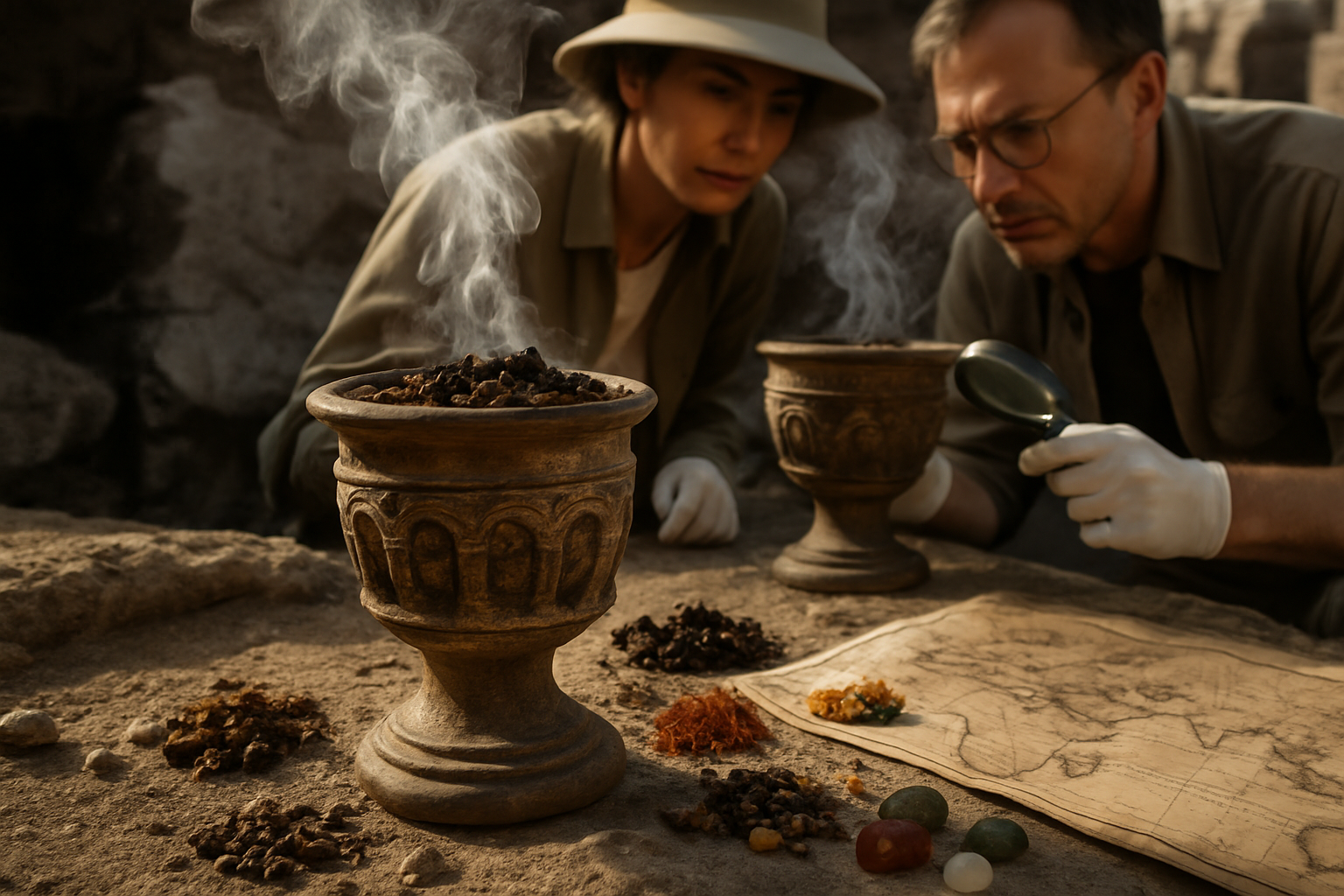
Archaeological researchers have uncovered remarkable evidence of ancient global trade networks through analysis of incense residues found in Pompeii's household ceremonial vessels, revealing the sophisticated commercial connections that linked the Roman Empire to distant corners of the world over 2,000 years ago.
The groundbreaking discovery, announced on April 4, 2026, represents the first comprehensive analysis of domestic cult practice residues from the ancient city. German archaeologists working in collaboration with Italian institutions have successfully decoded the ritual offerings that Roman families burned for their household gods, uncovering traces of exotic materials that traveled thousands of miles to reach Pompeii's homes.
Unprecedented Archaeological Analysis
The research team employed advanced chemical analysis techniques to examine carbonized remains found within domestic incense burners, known as rhytons, discovered throughout Pompeii's residential districts. These ceremonial vessels, used by Roman families for daily religious practices honoring their household deities (Lares and Penates), contained microscopic traces of materials that tell an extraordinary story of ancient commerce.
"This is the first time we've been able to analyze the actual substances used in domestic Roman religious practices," explained Dr. Elena Marchetti, lead archaeologist on the project. "The preservation conditions at Pompeii have allowed us to identify organic compounds that would normally decay over time, providing a unique window into the daily spiritual lives of ordinary Roman citizens."
The analysis revealed traces of frankincense from Arabian Peninsula, cinnamon from Southeast Asia, black pepper from India's Malabar Coast, and exotic resins from Africa's Horn region. These findings demonstrate that even middle-class Roman households had access to luxury goods from across the known world, suggesting trade networks far more extensive and accessible than previously understood.
Evidence of Sophisticated Commercial Networks
The diversity of materials found in Pompeii's household incense burners reveals the remarkable reach of Roman commercial networks. Frankincense, one of the most valuable commodities in the ancient world, originated in modern-day Oman and Yemen. Its presence in ordinary Pompeii households indicates that Arabian trade routes had successfully integrated with Roman distribution systems.
Perhaps most surprising was the discovery of Southeast Asian cinnamon and Indian pepper, spices that required complex maritime and overland transportation networks. These materials would have traveled from their origins through multiple intermediaries, including Persian Gulf traders, Red Sea merchants, and Egyptian distributors, before reaching Roman markets.
"The chemical signatures we've identified represent some of the world's most valuable ancient commodities being used in daily religious practice by ordinary citizens. This suggests that global trade had penetrated Roman society at levels we never previously imagined."
— Dr. Marcus Weber, Chemical Archaeologist, University of Heidelberg
The research also identified African materials, including aromatic resins from Ethiopia and Sudan, confirming that trans-Saharan trade routes were supplying Roman markets with goods from sub-Saharan Africa. This evidence supports theories that Roman commercial influence extended far beyond the empire's official boundaries through sophisticated networks of allied tribes and client kingdoms.
Religious and Social Implications
The use of these expensive imported materials in household religious practices reveals important aspects of Roman social and spiritual life. The presence of exotic incense in middle-class homes suggests that religious devotion transcended economic barriers, with families willing to invest significant resources in proper worship of their household gods.
Roman religious practice emphasized the importance of maintaining favorable relationships with protective deities through regular offerings. The quality and exotic nature of incense materials may have been believed to enhance the effectiveness of prayers and ensure divine protection for family members.
The findings also indicate that global trade goods had become sufficiently integrated into Roman culture that their foreign origins may have enhanced their perceived spiritual value. Exotic materials from distant lands could have been seen as more powerful or effective in religious ceremonies due to their rarity and cost.
Archaeological Renaissance Context
This discovery occurs within what scholars are calling the "2026 Archaeological Renaissance," a period marked by unprecedented international cooperation and technological advancement in archaeological research. Advanced analytical techniques, including sophisticated chemical analysis and environmental reconstruction methods, are revealing previously invisible aspects of ancient life.
The Pompeii incense analysis exemplifies how modern technology can unlock secrets hidden for millennia. Ground-penetrating radar initially identified the household shrines, while advanced spectroscopic analysis revealed the chemical fingerprints of ancient organic materials. Digital documentation systems ensure these findings are preserved and accessible to researchers worldwide.
Similar breakthroughs across the globe have revealed sophisticated ancient civilizations capable of complex technological achievements and international cooperation. From 5,000-year-old Egyptian drilling machines to 45,000-year-old symbolic communication systems in Germany, 2026 has established new standards for understanding human historical capabilities.
Climate Change and Archaeological Urgency
The research takes on added significance given the urgent threats facing archaeological sites worldwide. January 2026 marked the 18th consecutive month that global temperatures exceeded 1.5°C above pre-industrial levels, creating unprecedented environmental pressures on historical sites.
Pompeii itself faces ongoing challenges from extreme weather, increased tourism pressure, and environmental degradation. The sophisticated preservation techniques employed in this study represent a race against time to document archaeological treasures before they may be lost to climate change.
The international cooperation exemplified by the German-Italian research partnership provides a model for addressing these challenges through shared expertise and coordinated preservation efforts. Digital documentation and chemical analysis create permanent records that remain accessible even if original materials face deterioration.
Economic and Cultural Impact
The discovery is expected to generate significant benefits for both scientific understanding and cultural tourism. The findings position Pompeii as a window into ancient globalization, potentially attracting visitors interested in understanding how international commerce functioned 2,000 years ago.
Educational institutions worldwide are already incorporating the research into programs exploring ancient economics and religious practices. Museums are developing exhibitions that use the incense analysis to illustrate the sophisticated trade networks that connected ancient civilizations.
The research also contributes to broader understanding of how ancient economies functioned, providing insights relevant for contemporary discussions about globalization, cultural exchange, and international commerce.
Future Research Directions
The successful analysis of Pompeii's incense residues opens new avenues for archaeological investigation. Researchers plan to expand the study to other Roman sites throughout the Mediterranean, seeking to map the full extent of ancient trade networks and their social impact.
Advanced chemical techniques are being applied to similar artifacts from other archaeological sites, potentially revealing comparable evidence of global commerce in ancient Egypt, Greece, and Mesopotamia. The methodologies developed for this project could revolutionize understanding of ancient economic systems across multiple civilizations.
Collaborative research partnerships are being established between European and Middle Eastern institutions to trace the supply chains that brought exotic materials to Roman markets. This work requires expertise spanning archaeology, chemistry, geography, and ancient history, demonstrating the interdisciplinary nature of modern archaeological research.
Transforming Our Understanding of Ancient Rome
The Pompeii incense analysis fundamentally challenges previous assumptions about the accessibility of global trade goods in the ancient world. Rather than luxury items available only to the wealthy elite, exotic spices and resins appear to have penetrated Roman society at multiple economic levels.
This discovery suggests that ancient globalization was more extensive and democratic than traditionally understood. The integration of worldwide trade goods into daily religious practice indicates that international commerce had become a normal part of Roman life, not an exceptional occurrence.
The research also highlights the central role of religious practice in ancient economic systems. The demand for exotic incense materials may have driven commercial innovation and expansion, as merchants sought new sources of aromatic substances to supply growing spiritual markets.
As archaeological techniques continue to advance and international cooperation deepens, discoveries like the Pompeii incense analysis demonstrate that much of human history remains hidden, waiting to be revealed through careful scientific investigation and collaborative research efforts. The ancient world proves to have been far more interconnected and sophisticated than previous generations of scholars imagined.