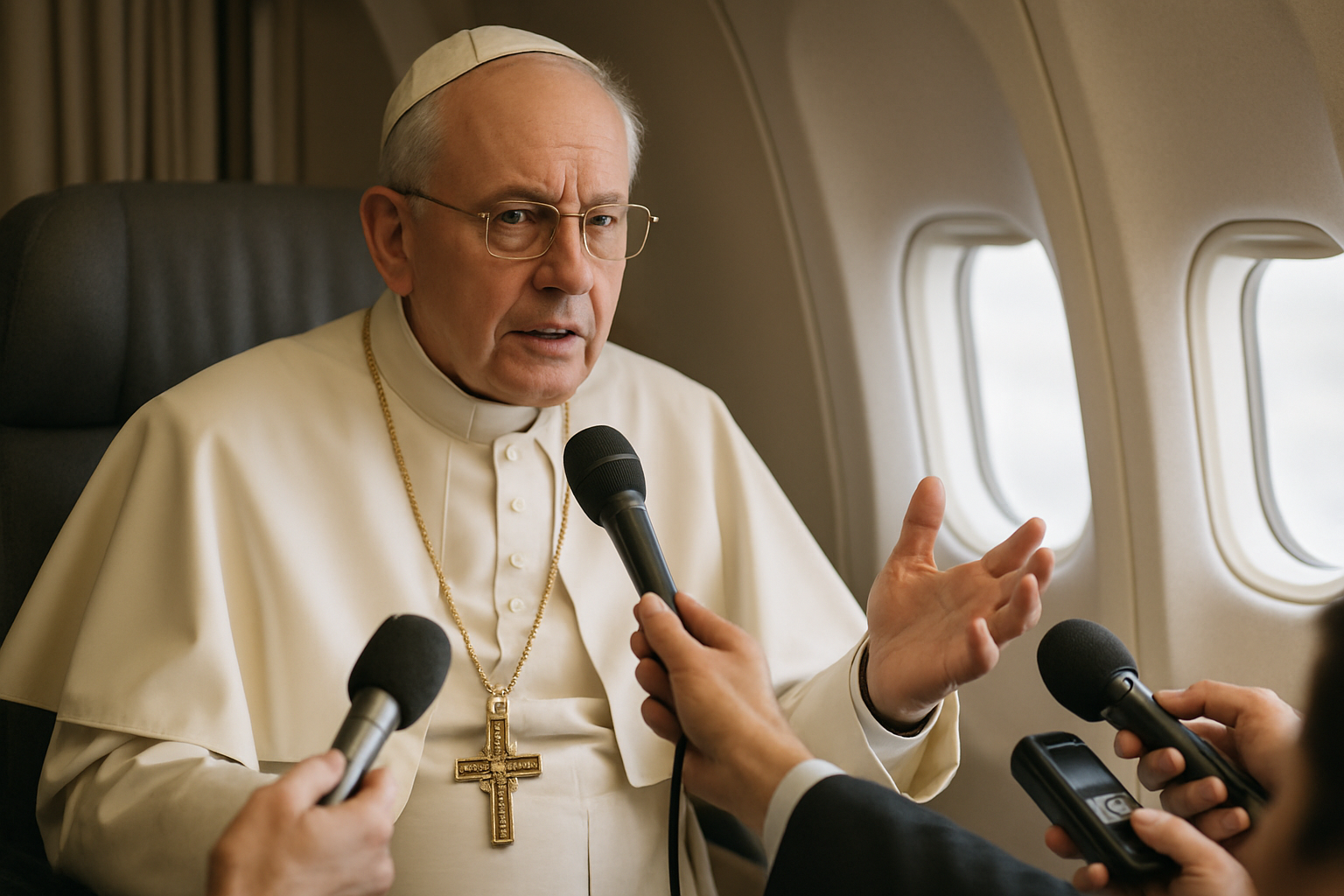
Pope Leo XIV sought to defuse unprecedented tensions with the Trump administration during his papal flight to Angola, clarifying that his recent condemnation of global "tyrants ravaging the world" was prepared well before President Trump's attacks on the Vatican and was not directed at the American leader.
Speaking to reporters aboard the papal aircraft on Saturday, the first American pontiff in Catholic Church history emphasized that his controversial speech denouncing world leaders who "spend billions on wars while ignoring humanitarian needs" was "prepared two weeks ago, well before the president ever commented on myself."
Despite the clarification, Pope Leo XIV maintained that engaging in debate with Trump "is not in my interest at all" while continuing his unwavering commitment to peace advocacy during what has become the most serious Vatican-White House diplomatic crisis in modern history.
Historic Diplomatic Breach Continues
The clarification comes amid an extraordinary confrontation between America's first pope and its current president that has shocked Catholic communities worldwide. Trump had called Pope Leo XIV "WEAK on Crime, terrible for Foreign Policy" and posted AI-generated religious imagery depicting himself in Christ-like poses.
The crisis escalated further when Vice President JD Vance, himself a Catholic convert of seven years, told the Pope to "be careful when he talks about matters of theology" during a Georgia event - representing an unprecedented vice presidential rebuke of papal authority.
"I have no fear of the Trump administration and no fear of loudly proclaiming the Gospel message, because that is what I am here for."
— Pope Leo XIV, responding to Trump's attacks
International support for the Vatican position has been overwhelming. Italian Prime Minister Giorgia Meloni called Trump's criticism "unacceptable," Iranian President Pezeshkian condemned the AI religious imagery as "profanation of Jesus," and European leaders have increasingly referenced papal peace appeals in their own diplomatic initiatives.
Successful Algeria Visit Sets Diplomatic Precedent
The Pope's clarification came as he departed for Angola, the third stop on his historic 11-day African tour. He had just completed the first papal visit to Algeria in Catholic Church history, where President Abdelmadjid Tebboune declared him "the best advocate for peace in the world."
The Algeria visit carried profound spiritual significance, as Pope Leo XIV conducted a pilgrimage to ancient Hippo (modern Annaba) where Saint Augustine - patron saint of the Pope's Augustinian order - lived and wrote his theological masterworks "Confessions" and "The City of God" in the 5th century.
The timing during the final days of Ramadan created what Vatican sources described as a "Catholic-Muslim spiritual convergence," demonstrating the Pope's commitment to interfaith dialogue even amid political tensions with his home country's administration.
Angola Phase Addresses Economic Justice
Arriving in Luanda to thousands of welcoming faithful, Pope Leo XIV used his Angola visit to denounce what he called the "logic of extractivism" that has exploited the country's vast natural resources while leaving many in poverty. This marked his third papal visit to Angola, following John Paul II in 1992 and Benedict XVI in 2009.
The Pope urged Angolan authorities not to "have fear of dissidence" in the country that has been dominated by the same political party since its 1975 independence. His message emphasized social justice and environmental responsibility, themes that have become central to his pontificate.
Revolutionary Vatican Diplomacy
Vatican sources confirm that Pope Leo XIV has deliberately adopted what they term a "moral authority over diplomatic comfort" approach - a fundamental departure from the traditional Vatican protocols that favor careful diplomatic language over direct moral challenges.
This diplomatic revolution began with the Pope's evolution from expressing "deep concern" about global conflicts to delivering increasingly forceful condemnations, including his Palm Sunday declaration that God rejects leaders with "hands full of blood" and his Easter message urging those with weapons to "lay them down."

American Catholic Community in Crisis
The unprecedented situation of America's first pope confronting America's current president has created what observers describe as a constitutional crisis within the American Catholic community. Traditional Trump supporters have expressed "unprecedented dismay" at attacks on papal authority, with Catholic author George Weigel noting that "American Catholics are understanding the mistake - they voted for a narcissist."
The confrontation represents a fundamental test between political loyalty and religious conviction, particularly significant given that Catholics constitute a crucial swing demographic in American elections.
Africa Tour Demonstrates Global Vision
The comprehensive 10-day African tour (April 13-23) across Algeria, Cameroon, Angola, and Equatorial Guinea acknowledges Africa as the fastest-growing Catholic region worldwide, with over 1.4 billion believers representing more than a fifth of the world's Catholics.
The tour includes 11 cities, 25 speeches, and 8 masses, representing the most ambitious papal journey of Leo XIV's pontificate. In Cameroon, he addressed the decade-long anglophone conflict through a visit to Bamenda, demonstrating the Vatican's commitment to direct pastoral engagement with contemporary challenges rather than ceremonial protocols.
Template-Setting Implications
Vatican experts describe the current confrontation as potentially template-setting for 21st-century papal diplomacy. The success or failure of maintaining papal independence despite direct political pressure from the American administration could influence Vatican global influence for decades.
The Pope's clarification about his "tyrants" comments demonstrates sophisticated diplomatic balance - reducing tension while maintaining unwavering commitment to peace advocacy. This approach positions the Vatican as an increasingly important voice in international affairs, showing how ancient spiritual traditions can provide contemporary moral guidance for a world seeking peace and justice.
Continuing Impact
As Pope Leo XIV continues his African tour with upcoming visits to Equatorial Guinea, the template he is establishing - combining massive popular support with moral clarity on global issues - represents a fundamental shift in how the Vatican engages with contemporary challenges.
The success of his Algeria breakthrough provides a framework for future Vatican diplomatic initiatives connecting the ancient church's African roots with its contemporary global mission, while his clarification regarding Trump demonstrates the sophisticated balance required in maintaining religious authority amid unprecedented political pressure.