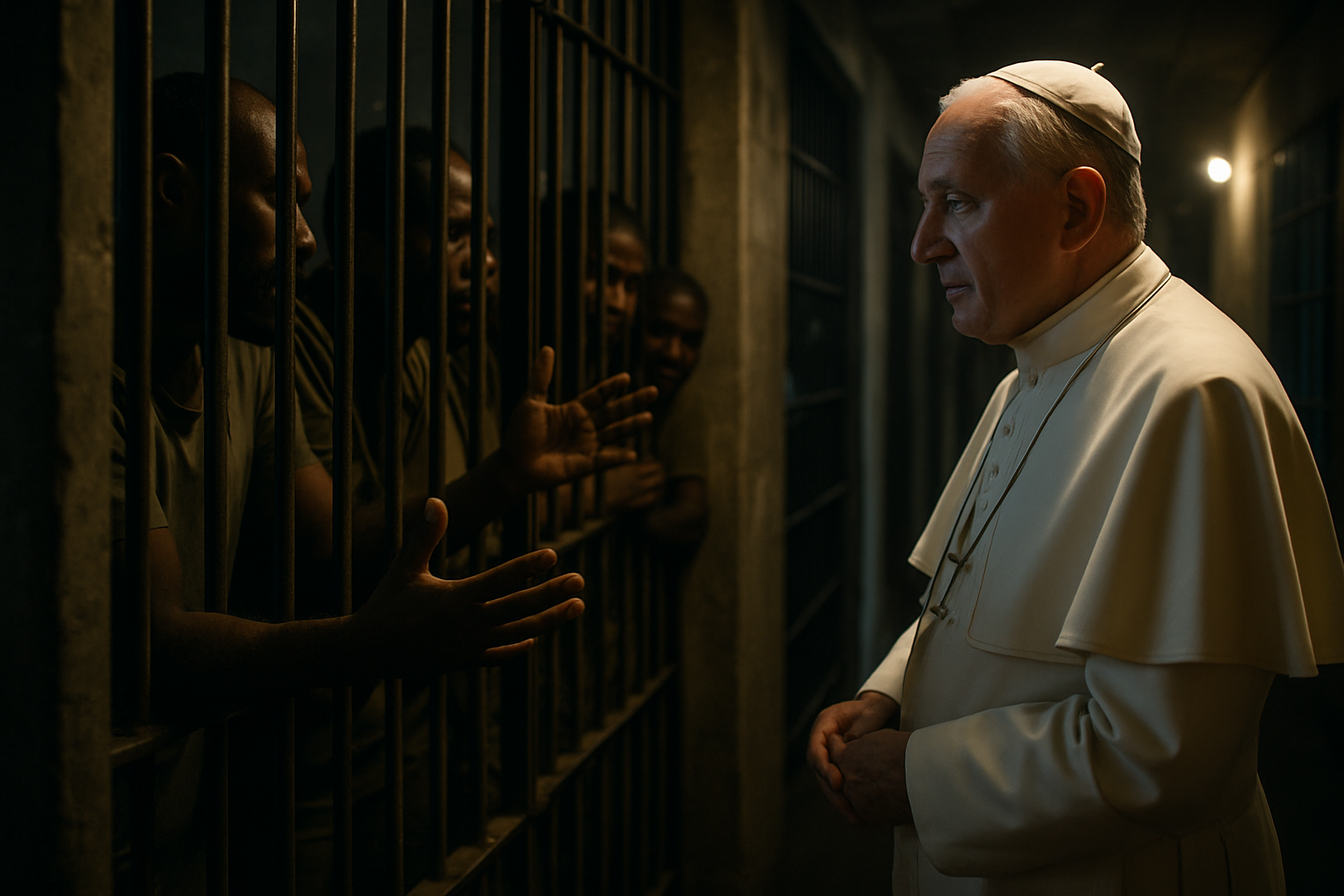
Pope Leo XIV concluded his groundbreaking 11-day African tour on Wednesday with one of the most dramatic moments of his pontificate, visiting a prison in Equatorial Guinea where inmates cried out for freedom as the pontiff delivered a message of hope and justice in one of Africa's most repressive nations.
The historic tour, spanning April 13-23 across four African countries, marked the most ambitious papal journey of Leo XIV's pontificate and established new precedents for Vatican engagement with the Global South. The American Pope's final stop in Equatorial Guinea proved particularly poignant, as he confronted issues of corruption and inequality in a country widely criticized for its authoritarian governance.
Prison Visit Highlights Inequality and Repression
During his visit to a prison facility in Equatorial Guinea, Pope Leo XIV witnessed firsthand the conditions that have made the Spanish-speaking nation one of the most criticized regimes in the region. According to multiple sources, inmates could be heard calling out for "freedom" as the pontiff moved through the facility, creating some of the most powerful imagery of the entire African tour.
The prison visit came as Pope Leo XIV delivered some of his strongest criticisms yet of global inequality and corruption. Speaking before the nation's leadership, including President Teodoro Obiang Nguema Mbasogo and his family, the Pope called for "more justice" in the country, marking a significant departure from traditional diplomatic protocols.
"The visit of the Pope to Equatorial Guinea presents a paradox: it offers a rare opportunity to spotlight injustice, yet risks being appropriated by the regime for its own validation."
— Tutu Alicante, International Human Rights Lawyer
International human rights advocate Tutu Alicante warned that while the papal visit could shine a spotlight on injustice, it also risked being exploited by the authoritarian regime for legitimacy. "Could the moral authority on the world stage inadvertently lend credence to the authoritarian regime?" Alicante questioned, emphasizing that natural resources in Equatorial Guinea "have failed to lift up society and translate into human dignity."
Culmination of Revolutionary African Tour
The Equatorial Guinea visit marked the dramatic conclusion of what Vatican experts describe as the most transformative papal journey in decades. The 11-day tour included the first papal visit to Algeria in Catholic Church history, powerful condemnations of global "tyrants" in Cameroon, and anti-corruption appeals in Angola.
Throughout the journey, Pope Leo XIV demonstrated his commitment to what Vatican sources call "moral authority over diplomatic comfort" — a fundamental departure from traditional papal protocols that favor careful diplomatic language over direct moral challenges.
Algeria Breakthrough
The tour began with historic success in Algeria, where Pope Leo XIV became the first pontiff ever to visit the Muslim-majority nation. The spiritual pilgrimage to ancient Hippo, where Saint Augustine lived and wrote his theological masterworks, carried profound significance for the Augustinian Pope. President Abdelmadjid Tebboune welcomed the Pope as "the best advocate for peace in the world."
Cameroon's Powerful Message
In Cameroon, the Pope delivered perhaps his strongest condemnation of global leadership, declaring the world "ravaged by a handful of tyrants" who spend billions on wars while ignoring humanitarian needs. Speaking in Bamenda, the largest city in the conflict-affected anglophone regions, he called for "decisive change of course towards peace."
Angola's Anti-Corruption Stand
The Angola phase saw the Pope denounce the "logic of extractivism" that has characterized the oil-rich nation's relationship with its vast natural resources. Visiting the Sanctuary of Mama Muxima, built on a former Portuguese slave trade site, the first American pontiff addressed historical wounds while calling for contemporary justice.
Template for 21st-Century Papal Diplomacy
Vatican experts describe the African tour as potentially template-setting for 21st-century papal diplomacy, demonstrating how religious authority can challenge political power through moral clarity rather than diplomatic accommodation.
The tour's success comes despite unprecedented tensions with the Trump administration, which escalated during the journey when Vice President JD Vance criticized the Pope's theological statements and President Trump called the pontiff "weak on crime" and "terrible for foreign policy." The Pope's response was unequivocal: "I have no fear of the Trump administration and no fear of loudly proclaiming the Gospel message."
International support for the Vatican's position has been overwhelming, with Italian Prime Minister Giorgia Meloni calling Trump's criticism "unacceptable," and Iranian President Masoud Pezeshkian condemning attacks on papal authority. European leaders increasingly reference papal appeals in their own diplomatic initiatives.
Africa as the Church's Future
The comprehensive tour acknowledged Africa as the fastest-growing Catholic region worldwide, representing over 1.4 billion believers — more than a fifth of the world's Catholics. The 11-day journey spanning four nations, 11 cities, 25 speeches, and 8 masses demonstrated the Vatican's commitment to direct engagement with the Global South.
Pope Leo XIV's approach represents a fundamental shift from ceremonial protocols toward pastoral work that directly addresses contemporary challenges including corruption, conflict mediation, and poverty alleviation.
Equatorial Guinea's Critical Context
The final stop in Equatorial Guinea proved particularly significant given the country's reputation as one of the most repressive in the region. The Spanish-speaking nation has been run by the same family since independence, with governance characterized by what critics describe as exclusion, repression, and erosion of accountability.
Despite the nation's oil wealth, the majority of its population remains in poverty, exemplifying what the Pope has criticized as the "logic of extractivism" that benefits elites while failing to improve ordinary citizens' lives.
The prison visit served as a powerful symbol of the Pope's commitment to reaching the most marginalized populations, even in contexts where such visits might create diplomatic complications.
Global Impact and Future Implications
The African tour's conclusion in Equatorial Guinea sends a clear message about the Vatican's evolving role in global affairs. Rather than avoiding controversial situations, Pope Leo XIV has chosen to engage directly with some of the world's most challenging governance contexts.
This approach reflects the Pope's broader philosophy of placing moral authority above diplomatic comfort, potentially influencing how religious leadership engages with political power for decades to come.
As the first American pope completes his most ambitious international journey, the dramatic scenes from Equatorial Guinea — inmates crying for freedom, a pontiff undaunted by authoritarian settings — may well define the template for Vatican engagement with the 21st century's most pressing challenges.
Looking Ahead
The successful completion of the African tour, despite unprecedented political pressure from Washington and challenging contexts across the continent, demonstrates the resilience of papal moral authority in international affairs. The journey from Algeria's interfaith dialogue to Equatorial Guinea's prison corridors illustrates Pope Leo XIV's commitment to reaching all communities, regardless of political sensitivities.
As the Vatican continues to position itself as an uncompromising voice for peace and justice, the African tour's template of direct engagement over ceremonial protocols may well influence papal diplomacy for generations to come, establishing new standards for how religious authority can effectively challenge political power in an increasingly interconnected world.