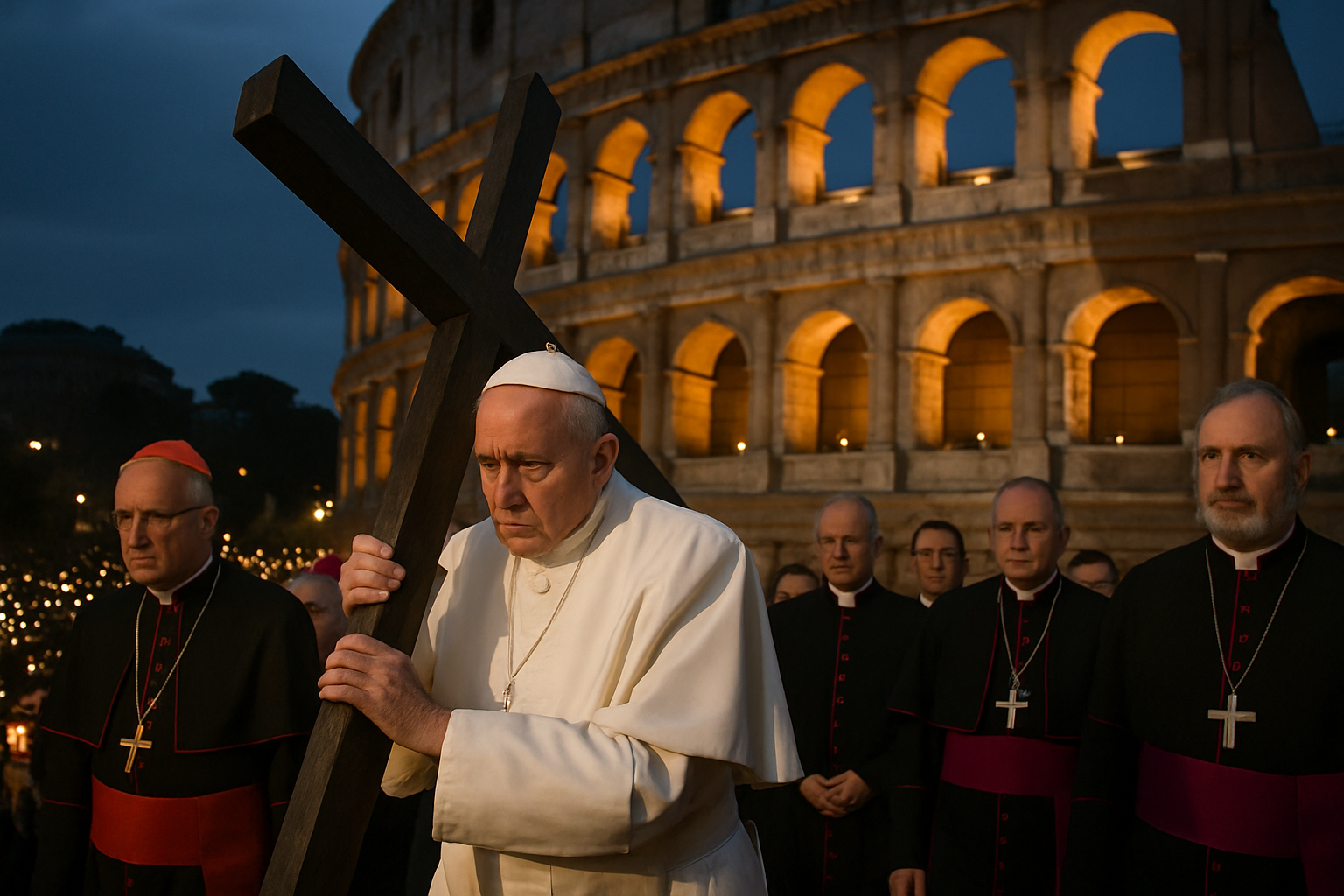
Pope Leo XIV made history on Good Friday as he personally carried the wooden cross through all 14 stations of the Way of the Cross at Rome's ancient Colosseum, becoming the first pope in more than three decades to perform this deeply symbolic act for the entire Via Crucis ceremony.
The 69-year-old pontiff lifted the heavy wooden cross from his waist at the beginning of the procession on April 3, 2026, and continued to bear it through each station representing Christ's path to crucifixion. The extraordinary gesture marked a significant departure from recent tradition, where the cross is typically carried by various participants including young people, religious figures, and community representatives while the pope presides over meditations.
"I think it will be an important sign because of what the pope represents, a spiritual leader in the world today, and for this voice, that everyone wants to hear, that says Christ still suffers," Pope Leo told reporters earlier in the week, explaining his decision to personally carry the cross throughout the ceremony.
Historic Significance and Symbolism
The last time a pope carried the cross for the full Good Friday procession was in 1994, making Leo XIV's gesture a watershed moment in Vatican traditions. The Via Crucis at the Colosseum has been a cornerstone of Catholic Holy Week observances since its establishment, drawing millions of faithful worldwide who follow the ceremony through television and digital broadcasts.
Cardinal Baltazar Porras, who helped organize prayer vigils during Holy Week, described the papal gesture as demonstrating "extraordinary commitment to embodying Christ's suffering in our modern world." The symbolism was particularly powerful given the ceremony's setting at the Colosseum, where early Christians faced persecution nearly two millennia ago.
"This gesture speaks to the Pope's desire to show personal solidarity with suffering humanity at a time when conflicts rage worldwide and millions face persecution for their faith."
— Cardinal Pierbattista Pizzaballa, Latin Patriarch of Jerusalem
Global Significance Amid International Tensions
The unprecedented papal gesture took place against the backdrop of heightened global tensions, including ongoing conflicts in the Middle East and restrictions on religious freedom in various regions. Just days before Good Friday, Israeli authorities had prevented Cardinal Pizzaballa from entering the Church of the Holy Sepulchre for Palm Sunday mass, marking the first such restriction in centuries.
During his earlier Palm Sunday address, Pope Leo XIV had delivered his strongest condemnation yet of global warfare, declaring that God rejects the prayers of leaders who wage war with "hands full of blood." The Good Friday cross-bearing continued this theme of papal engagement with contemporary suffering.
The ceremony attracted thousands of faithful to the Colosseum and was watched by millions around the world. Security measures were heightened due to ongoing regional tensions, but the procession proceeded peacefully with participants holding candles as darkness fell over the ancient amphitheater.
International Catholic Community Response
Catholic communities worldwide responded with overwhelming support for Pope Leo XIV's historic gesture. In El Salvador, the traditional "Procesión de Los Cristos" in Izalco district drew hundreds of faithful who saw the papal example as reinforcing their own Holy Week devotions. German media noted the contrast with previous papal approaches, describing Leo XIV as demonstrating "authentic spiritual leadership over ceremonial displays."
The ceremony concluded with Pope Leo XIV offering his apostolic blessing from the area near the Roman Forums, bringing the historic Good Friday observance to a close. Japanese Catholic media reported that the evening service included special prayers for war orphans and deported immigrant children, reflecting the Pope's commitment to addressing contemporary humanitarian crises.
Continuing Holy Week Traditions Worldwide
While Rome provided the centerpiece of Good Friday observances, Catholic communities worldwide maintained their own rich traditions. In Jerusalem, despite earlier restrictions, Catholic leaders were eventually able to celebrate Good Friday ceremonies, though with enhanced security measures. Finland held its annual "Via Crucis" passion play at Senate Square in Helsinki, demonstrating the global reach of Good Friday observances.
The papal gesture also resonated across Latin America, where Holy Week processions continue to draw massive participation. Venezuela's media highlighted how Pope Leo XIV had "recovered the tradition" of personally bearing the cross, connecting his action to centuries of papal precedent while acknowledging its contemporary rarity.
Looking Ahead: Papal Leadership Style
Pope Leo XIV's decision to carry the cross throughout the entire Good Friday ceremony provides insight into his evolving leadership style since becoming pontiff in May 2025. The American-born pope has consistently emphasized substantive spiritual messaging over traditional ceremonial gestures, and Friday's cross-bearing represented perhaps his most powerful symbolic act to date.
The gesture also sets a precedent for future papal Good Friday ceremonies. Vatican observers note that such personal involvement in the physical aspects of the Via Crucis reflects Pope Leo XIV's broader approach to papacy – one that emphasizes direct engagement with the symbols and practices of Christian faith rather than purely ceremonial oversight.
As the Catholic Church approaches Easter Sunday, the image of Pope Leo XIV bearing the cross through all 14 stations will likely remain one of the defining moments of his pontificate, demonstrating how ancient traditions can find powerful new expression through pastoral leadership willing to embody the faith's central message of redemption through suffering.