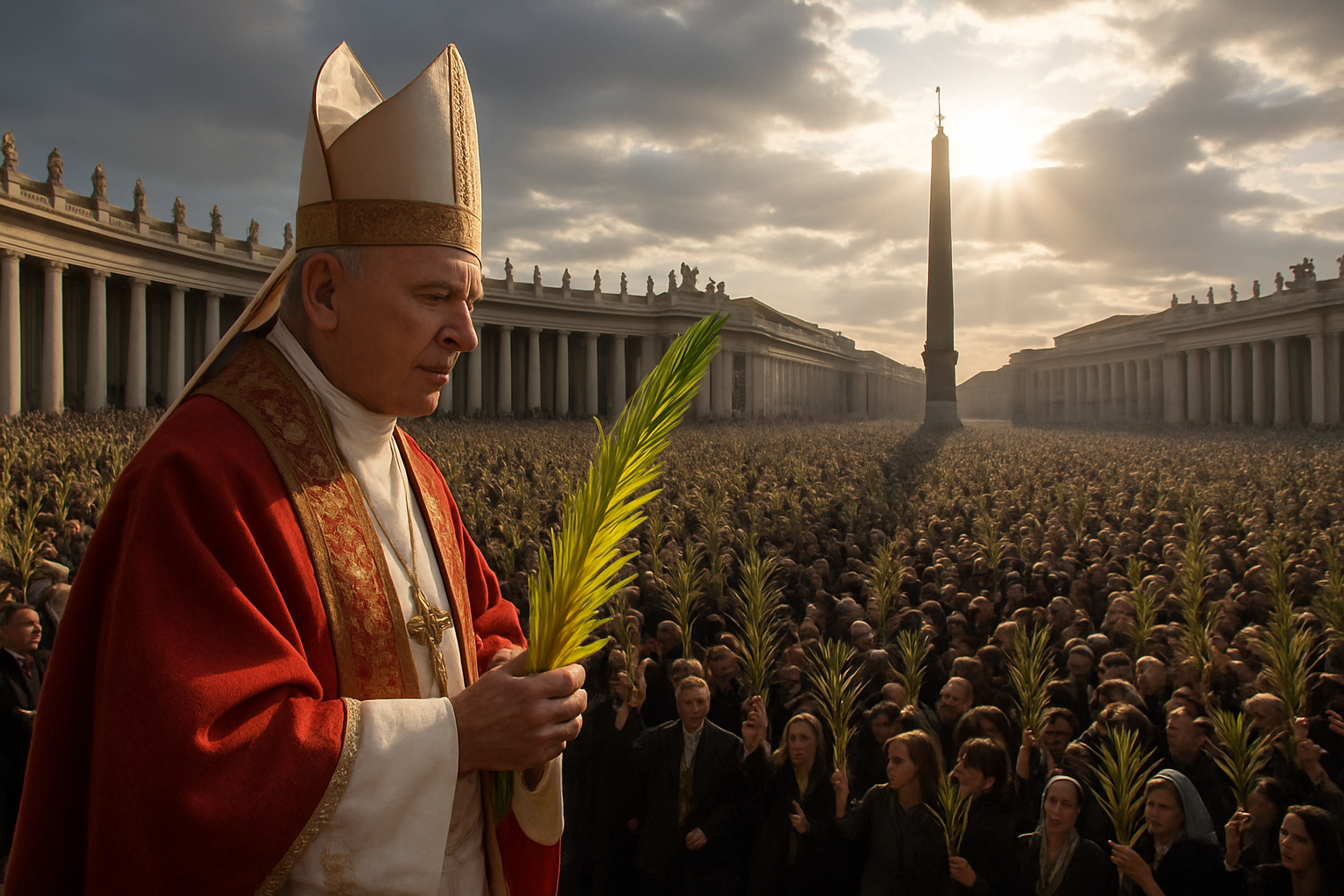
Pope Leo XIV delivered his most forceful condemnation of warfare yet during Palm Sunday Mass at St. Peter's Square, declaring that God rejects the prayers of leaders who start wars and have "hands full of blood," in unusually strong remarks as the Iran conflict continues to devastate the Middle East.
Addressing tens of thousands of faithful gathered in St. Peter's Square on March 29, 2026, the American pontiff used the traditional Palm Sunday celebration – which opens Holy Week leading to Easter – to deliver an uncompromising message against those who justify violence in God's name.
"This is our God: Jesus, King of Peace, who rejects war, whom no one can use to justify war," Pope Leo XIV told the crowds in brilliant sunshine. "[Jesus] does not listen to the prayers of those who wage war, but rejects them, saying: 'Even though you make many prayers, I will not listen: your hands are full of blood.'"
Biblical Foundation for Peace
The Pope's remarks, citing the Old Testament book of Isaiah, represented a significant escalation in papal rhetoric as the Iran war enters its second month with devastating consequences across the Middle East. The conflict has resulted in over 18,000 flight cancellations globally, oil prices exceeding $80 per barrel, and the closure of the Strait of Hormuz affecting 40% of global oil transit.
During the traditional blessing of palm branches that began the ceremony, Pope Leo XIV emphasized that the Christian faith fundamentally rejects the use of religion to justify military action. The message resonated particularly strongly given the ongoing conflicts in Iran, Ukraine, and other global flashpoints.
"No one can invoke God's name to justify violence and oppression," the pontiff declared, speaking in his characteristically direct style that has defined his papacy since his election in May 2025 as the first American Pope.
Middle East Crisis Context
The Palm Sunday address comes at a critical moment in the Middle East crisis, which began with the US-Israeli "Operation Epic Fury" strikes and has since escalated into Iran's systematic "Operation True Promise 4" retaliation targeting regional allies and US military installations.
Casualties continue to mount across the region: the UAE reported one civilian killed from missile debris in Abu Dhabi, while Kuwait's airport suffered drone strikes injuring multiple employees. Israel has faced continued missile barrages, with recent strikes in Tel Aviv killing civilians including an infant.
The aviation crisis has become unprecedented in scope, with eight Middle Eastern countries simultaneously closing their airspace and Dubai International Airport – the world's busiest – remaining shuttered due to missile damage.
Historical Precedent and Papal Authority
Pope Leo XIV's Palm Sunday intervention builds on a pattern of increasingly forceful peace appeals since moving into the renovated Apostolic Palace in March 2026. His March 15 call for an immediate Middle East ceasefire marked his strongest intervention yet, evolving from expressions of "deep concern" to direct appeals to "those responsible for this conflict."
The timing of the message – delivered from the newly restored papal residence after ten months of renovation – signals the full weight of papal authority being brought to bear on the crisis. This represents a template-setting moment for Vatican moral leadership in 21st-century international affairs.
"Violence can never lead to the justice, stability and peace that the people are waiting for."
— Pope Leo XIV, March 15, 2026
Global Diplomatic Implications
The Pope's Palm Sunday message occurs against the backdrop of collapsing diplomatic frameworks. The Iran nuclear crisis emerged from the breakdown of Geneva negotiations despite achieving "broad agreement on guiding principles" – the most progress since the 2018 JCPOA collapse.
The structural obstacle remains unchanged from decade-old diplomatic efforts: Iran excludes ballistic missiles and proxy activities as "red lines" from nuclear-only talks, while the US demands comprehensive agreements addressing missiles, armed groups, and human rights.
This diplomatic failure unfolds amid broader nuclear governance breakdown, with the New START treaty between the US and Russia having expired February 5, 2026 – marking the first time in over 50 years without nuclear arms control constraints between superpowers.
Religious Freedom Under Threat
The Pope's message gains additional urgency from reports that Israeli authorities prevented Cardinal Pierbattista Pizzaballa, the Latin Patriarch of Jerusalem, from entering the Church of the Holy Sepulchre for Palm Sunday Mass – marking what observers called the "first time in centuries" such restrictions occurred at Christianity's holiest site.
The incident drew international condemnation from Italy, France, and multiple European leaders, highlighting how the expanding conflict threatens religious freedom for all faiths in the region. Simultaneous restrictions affecting 2 billion Muslims during Ramadan and 2.4 billion Christians during Holy Week represent an unprecedented situation.
Interfaith Dialogue and Monaco Legacy
Pope Leo XIV's Palm Sunday address follows his historic March 28 visit to Monaco – the first papal visit to the Principality in 488 years – where he addressed economic inequality and delivered a powerful message about social justice. The Monaco visit occurred during Ramadan, creating what Vatican observers called a "Catholic-Muslim spiritual convergence" aligned with the Pope's commitment to interfaith dialogue.
This emphasis on bridge-building between faiths becomes particularly significant as conflicts worldwide increasingly involve religious justifications or target religious communities.
Humanitarian Focus
Throughout his Palm Sunday homily, Pope Leo XIV maintained focus on civilian casualties, particularly children and medical personnel. The ongoing conflicts have resulted in systematic targeting of healthcare workers, with Lebanon reporting 26 paramedics killed and 51 wounded, while Iran has suffered civilian casualties including a devastating school attack in Minab that killed dozens of students.
The Vatican has expressed particular concern about attacks on medical facilities, describing them as violations of the Geneva Conventions that protect civilian infrastructure during wartime.
Looking Toward Easter
As the Catholic Church enters Holy Week, Pope Leo XIV's message sets the tone for Easter celebrations that will be closely watched globally. The Pope's condemnation of leaders who "wage war" while claiming divine justification establishes a clear moral framework as the world grapples with multiple conflicts.
The Vatican has announced that Easter Sunday will include special prayers for peace in the Middle East and Ukraine, continuing the Pope's pattern of using major liturgical occasions to advocate for diplomatic solutions to international crises.
With his April 13-23 Africa tour approaching – including the first papal visit to Algeria in papal history – Pope Leo XIV's Palm Sunday message demonstrates his commitment to global peace advocacy as a central pillar of his pontificate.
International Response
The Pope's unusually strong language has garnered widespread international attention, with media coverage extending from Australia to Europe highlighting the significance of his intervention. Religious leaders across denominations have echoed similar calls for peace, while diplomatic circles view the papal message as potentially influential in ongoing mediation efforts.
The message particularly resonates in regions experiencing conflict, where religious communities often serve as crucial voices for reconciliation and humanitarian assistance.
As Holy Week continues, Pope Leo XIV's Palm Sunday declaration that "God rejects the prayers of those who wage war" stands as perhaps his most uncompromising statement yet on the moral obligations of world leaders in pursuing peace over conflict.