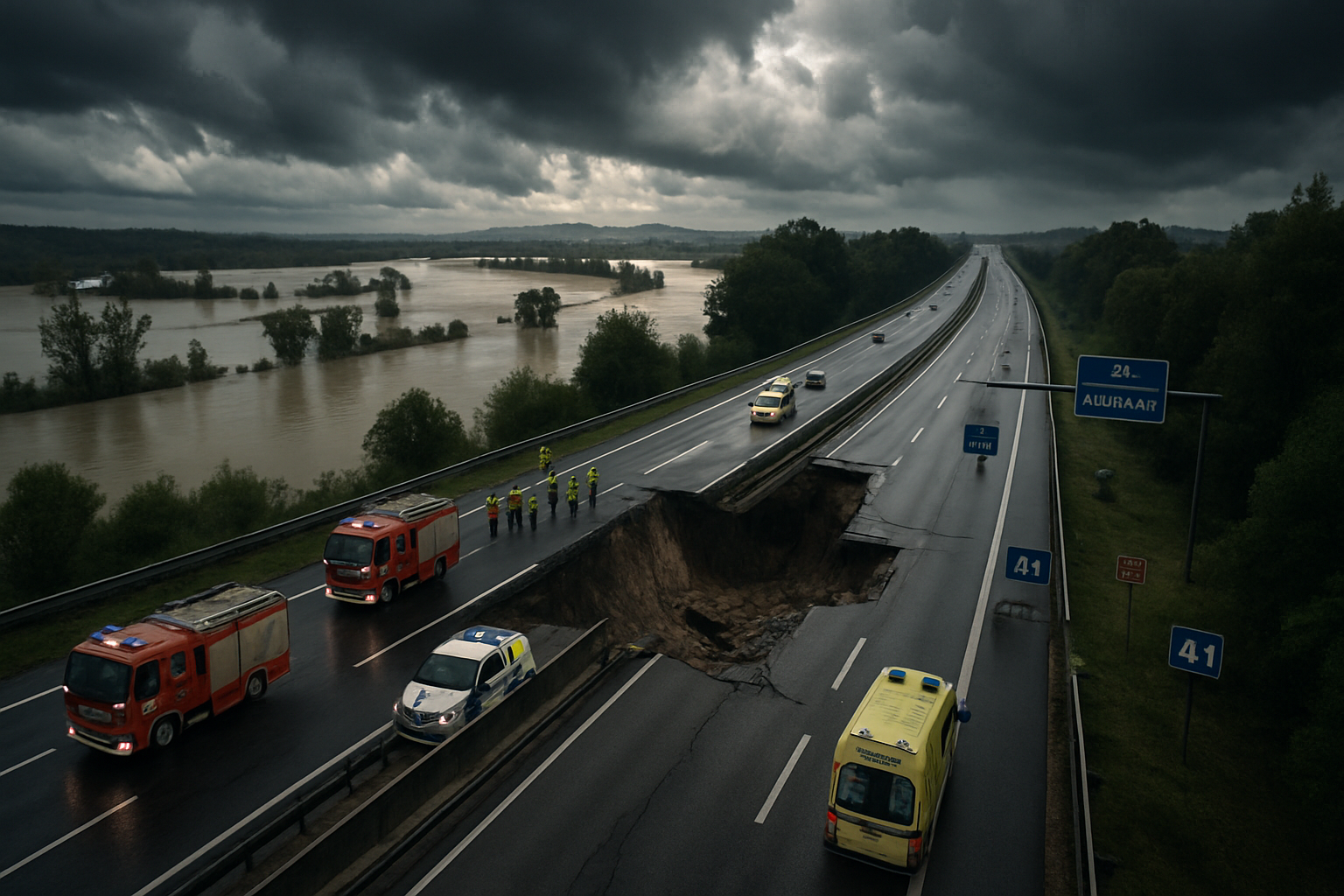
A critical section of Portugal's main A1 highway collapsed near Coimbra early Thursday morning after devastating flooding from the swollen Mondego River undermined the roadway, marking the latest catastrophic infrastructure failure from consecutive Atlantic storms that have killed at least 16 people and prompted the largest peacetime rescue operation in Portuguese history.
The highway section at kilometer 191.2 in the Norte-Sul direction completely gave way due to immense water pressure from the Mondego River following the collapse of a protective dike in Coimbra. The failure occurred near the Ponte dos Casais, forcing authorities to close the A1 in both directions as emergency teams assessed the extensive damage.
"The situation is very serious and will take considerable time to repair," announced Civil Protection authorities, warning that the A1 closure would significantly impact transportation throughout central Portugal. The highway serves as the country's main north-south arterial route connecting Lisbon to Porto.
Unprecedented Infrastructure Crisis
The A1 collapse represents the most severe infrastructure damage from a relentless succession of three Atlantic storms - Kristin, Leonardo, and Marta - that have battered the Iberian Peninsula over two weeks in February 2026. Portugal has deployed an unprecedented 26,500 rescue personnel, including 1,975 military staff and 30 naval vessels, in response to more than 1,800 weather-related incidents since February 1.
Civil Protection officials report that Portugal has experienced over 1,600 weather emergencies, with the Centro region and Lisboa and Vale do Tejo areas bearing the brunt of flooding and tree collapses. The Mondego River basin has emerged as the primary concern for authorities, with water levels reaching critical thresholds not seen since 1997.
In the riverside parish of São João do Campo, local president Valter Santos indicated that some residents have refused evacuation orders despite the mounting dangers. "Some people decided to stay," Santos told reporters, noting that the right bank of the river poses fewer risks to the population.
Widespread Evacuations and Emergency Response
The infrastructure collapse comes as Portugal has extended its national calamity status through February 15, with authorities coordinating mass evacuations across flood-prone areas. The government launched "Portugal Acolhe" (Portugal Welcomes), a program that has mobilized 27 hotel units to provide emergency accommodation for displaced families affected by the severe weather.
Transportation networks across Portugal remain severely disrupted. The Castanheira-Alverca railway line, a critical commuter route serving Lisbon, has been suspended indefinitely due to flooding. Multiple other rail services across the Norte, Douro, Oeste, Beira Baixa, Cascais, and Vendas Novas lines have been cancelled, leaving thousands of daily commuters stranded.
The Douro River reached critical 1997 flood levels in Porto, threatening the historic Ribeira and Miragaia neighborhoods. In Alcácer do Sal, flooding has exceeded the catastrophic 1963 levels, with one confirmed death from the overflowing Sado River.
International Context and Climate Implications
The Portuguese crisis unfolds against the backdrop of what scientists have confirmed as January 2026 being the hottest month in recorded global history - the 18th of the past 19 months to exceed 1.5°C above pre-industrial levels. This paradoxical situation demonstrates how global warming can simultaneously enable both heat records and devastating regional extremes through disrupted weather patterns.
According to historical records from our investigation, Portugal's current emergency represents the culmination of a devastating succession of storms that have killed more than 14 Europeans since late January, requiring emergency personnel deployment of 26,500 - the largest peacetime operation in Portuguese history.
The European Union has activated its Civil Protection Mechanism in response to the crisis, with Sweden and Denmark announcing a €246 million emergency assistance package. The coordinated international response highlights the regional nature of the climate emergency affecting multiple European nations simultaneously.
Political and Democratic Resilience
Despite the infrastructure chaos, Portugal's presidential runoff election proceeded as scheduled on February 8, demonstrating remarkable democratic resilience under extreme conditions. Socialist candidate António José Seguro achieved a landslide victory with 66.82% of the vote against far-right challenger André Ventura, though approximately 36,000 voters were unable to participate due to storm damage affecting 14.4% of the electorate in the worst-hit areas.
The election proceeded despite constitutional law preventing national postponement, setting a significant precedent for maintaining democratic processes during environmental emergencies. The new president will inherit massive reconstruction challenges, with billions in damages across agricultural and tourism sectors.
Economic and Social Impact
The successive storms have exposed critical vulnerabilities in Portugal's infrastructure systems. Power outages have affected 167,000 residents, with some localities in Pombal remaining without electricity for over 10 days, prompting public demonstrations. The prolonged outages have forced the closure of cultural institutions including Lisbon's MAAT museum, the Monument to Discoveries, and São Jorge Castle.
Agricultural and tourism sectors face devastating losses estimated in the billions of euros. Spanish reservoirs have surged to 67.3% capacity with 31 at 100% following the exceptional rainfall. The region of Grazalema recorded 1,500 liters per square meter of rainfall in 36 hours - exceeding Madrid's entire annual total.
Recovery efforts are expected to extend for months, with authorities emphasizing the need to "build back better" with climate-resilient infrastructure. The crisis has exposed the inadequacy of current systems designed for historical climate patterns rather than the increasing volatility of extreme weather events.
Looking Forward: Adaptation and Resilience
The A1 highway collapse and broader infrastructure failures represent a watershed moment for European climate adaptation strategies. The simultaneous nature of disasters across the continent has strained traditional regional aid mechanisms, requiring enhanced international cooperation frameworks.
Scientists warn that the frequency and intensity of such extreme weather events will continue to increase as global warming progresses, making the current crisis a preview of routine conditions expected in the 2030s without significant climate action and adaptation investment.
As emergency services work around the clock to restore basic services and begin the massive reconstruction effort, the Portuguese crisis serves as both a tragic reminder of climate change impacts and a template for how democratic institutions can maintain continuity even under the most challenging environmental conditions.
The collapsed A1 highway section near Coimbra stands as a stark symbol of the new reality facing Europe: infrastructure built for yesterday's climate struggling to survive in tomorrow's world, demanding fundamental rethinking of how societies prepare for an era of permanent climate volatility.