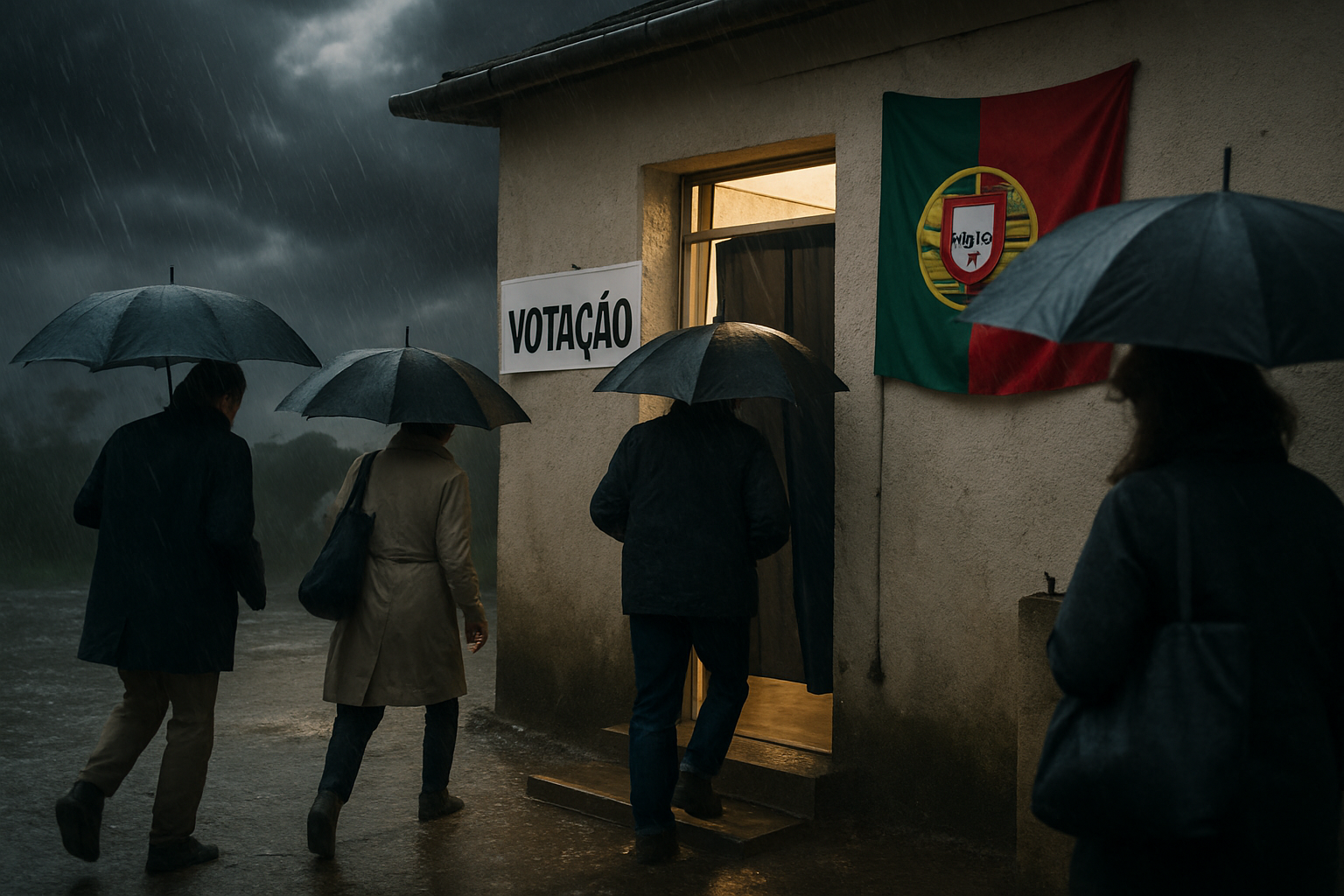
Portuguese voters headed to polling stations Sunday in extraordinary weather conditions to elect their next president, with the decisive runoff between center-left Socialist António José Seguro and far-right populist André Ventura proceeding despite Storm Marta's devastating impact across the country.
The election represents a critical test of Portugal's democratic resilience as the nation grapples with the intersection of climate crisis and electoral processes. Polls opened at 8 AM local time and will close at 7 PM, with approximately 11 million eligible voters choosing the successor to outgoing President Marcelo Rebelo de Sousa.
Storm Conditions Challenge Democratic Process
The election unfolds against the backdrop of Portugal's most severe weather crisis in recent memory. Storm Marta, the third major Atlantic storm to strike the Iberian Peninsula in just two weeks, brought 120 km/h winds and 13-meter waves, affecting the country until 3 PM Sunday. Following the devastating impacts of Storms Kristin and Leonardo, which killed at least 14 people and forced mass evacuations, Portugal has maintained its largest peacetime rescue operation with 26,500 personnel deployed.
Weather-related disruptions have created unprecedented challenges for the electoral process. Italian sources report that 14.4% of Portuguese voters live in storm-affected areas, with approximately 36,000 citizens unable to vote due to infrastructure damage. Eight municipalities face partial or total voting limitations, though electoral law prohibits national postponement of the election.
"The choice is between António José Seguro and André Ventura. Polls opened at eight o'clock Lisbon time and close at 7 PM. There are eight councils with partial or total limitations due to bad weather."
— Portuguese Election Officials
The storm's impact extends far beyond voting logistics. Power outages affect 167,000 Portuguese residents, with some localities in Pombal remaining without electricity for over 10 days. Transportation networks remain severely disrupted, with the Castanheira-Alverca railway suspended and multiple roads closed due to flooding.
The Candidates and Political Stakes
The runoff pits two dramatically different visions for Portugal's future. António José Seguro, representing the center-left Socialist Party, emerged as the frontrunner from the January 18 first round and is widely expected to secure victory. His campaign has emphasized democratic stability, European integration, and moderate governance.
Facing him is André Ventura of the far-right Chega party, whose populist message has failed to unite Portugal's right wing behind his candidacy. International observers note that Ventura's campaign has been significantly hampered by his inability to build broader conservative coalitions following the first round of voting.
The electoral context reflects broader European concerns about far-right populism. A broad political coalition has formed against Ventura, with prominent conservatives backing Seguro to defend democratic values—a pattern seen across Europe as mainstream parties unite against extremist movements.
Climate Crisis Tests Democratic Institutions
The election occurs during what has been confirmed as January 2026, the hottest month in global history—the 18th of the past 19 months to exceed 1.5°C above pre-industrial levels. This temperature anomaly provides stark context for the extreme weather events disrupting Portugal's democratic process.
The succession of three major storms—Kristin, Leonardo, and Marta—represents an unprecedented challenge to European emergency systems. Portugal has extended its national calamity status through February 15, with the Douro River reaching critical 1997 levels and agricultural sectors facing catastrophic damage.
"This election is taking place in a context strongly marked by damage from continuous storms affecting different municipalities."
— RTP Portuguese Television
The crisis has prompted significant international assistance, with the EU Civil Protection Mechanism activated and Sweden-Denmark providing €246 million in emergency aid. The response demonstrates European solidarity while highlighting the growing frequency and intensity of extreme weather events.
Electoral Logistics Under Extreme Conditions
Despite the challenges, Portuguese electoral authorities have maintained their commitment to democratic continuity. The decision to proceed with the election, while controversial, reflects constitutional requirements and the principle that democratic processes should not be easily disrupted.
Ventura had demanded a national postponement citing infrastructure damage and fairness concerns, but electoral law prohibits such measures except in the most severely affected local areas. This legal framework has been tested to its limits as authorities balance democratic participation with public safety.
Emergency services continue their largest peacetime operation, with 1,975 military personnel and 30 naval vessels responding to over 1,800 weather incidents since February 1. The coordination between emergency response and electoral administration represents a complex logistical challenge unique in Portuguese democratic history.
International Implications and Regional Impact
The Portuguese election is being closely watched across Europe as a bellwether for democratic resilience in the face of both political extremism and climate disruption. The outcome will influence European Union discussions on climate adaptation governance and the democratic response to environmental emergencies.
Regional cooperation has been crucial during the crisis, with Spain also facing severe flooding that forced the evacuation of over 8,000 people in Andalusia. The cross-border nature of the weather emergency has strengthened arguments for enhanced European climate coordination and emergency response mechanisms.
The election also represents a significant moment for Portugal's relationship with European integration, as voters choose between Seguro's pro-European stance and Ventura's more Eurosceptic positions.
Historical Context and Precedent
This election marks the end of Marcelo Rebelo de Sousa's presidency after two terms, during which Portugal maintained a relatively stable political trajectory within the European mainstream. The current crisis represents a confluence of challenges—political polarization, climate emergency, and institutional stress—that tests the durability of Portugal's democratic consensus.
The integration of emergency response with electoral administration creates precedents for future climate-related disruptions to democratic processes. As extreme weather events become more frequent and severe, the Portuguese experience may serve as a model for maintaining democratic continuity under environmental stress.
Looking Forward: Recovery and Reconstruction
Regardless of the electoral outcome, Portugal faces months of recovery from the unprecedented storm damage. The new president will inherit significant challenges related to infrastructure reconstruction, climate adaptation, and maintaining social cohesion during the recovery process.
The agricultural and tourism sectors, crucial to Portugal's economy, have sustained billions in damages. Recovery efforts will require sustained international cooperation and significant domestic investment in climate-resilient infrastructure.
The election represents more than a simple choice between candidates—it embodies Portugal's commitment to democratic governance even under the most challenging circumstances. As voters brave storm conditions to exercise their democratic rights, they demonstrate the resilience of democratic institutions in the face of unprecedented environmental and political challenges.
Results are expected to emerge Sunday evening, weather permitting, marking the conclusion of one of the most dramatic presidential elections in Portuguese democratic history. The winner will face the immediate challenge of leading national recovery efforts while strengthening democratic institutions against future climate-related disruptions.