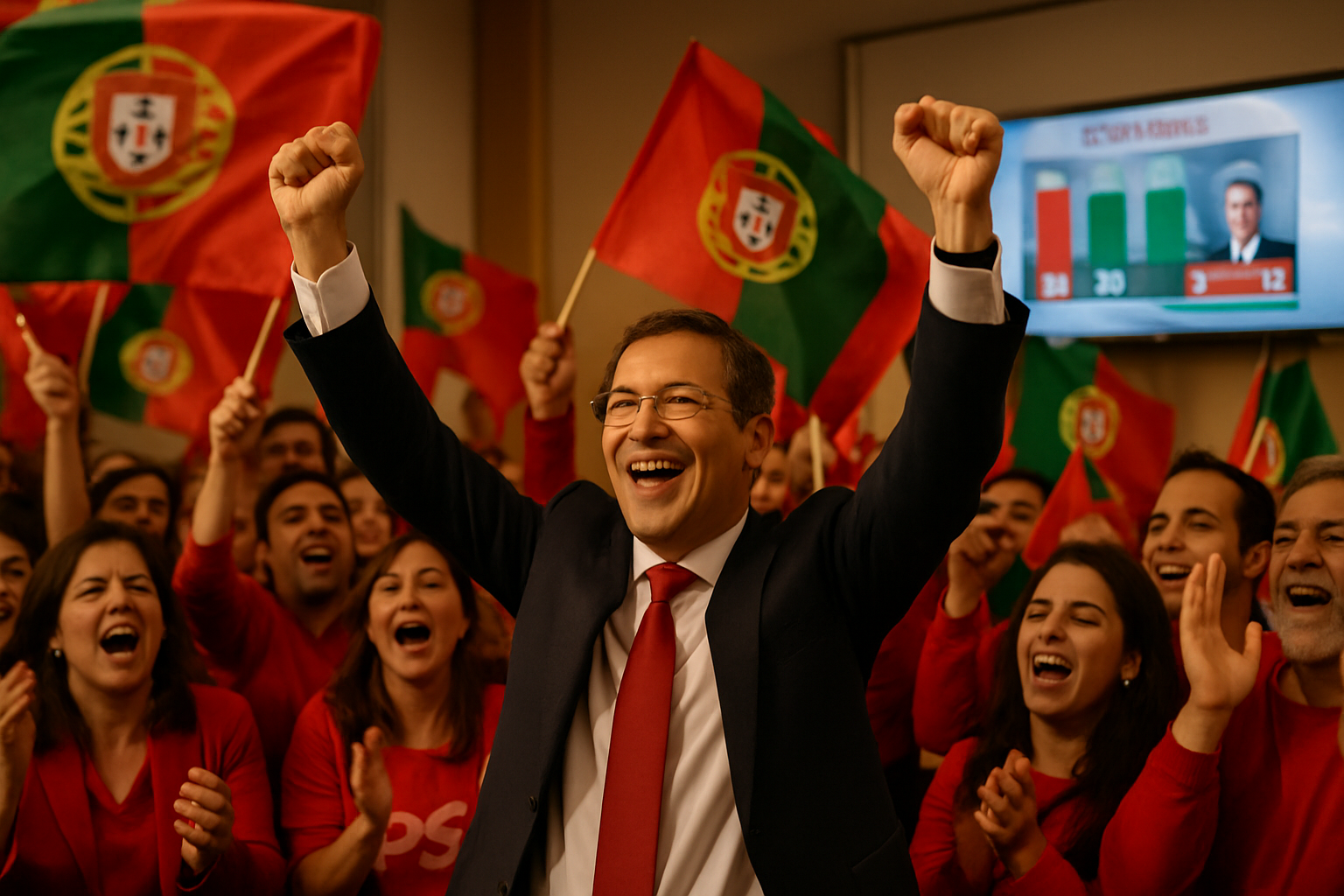
Socialist candidate António José Seguro achieved a commanding landslide victory in Portugal's presidential election runoff on February 8, 2026, securing 66.82% of the vote to decisively defeat far-right challenger André Ventura's 33.18% in a contest that proceeded despite unprecedented weather disruption.
The 63-year-old former Socialist Party leader's triumph marks the return of the left to Portugal's presidency after 20 years, with Seguro more than doubling his first-round performance to claim over 3.4 million votes against Ventura's 1.7 million. The victory margin of over 30 percentage points represents one of the largest presidential election victories in Portuguese democratic history.
Election Proceeds Despite Storm Crisis
The election unfolded under extraordinary circumstances as Portugal battled its worst weather emergency in decades. Storm Marta, the third consecutive major Atlantic storm to hit the country in two weeks, brought 120 km/h winds and 13-meter waves, leaving 167,000 residents without power and forcing the deployment of 26,500 rescue personnel in the nation's largest peacetime emergency operation.
Despite infrastructure damage that prevented 36,000 voters from participating—14.4% of the electorate in the worst-affected areas—the election proceeded according to constitutional law, which prohibits national postponement. Three municipalities were forced to delay voting by one week due to storm damage, but the overwhelming majority of Portugal's 11 million eligible voters were able to cast their ballots.
"The Portuguese people have shown extraordinary resilience in defending our democratic values under the most challenging circumstances,"
— António José Seguro, President-elect
Broad Coalition Against Extremism
Seguro's victory was powered by an unprecedented broad political coalition that formed to prevent far-right governance. The socialist candidate secured support from across the political spectrum, including backing from the center-left, centrist parties, and notably, several prominent conservative figures who crossed party lines to defend democratic institutions.
The coalition strategy proved remarkably effective, with Seguro winning all 18 districts and both autonomous regions, capturing 303 of Portugal's municipalities and over 2,900 parishes. This geographic sweep demonstrated the breadth of opposition to Ventura's populist Chega party platform.
Significantly, Prime Minister Luís Montenegro, despite not formally endorsing Seguro, emphasized "convergence" with the president-elect and highlighted the prospect of "three years and half without national elections," suggesting a period of political stability ahead.
International Implications
The result carries significant implications beyond Portugal's borders, serving as a crucial test case for European democracy's ability to resist far-right populism. The election was closely watched across Europe, where similar movements have gained ground in recent years, from France's Marine Le Pen to Italy's far-right coalition.
European Union leaders praised the outcome as evidence of democratic resilience. The victory comes at a critical time for European unity, as the continent faces multiple challenges including the ongoing Ukraine conflict, climate change pressures, and economic uncertainties.
International observers noted the significance of Portugal maintaining its moderate, pro-European path during a period when democratic institutions face stress across the globe. The successful conduct of elections despite natural disaster conditions also sets important precedents for democratic continuity under environmental emergency conditions.
Ventura's Concession and Future Challenges
André Ventura, the 43-year-old Chega party leader, conceded defeat while maintaining defiant rhetoric about his movement's future. "The success of António José Seguro at the head of Portugal will be the success of all," Ventura stated, though he quickly added that his party would "soon govern this country."
Despite the loss, Ventura's 33.18% represents a significant increase from his party's previous electoral performances, demonstrating that populist sentiment remains a substantial force in Portuguese politics. The far-right leader emphasized that Chega now "leads the right," positioning his party for future electoral battles.
Political analysts noted that while Seguro's victory was decisive, the substantial support for Ventura indicates underlying social and economic grievances that the new president will need to address during his five-year term.
Climate Crisis and Democratic Resilience
The election's most remarkable aspect may be its successful completion despite the ongoing weather emergency. Portugal's ability to maintain democratic processes while managing a crisis that required military deployment and international assistance—including €246 million in aid from Sweden and Denmark—demonstrates institutional resilience rarely tested in modern democracies.
The succession of storms Kristin, Leonardo, and Marta that killed 14 people and caused billions in agricultural and infrastructure damage created an unprecedented intersection of climate crisis and democratic governance. Emergency services remained at operational capacity limits throughout election day, yet the constitutional process continued.
This successful navigation of simultaneous crises provides a template for other democracies increasingly likely to face similar challenges as extreme weather events become more frequent due to climate change.
Economic Reconstruction Challenges
President-elect Seguro inherits a nation requiring massive reconstruction efforts. The storm damage has devastated key economic sectors, with agricultural losses mounting into billions of euros and the tourism industry facing months of recovery. Power grid restoration, transportation infrastructure rebuilding, and flood defense improvements will require substantial investment and international cooperation.
The incoming president's economic agenda will be shaped by these immediate reconstruction needs while addressing longer-term challenges including housing costs, employment security, and climate adaptation infrastructure that have fueled populist sentiment.
European Union support mechanisms, already activated through the Civil Protection system, will play crucial roles in Portugal's recovery efforts, reinforcing the country's commitment to European integration that Seguro championed throughout his campaign.
Historical Significance
Seguro's return to political prominence represents a remarkable political comeback. Once sidelined within his own Socialist Party after internal disputes in 2014, his presidential victory validates his patient approach to democratic politics and cross-party coalition building.
The election marks the first time in Portuguese democratic history that a presidential contest has been conducted during a national emergency of this magnitude. The successful completion of the electoral process under such conditions strengthens Portugal's reputation as a stable democracy and provides lessons for democratic governance under stress.
As Seguro prepares to take office in early March, succeeding the popular conservative President Marcelo Rebelo de Sousa who served two terms, he faces the immediate challenge of national reconstruction while working to heal political divisions and address the economic concerns that fueled support for his far-right opponent.
The international community will be watching closely as Portugal demonstrates whether moderate, democratic leadership can effectively address the complex challenges of climate adaptation, economic recovery, and social cohesion that define governance in the 21st century.