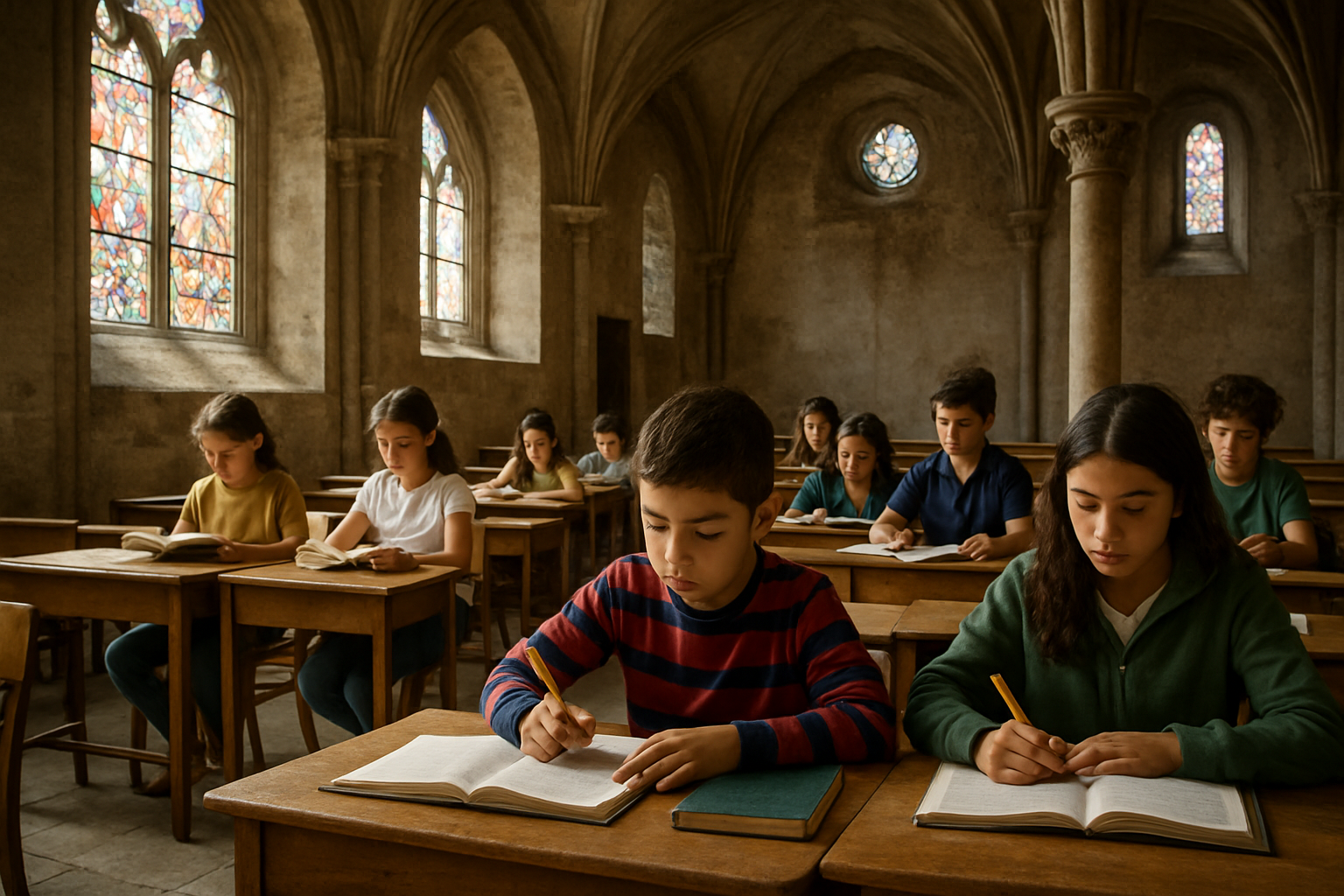
More than six weeks after Storm Kristin battered Portugal's central coast, hundreds of students in Vieira de Leiria continue their education in temporary facilities scattered across the village, including containers, parish halls, and remarkably, a former mortuary chapel.
The unprecedented educational disruption began when Storm Kristin struck Portugal on January 28, 2026, bringing devastating floods that severely damaged multiple school buildings in the coastal municipality. The tempest required extensive reconstruction work that has left educational authorities scrambling to maintain learning continuity without clear timelines for repairs.
According to local reports from Portuguese public broadcaster RTP, the primary school in Vieira de Leiria was forced to disperse its 400 students across various temporary venues throughout the village. The most unusual of these makeshift classrooms is housed in a former chapel previously used for funeral services, where children now practice reading and mathematics surrounded by centuries-old stone walls.
Infrastructure Damage and Emergency Response
Storm Kristin marked the beginning of an unprecedented series of Atlantic weather systems that would claim over 35 lives across Portugal, Spain, and France throughout February 2026. The storm was part of what meteorologists called an "extraordinary succession" of five major Atlantic storms (Kristin-Leonardo-Marta-Nils-Pedro) that overwhelmed European emergency response systems.
In Portugal alone, the crisis required deployment of 26,500 emergency personnel in the largest peacetime rescue operation in the country's history. The response included 1,975 military personnel and 30 naval vessels responding to more than 1,800 weather-related incidents between February 1-15.
The educational sector bore significant damage, with over 100 museums and cultural institutions affected nationwide, including several UNESCO World Heritage sites. The crisis exposed critical vulnerabilities in Portugal's educational infrastructure, much of which was designed for historical rather than current climate conditions.
Temporary Learning Solutions
Educational authorities in Leiria district have demonstrated remarkable creativity in maintaining classroom instruction. Beyond the former chapel, students attend classes in:
- Prefabricated container classrooms hastily installed in school courtyards
- Parish social halls converted into temporary learning spaces
- Community centers repurposed for small-group instruction
- Municipal buildings offering unused meeting rooms
Teachers have adapted their pedagogical approaches to work within these unconventional spaces, often lacking traditional classroom amenities like whiteboards, proper lighting, or climate control systems. Despite these challenges, attendance rates have remained surprisingly high as families prioritize educational continuity.
Regional Context and Climate Impact
The educational crisis in Vieira de Leiria reflects broader infrastructure challenges across Portugal's central coast region. Leiria district was among the hardest hit areas, with some localities experiencing power outages lasting up to 18 days. The region's agricultural sector also suffered extensive damage, with billions of euros in losses across farming and tourism industries.
Climate scientists note that January 2026 marked the 18th consecutive month of global temperatures exceeding 1.5°C above pre-industrial levels – the longest sustained warming streak in recorded history. This climate volatility has enabled increasingly severe weather events that test infrastructure limits and emergency response capabilities.
Government Response and Recovery Planning
Portugal's Ministry of Education has announced comprehensive reconstruction plans, but officials acknowledge that some facilities may require up to two academic years for complete restoration. The government has allocated significant emergency funding for educational infrastructure improvements, emphasizing "build back better" approaches that incorporate climate resilience measures.
"We are not simply rebuilding what was destroyed – we are creating educational facilities designed to withstand the climate challenges of the coming decades."
— Ministry of Education spokesperson
The European Union activated its Civil Protection Mechanism in response to the crisis, with Sweden and Denmark providing a €246 million assistance package – the largest coordinated European weather response on record. This international support has enabled accelerated reconstruction efforts across affected regions.
Educational Innovation Under Pressure
The crisis has accelerated certain educational innovations, including increased use of digital learning platforms and more flexible scheduling systems. Teachers report that the temporary arrangements have fostered stronger community connections, with local volunteers assisting in classroom setup and maintenance.
Some educational experts suggest the experience may provide valuable lessons for future emergency preparedness, demonstrating how communities can maintain educational continuity under extreme circumstances. The use of diverse community spaces has also highlighted the potential for more integrated educational approaches beyond traditional school buildings.
Long-term Implications
The extended displacement of students raises concerns about potential learning gaps and psychological impacts from prolonged educational disruption. Child psychologists emphasize the importance of maintaining routine and stability for young learners, even within temporary facilities.
The crisis also illuminates broader questions about climate adaptation in educational infrastructure across Europe. As extreme weather events become more frequent and severe, educational planners must balance immediate reconstruction needs with long-term resilience planning.
For students in Vieira de Leiria, the former chapel classroom represents both the challenges and adaptability of Portuguese education under climate pressure. While far from ideal, these temporary arrangements demonstrate community resilience and the prioritization of learning continuity even under the most unusual circumstances.
Recovery timelines remain uncertain, but educational authorities stress their commitment to maintaining quality instruction regardless of venue. As one local teacher noted, "Education continues – whether in a classroom, a container, or a chapel. Our students' futures depend on it."