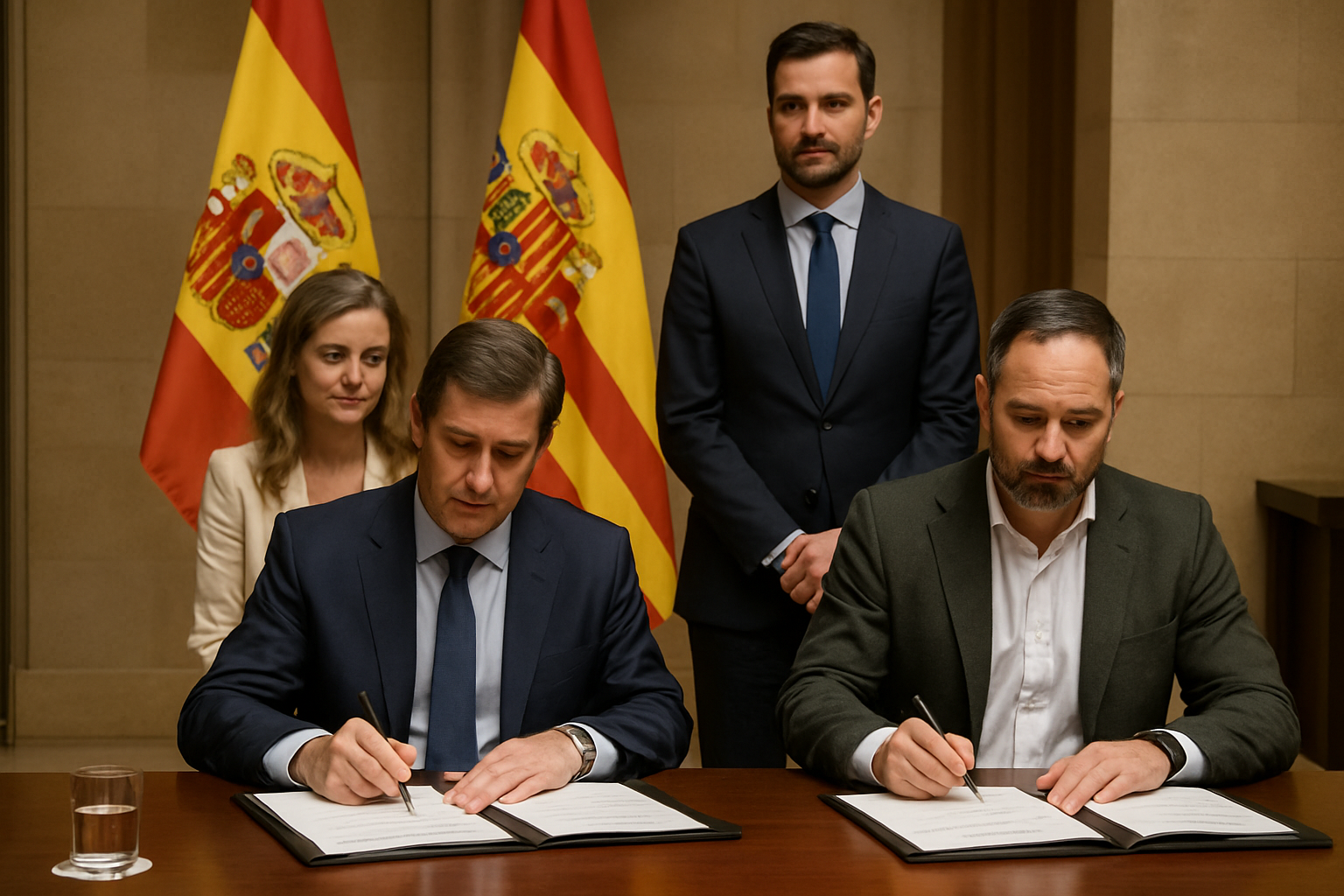
Spain's Popular Party (PP) and far-right Vox have reached a definitive coalition agreement in Aragón, officially announced on April 22, 2026, marking the return of the far-right party to regional governance with enhanced influence following their electoral surge in February's regional elections.
The agreement, sealed two months and two weeks after Aragón's regional elections, ensures that PP leader Jorge Azcón will be reinvested as regional president, avoiding the need for repeat elections. The deal represents a significant political milestone as Azcón becomes the first Popular Party president to secure reelection in the autonomous community.
Coalition Structure and Key Appointments
Under the terms of the agreement, Vox will control three crucial government departments: Deregulation, Social Services and Family; Agriculture, Livestock and Food; and Environment and Tourism. One of these portfolios will carry the rank of vice-presidency, significantly elevating Vox's profile within the regional executive.
Vox leader in Aragón, Alejandro Nolasco, announced that "there will be more Vox" in the government, emphasizing the party's enhanced position compared to previous coalition arrangements. The far-right party has also secured the appointment of the autonomous senator and one of the vice-presidencies of the Mesa of the Cortes of Aragón.
The agreement follows the same ideological framework established in Vox's previous regional coalition deals, including the controversial principle of "national priority" in access to public services—a policy that has sparked significant debate about its compatibility with democratic values and constitutional principles.
Electoral Context and Political Mathematics
The coalition agreement comes after Aragón's February 8, 2026 elections, where President Jorge Azcón's gamble to call snap elections backfired spectacularly. Rather than reducing his dependence on Vox, the early election strategy resulted in the far-right party more than doubling its representation from 7 to 14 seats in the 67-member regional parliament.
While the PP maintained its position as the largest party with 26 seats (down from 28), the enhanced Vox presence fundamentally altered the coalition dynamics. The combined PP-Vox alliance maintains a comfortable 40-seat majority, but Vox's dramatically strengthened negotiating position has enabled the party to demand substantial policy concessions and governmental roles.
The Socialist Party (PSOE), led by former minister Pilar Alegría, suffered a devastating defeat, falling to just 18 seats—matching their worst historical result in Aragón. The regional party Chunta Aragonesista emerged as the surprise winner on the left, doubling their representation from 3 to 6 seats under Jorge Pueyo's leadership.
National Political Implications
The Aragón agreement represents the second disappointing electoral result for PP national leader Alberto Núñez Feijóo's strategy of reducing dependence on far-right support. Instead of weakening Vox's influence, both the Castilla y León and Aragón elections have demonstrated the continued necessity of far-right coalition partnerships for conservative governance in Spain.
The development occurs amid mounting pressure from Feijóo on Vox leader Santiago Abascal to finalize similar government agreements in other regions, including Extremadura and Castilla y León. Feijóo's March ultimatum demanding that Abascal choose between "change or Sánchez" reflects growing tensions within the conservative alliance over the pace and terms of coalition negotiations.
"The PP-Vox coalition maintains its 40-seat majority, but Vox's doubled representation shifts internal balance significantly toward the far-right."
— Political Analysis, February 2026
European Context and Democratic Concerns
The Aragón coalition agreement fits within a broader European pattern of "authoritarian innovation"—sophisticated far-right movements operating within democratic systems while gradually eroding liberal norms through electoral success and coalition participation rather than revolutionary violence.
Similar developments across Europe include Sweden's Liberal Party abandoning decades of opposition to the Sweden Democrats, Germany's AfD breakthrough to 18% in Baden-Württemberg, and France's National Rally achieving unprecedented urban gains. These parallel developments reflect a continental challenge to traditional democratic mechanisms of containing extremist movements.
The "national priority" principle central to the PP-Vox agreement has faced particular scrutiny. While the Popular Party voted against a similar Vox motion in the national Congress, calling it too extreme, they have simultaneously accepted the concept in regional coalition agreements—highlighting the contradictions in the party's approach to far-right cooperation.
Policy Implications and Governance Challenges
Vox's control of the Agriculture, Livestock and Food ministry positions the party to influence crucial policies affecting Aragón's significant rural economy. The Environment and Tourism portfolio provides oversight of policies related to climate adaptation and sustainable development—areas where Vox's positions often conflict with European Union environmental directives.
Perhaps most controversially, Vox's leadership of Social Services and Family threatens to introduce ideological elements into areas traditionally focused on technical service delivery. The party's emphasis on "traditional family values" and restrictive approaches to immigration and social integration could significantly alter the region's social policies.
The Deregulation ministry represents a new governmental structure specifically created to accommodate Vox's anti-bureaucracy rhetoric, potentially affecting business regulation, administrative efficiency, and public sector operations across the autonomous community.
Opposition Response and Democratic Oversight
The Socialist Party has characterized the agreement as a capitulation to extremist demands, with party spokesperson pointing to the contradiction between the PP's national rhetoric and regional behavior. "Every pact with Vox has a price—it's a right that citizens lose," warned PSOE spokesperson Montse Mínguez in March.
The agreement also highlights the challenges facing Spanish democracy in maintaining institutional balance when coalition mathematics require partnerships with parties that explicitly challenge fundamental democratic norms. The normalization of far-right participation in governance represents a significant shift in Spain's post-Franco democratic culture.
Historical Significance and Future Outlook
The Aragón coalition agreement marks the institutionalization of far-right influence in Spanish regional governance following decades of marginalization. Unlike previous periods when extreme parties remained isolated, Vox has successfully positioned itself as an indispensable partner for conservative governance.
The agreement's success or failure will likely influence similar negotiations across Spain and provide a template for far-right integration strategies throughout Europe. International observers are closely monitoring the Spanish experience as a potential model for managing extremist movements through coalition governance rather than exclusion.
For Jorge Azcón, the agreement represents both a political survival strategy and a significant compromise of his original vision for reducing far-right dependence. The enhanced Vox presence in his government will test his ability to maintain moderate governance while accommodating increasingly radical coalition partners.
As Spain grapples with these developments, the Aragón coalition agreement stands as a watershed moment in the country's democratic evolution—demonstrating both the resilience of democratic institutions in accommodating diverse political forces and the ongoing challenges of maintaining liberal democratic values amid rising populist and nationalist pressures.