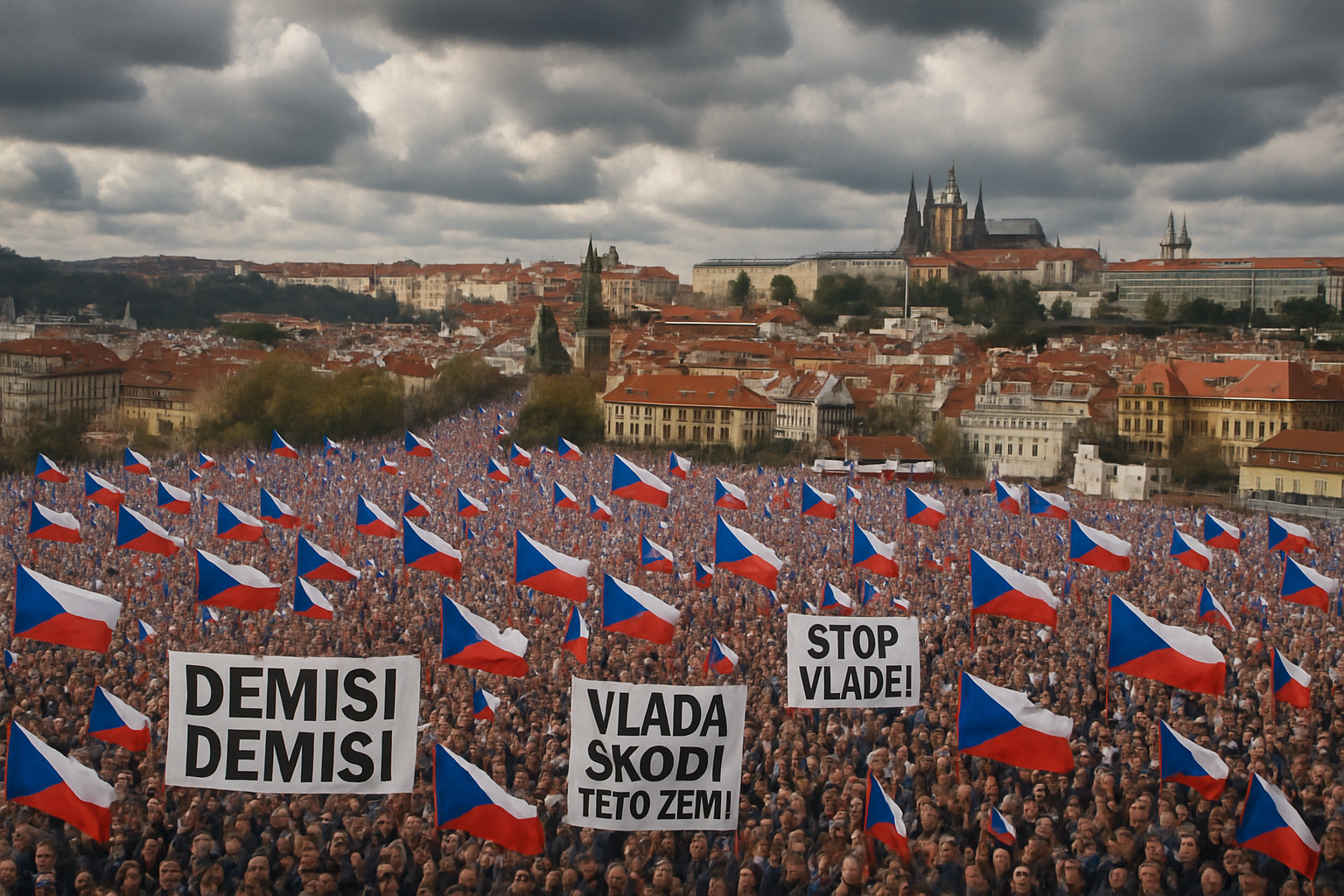
Tens of thousands of protesters gathered in Prague on Saturday at the historic Letná Park in the largest anti-government demonstration since 2019, voicing fierce opposition to the policies of billionaire populist Prime Minister Andrej Babiš and what critics call his administration's "arrogance of power."
The peaceful demonstration drew participants from across the Czech Republic to the symbolically significant Letná Plain, the same location where massive gatherings in 1989 played a crucial role in bringing down the communist regime. The choice of venue carried powerful historical resonance as demonstrators called for democratic accountability and transparency from the current government.
Protesters expressed mounting frustration with what they described as Babiš's authoritarian tendencies, his alleged abuse of parliamentary immunity to evade criminal prosecution, and his government's controversial stance on international affairs. The demonstration reflected broader concerns about democratic regression and the concentration of power in the hands of the 71-year-old billionaire businessman-turned-politician.
Historic Venue Amplifies Democratic Message
The selection of Letná Park as the protest venue was deeply symbolic, evoking memories of the pivotal demonstrations during the 1989 Velvet Revolution that helped topple communist rule in Czechoslovakia. The sprawling green space overlooking the Vltava River has long served as a gathering point for Czech citizens seeking political change, making it an ideal location for those demanding democratic accountability from their current leadership.
Participants carried banners and Czech flags while chanting slogans demanding greater transparency and opposing what they view as the government's drift toward authoritarian governance. The peaceful nature of the demonstration stood in contrast to more volatile protests elsewhere in Europe, reflecting Czech citizens' commitment to democratic principles and non-violent political expression.
Growing Opposition to Babiš Administration
Saturday's protest represents the culmination of sustained criticism against Prime Minister Babiš, who has faced accusations of exploiting his position for personal gain and undermining democratic institutions. The demonstration followed a February no-confidence vote that Babiš survived after a marathon 22-hour parliamentary debate, though the underlying tensions between his government and opposition forces remain unresolved.
Critics have particularly targeted Babiš's approach to foreign policy, including allegations that his government has been "minimizing" Russian threats amid the ongoing Ukraine conflict. The Czech Republic, alongside Slovakia and Hungary, has refused to participate in the European Union's €90 billion loan package for Ukraine, creating divisions within the European bloc and raising questions about Central European alignment with broader EU foreign policy objectives.
The protest organizers, representing an independent citizen movement rather than traditional political parties, emphasized their commitment to grassroots democratic engagement. This bottom-up approach reflects a broader pattern of civic mobilization across Europe, where citizens are increasingly demanding accountability from their elected officials through sustained advocacy rather than relying solely on electoral politics.
International Context and European Democracy
The Prague demonstrations occur within a broader context of democratic stress testing across Central and Eastern Europe. Similar patterns of citizen mobilization have emerged in neighboring countries, where voters express growing concern about the concentration of power and the erosion of democratic norms.
The timing of the protests coincides with heightened geopolitical tensions surrounding the Ukraine conflict and ongoing debates about European unity. Czech citizens' demands for greater government accountability reflect broader anxieties about their country's role within European institutions and its relationships with both EU partners and neighboring nations.
International observers have noted the significance of sustained civic engagement in the Czech Republic, viewing it as a critical test of democratic resilience in a region where authoritarian populism has gained ground in recent years. The peaceful nature of the demonstrations and their focus on constitutional governance principles represent positive indicators for democratic stability.
Government Response and Political Implications
The Babiš government has yet to respond comprehensively to Saturday's demonstration, though previous statements from government officials have dismissed similar protests as politically motivated opposition activities. The Prime Minister's ability to weather sustained public criticism while maintaining his parliamentary coalition will likely influence his political future and the broader trajectory of Czech politics.
The protest's scale and organization suggest that opposition to the current government extends beyond traditional party politics, encompassing concerns about governance quality, transparency, and democratic accountability. This citizen-led approach to political engagement may signal a shift in how Czech civil society approaches political advocacy and institutional reform.
Historical Precedent and Democratic Legacy
Saturday's gathering echoes the historic protests that have shaped Czech political development, from the 1989 Velvet Revolution to more recent demonstrations against government policies. The consistent use of Letná Park as a venue for political expression underscores its importance as a space for democratic dialogue and civic engagement.
The peaceful nature of the demonstration and its focus on constitutional principles reflect the maturity of Czech democratic culture, even amid intense political disagreements. Participants emphasized their commitment to working within democratic institutions while demanding greater accountability from those institutions.
As the Czech Republic continues to navigate complex domestic and international challenges, Saturday's demonstration represents both a assertion of democratic values and a call for responsive governance. The government's response to these citizen demands may ultimately determine the country's political trajectory and its role within the broader European democratic community.
The protest's success in mobilizing tens of thousands of citizens without violence or major disruption demonstrates the continued vitality of Czech civil society and its commitment to democratic principles established during the post-communist transition. Whether this civic engagement translates into concrete policy changes or political reforms remains to be seen, but the demonstration itself stands as a powerful affirmation of democratic participation in contemporary Czech politics.