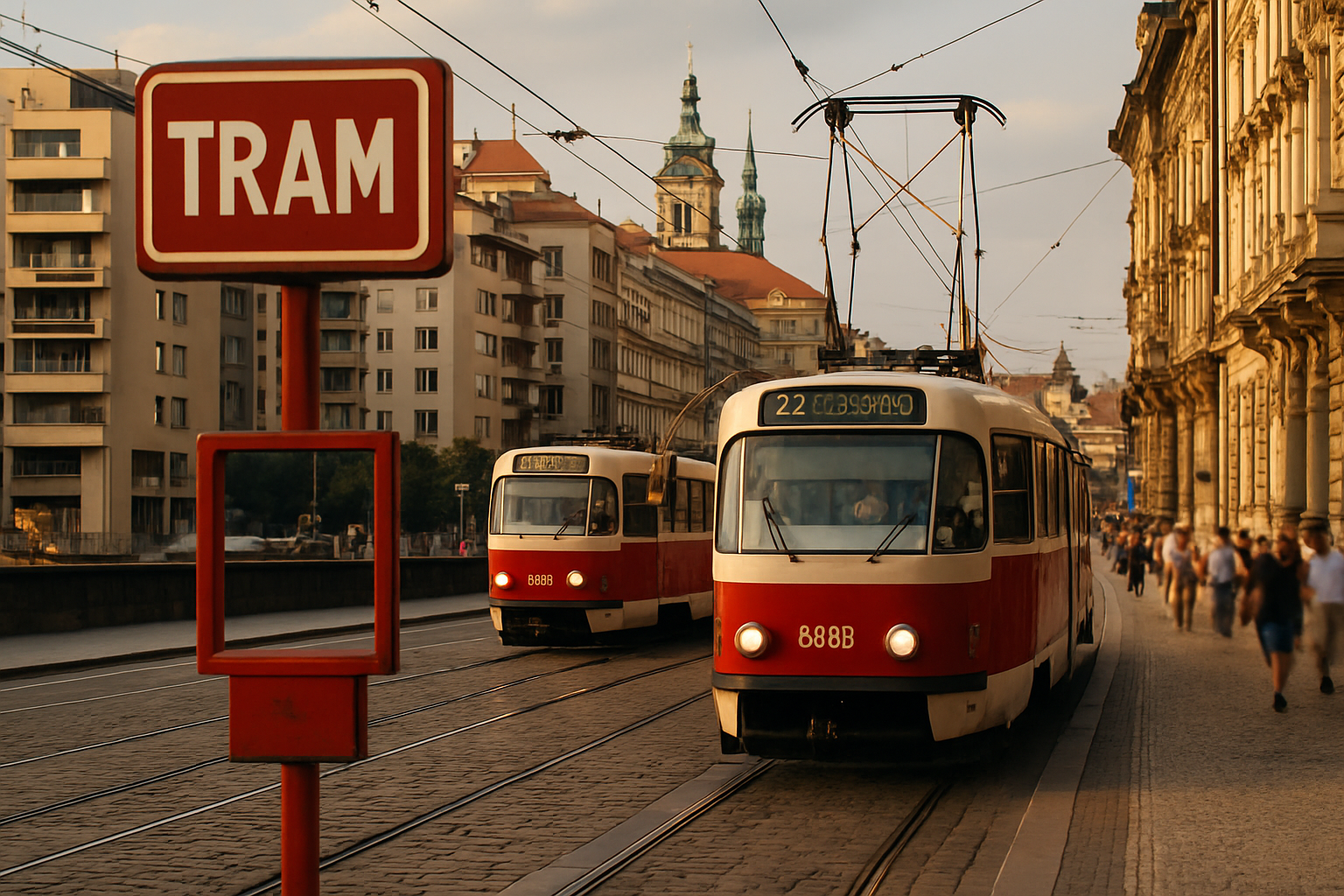
Prague stands at a crossroads of urban transformation as the Czech capital prepares to eliminate its iconic red tram and bus signs while grappling with a housing affordability crisis that threatens to fundamentally reshape the city's social fabric.
The dual developments — one symbolic, the other existential — underscore the complex challenges facing Central Europe's most visited city as it attempts to modernize its infrastructure while preserving its cultural identity amid mounting economic pressures on residents.
End of an Era for Prague's Transport Identity
Prague's distinctive red transport signage, a visual hallmark of the city's public transportation system for decades, will begin disappearing this spring as part of a comprehensive modernization initiative. The removal marks the end of an iconic design element that has guided millions of residents and tourists through the Czech capital's extensive tram and bus network.
The signage overhaul represents broader efforts to modernize Prague's public transportation infrastructure while maintaining the efficiency that has made the system a model for other European cities. However, the timing coincides with severe housing market pressures that are forcing many residents to reconsider their relationship with the city they call home.
Housing Affordability Reaches Crisis Levels
Prague's housing market has reached what experts describe as unprecedented affordability lows, with average salaries of approximately CZK 50,000 proving insufficient for sustainable homeownership in major urban centers. The crisis reflects broader patterns documented across Central and Eastern Europe, where international investment pressure has created pricing dynamics comparable to Western European capitals without corresponding social housing policies.
"The salary-housing cost disconnect threatens workforce mobility, family formation, and economic competitiveness as young professionals face unsustainable housing cost portions or lengthy commutes from affordable areas."
— Housing Policy Analysis, March 2026
The affordability crisis particularly affects young professionals and families, who increasingly face difficult choices between proximity to employment centers and housing costs they can reasonably manage. Many are being pushed to outlying areas, creating new pressures on the very transportation systems undergoing modernization.
International Investment Pressures
Prague's housing market challenges stem partly from international investment flows that have driven prices beyond the reach of many local residents. Unlike Vienna, which maintains social housing covering 60% of the rental market through sustained public investment, Prague lacks comprehensive affordable housing frameworks to counterbalance market pressures.
The situation reflects broader European Union recognition that housing has become a transnational challenge requiring coordinated responses rather than isolated national policies. Mediterranean countries have taken leadership roles, with Croatia targeting 600,000 empty homes for affordable rental conversion and Cyprus advancing foreign investment restrictions on residential property.
Construction Industry Constraints
The housing supply crisis is compounded by global construction industry challenges that have created negative developer profit margins across European markets. Material costs have risen substantially throughout 2025, while memory chip shortages have driven semiconductor prices up sixfold due to AI development demand, affecting smart building technologies that are becoming standard in modern developments.
These supply-side constraints add 20-30% to construction costs until new fabrication facilities come online in 2027, creating a dynamic where existing properties gain value due to limited new competition while simultaneously restricting options for new buyers.
Urban Development at a Crossroads
The removal of Prague's red transport signs occurs against this backdrop of housing market stress, symbolizing broader questions about how the city will balance modernization with affordability and cultural preservation. Transportation infrastructure improvements, while necessary for long-term urban efficiency, highlight the disconnect between infrastructure investment and housing policy coordination.
Prague's challenges mirror those facing other major European cities where historic centers must adapt to modern mobility needs without compromising accessibility for diverse income levels. The city's approach to these dual pressures will influence urban development patterns throughout Central Europe.
Regional Context and Coordination
Prague's situation reflects broader Central European patterns where EU integration has brought economic opportunities alongside housing market pressures. The Czech Republic, along with neighboring countries, faces mounting pressure to develop comprehensive housing strategies that address both local needs and international investment dynamics.
European policy coordination is evolving to recognize housing as requiring transnational responses, particularly as migration patterns, investment flows, and economic spillovers increasingly affect neighboring regions. The success or failure of Prague's approach to balancing transport modernization with housing accessibility will provide crucial lessons for similar cities across the region.
Technology Integration Challenges
The modernization of Prague's transport signage reflects broader technology integration trends where smart city systems, sustainable materials, and community-centered design are becoming standard requirements rather than premium options. However, the semiconductor shortage affecting construction costs also impacts transportation infrastructure upgrades, creating implementation challenges during a period of constrained municipal budgets.
Digital infrastructure improvements are critical for attracting remote workers to secondary cities and rural areas, potentially creating new residential demand patterns that could help alleviate Prague's housing pressures by distributing population more evenly across the region.
Looking Ahead: Policy Implications
The convergence of transport infrastructure changes with housing affordability challenges represents a critical test of Prague's urban planning capabilities. Traditional approaches may prove insufficient for addressing the current crisis scale and complexity, requiring innovative frameworks that balance housing supply adequacy with middle and lower-income affordability while maintaining construction industry viability.
Success will depend on sophisticated coordination between transportation planning, housing policy, and international cooperation as challenges become increasingly interconnected through migration patterns and cross-border investment flows. The window for effective action is narrowing due to demographic pressures, urbanization trends, and climate adaptation complexity.
"Housing accessibility determines whether cities attract and retain diverse talent necessary for 21st-century development versus becoming exclusive wealthy enclaves."
— Urban Development Analysis, March 2026
The Stakes for Prague's Future
The simultaneous transformation of Prague's transport identity and housing market dynamics will shape the city's character for decades to come. The removal of iconic red tram signs marks not just an infrastructure update but a symbolic moment in the city's evolution from post-communist transformation to modern European capital.
Whether Prague can successfully navigate these changes while maintaining its accessibility to diverse populations will influence its role as a cultural and economic center in Central Europe. The city's approach to balancing modernization pressures with social sustainability will provide a template for other historic European cities facing similar challenges in an era of rapid urban transformation.
The coming months will be crucial as Prague implements transport infrastructure changes while developing responses to housing market pressures that affect hundreds of thousands of residents. The success of these coordinated efforts will determine whether the Czech capital can maintain its position as an accessible, vibrant European city or risk transformation into an exclusive destination primarily serving wealthy international investors and visitors.