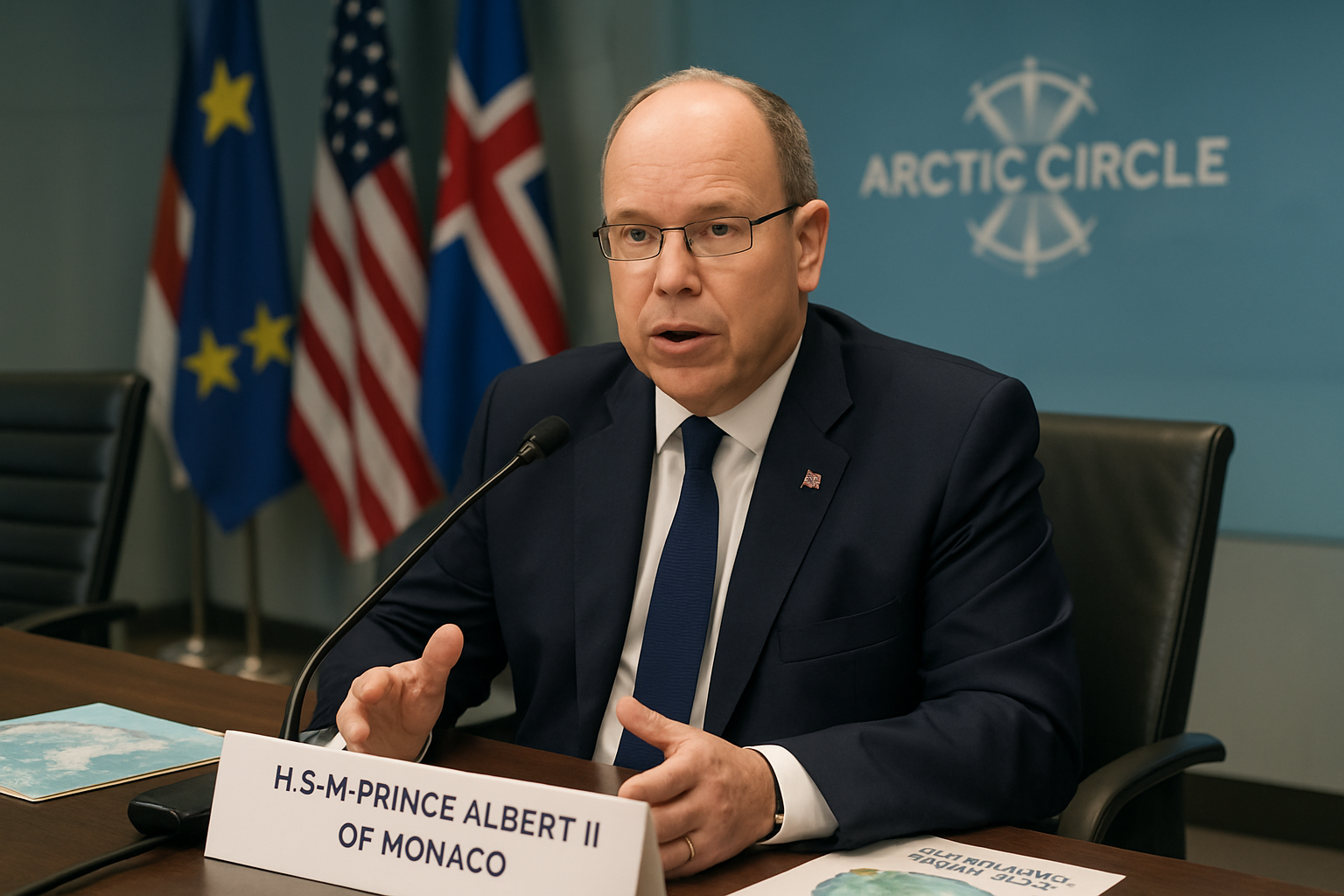
Prince Albert II of Monaco delivered an urgent call for international cooperation in Arctic policy during the Arctic Circle Forum in Rome on March 3rd, warning that escalating geopolitical tensions must not be allowed to undermine the critical scientific collaboration needed to address the accelerating climate crisis in the polar regions.
The Monégasque sovereign's appearance at the Rome forum came just days after he addressed the Monaco Polar Symposium via video call, where similar themes of deteriorating international collaboration and chronic underfunding in polar research dominated the three-day event. His message resonated with particular urgency as the Arctic faces unprecedented environmental pressures during what has become the 19th consecutive month of global temperatures exceeding 1.5°C above pre-industrial levels.
Indigenous Rights at the Center of Arctic Policy
Speaking directly to delegates gathered 700 kilometers from the nearest Antarctic research stations, Prince Albert emphasized that Indigenous communities must be central to any decisions shaping the Arctic's future. "The Arctic is a crucial issue that demands the voices of those who have stewarded these lands for millennia," he stated, echoing a growing international consensus that traditional ecological knowledge must be integrated with modern climate science.
This emphasis on Indigenous leadership reflects broader diplomatic efforts, including the February 2026 coordinated opening of French and Canadian consulates in Nuuk, Greenland, where Indigenous solidarity played a crucial role in supporting territorial sovereignty against external pressures. Canadian Governor General Mary Simon's Inuit heritage provided cultural legitimacy to international diplomatic responses, while Canadian Inuit delegations have actively opposed territorial acquisition attempts.
Arctic as Geopolitical Flashpoint
The Prince's call for scientific cooperation comes as the Arctic has emerged as a critical arena for great power competition. Climate change is opening new shipping routes and resource access points, creating what experts describe as a new domain of geopolitical tension. The European-led NATO Arctic Sentry mission, launched in February 2026, represents the alliance's most comprehensive Arctic security response, with the UK doubling its Norway troop presence from 1,000 to 2,000 over three years.
These security concerns intersect with accelerating environmental changes. According to recent memory of international developments, Arctic temperatures are increasing faster than global averages, with profound implications for ice sheet stability and sea level rise. The region's transformation is occurring at a pace that challenges both traditional diplomatic frameworks and Indigenous communities' adaptive capacity.
"Scientific cooperation and respect for international law must remain at the centre of Arctic policy, despite mounting geopolitical tensions."
— Prince Albert II of Monaco
Climate Science Reveals Urgent Timeline
The timing of Prince Albert's intervention reflects the unprecedented pace of climate change. January 2026 marked the hottest month ever recorded, extending an 18-month streak of global temperatures exceeding the critical 1.5°C threshold established in the Paris Agreement. This sustained warming is overriding natural climate variability, including La Niña cooling effects that typically moderate global temperatures.
Recent scientific breakthroughs underscore the urgency. A comprehensive 30-year study by University of California Irvine glaciologists reveals that vulnerable Antarctic sections are losing ice at unprecedented rates, with annual ice loss equivalent to the area of Vienna. Since 1996, total ice retreat has reached 12,820 square kilometers, representing massive reductions in frozen water reserves that could contribute significantly to global sea level rise.
In the Arctic specifically, research spanning 122 years of continuous observation from Argentina's Antarctic program documents accelerating changes. Romanian scientists have discovered 5,000-year-old bacteria in ice cores that reveal antibiotic resistance concerns as permafrost thaw accelerates, demonstrating how climate change creates cascading risks across multiple systems.
Technology and Traditional Knowledge Integration
Prince Albert's vision for Arctic cooperation emphasizes sophisticated integration of cutting-edge technology with traditional ecological knowledge and community-based management. This approach has shown remarkable success across multiple initiatives documented in recent international developments.
The Netherlands has deployed the most sophisticated polar climate monitoring network ever created, with equipment designed to function in -70°C temperatures and 200+ km/h winds while providing real-time data transmission. This technological advancement complements traditional knowledge systems that Indigenous communities have developed over millennia of Arctic stewardship.
Finland's recent €800 million investment in Europe's first major lithium mining operation demonstrates how Arctic resource development, conducted responsibly, could support the renewable energy transition while providing sustainable employment and reducing Chinese supply chain dependencies.
Economic and Environmental Protection Convergence
The Prince's advocacy reflects a growing understanding that environmental protection functions as an economic development strategy rather than a regulatory burden. Countries implementing comprehensive environmental protection demonstrate greater economic resilience and attract sustainable investment across green technology manufacturing, eco-tourism, and environmental services.
Canada's Arctic highway infrastructure faces unprecedented climate pressures as permafrost thaw affects traditional construction methods, requiring hundreds of millions in adaptation investments. However, proactive environmental protection and climate adaptation create economic opportunities through technological innovation and international cooperation frameworks.
The convergence of environmental and economic interests is evident in recent conservation successes. Finland's Metso forest conservation program faces overwhelming demand with 286 applications across three regions, demonstrating public support for voluntary conservation programs that balance economic returns with biodiversity protection.
International Cooperation Frameworks
Prince Albert's call for sustained international cooperation builds on Monaco's established leadership in environmental diplomacy. The Monaco Polar Symposium has become a critical forum for bringing together international scientists, policymakers, and experts to address the accelerating polar climate crisis.
The success of international cooperation is evident in recent developments across multiple sectors. The NATO Arctic Sentry mission represents unprecedented European leadership in Arctic security, while maintaining scientific collaboration frameworks. Sweden has deployed Air Force and Army Rangers plus Gripen jets to Greenland exercises, demonstrating how security and environmental cooperation can proceed simultaneously.
Knowledge sharing between nations has proven essential for addressing Arctic challenges. France-Canada diplomatic coordination in Greenland, combined with EU support packages and enhanced cooperation mechanisms, shows how smaller nations can drive global environmental diplomacy when urgency demands immediate action.
Window for Action Rapidly Narrowing
The Prince's intervention comes at what experts describe as a critical juncture for Arctic climate action. The window for effective intervention is narrowing rapidly as ecological systems approach critical thresholds that could trigger irreversible changes. However, the tools and knowledge exist for comprehensive protection, requiring unprecedented implementation speed and coordination.
Recent scientific evidence demonstrates both the challenge and the potential for solutions. Environmental DNA sampling and satellite monitoring provide unprecedented ecosystem tracking capabilities, while artificial intelligence analysis offers new insights into climate adaptation strategies. Success requires sustained international cooperation, enhanced financial commitments, and recognition that environmental protection constitutes essential infrastructure for human prosperity and planetary sustainability.
As Prince Albert emphasized in Rome, the Arctic represents humanity's shared future. Whether international cooperation can maintain the pace of environmental change during this decisive climate action decade will determine the trajectory of global environmental protection for generations to come. The Prince's Monaco leadership demonstrates how smaller nations can drive critical international environmental initiatives when coordinated action becomes urgently necessary for planetary survival.