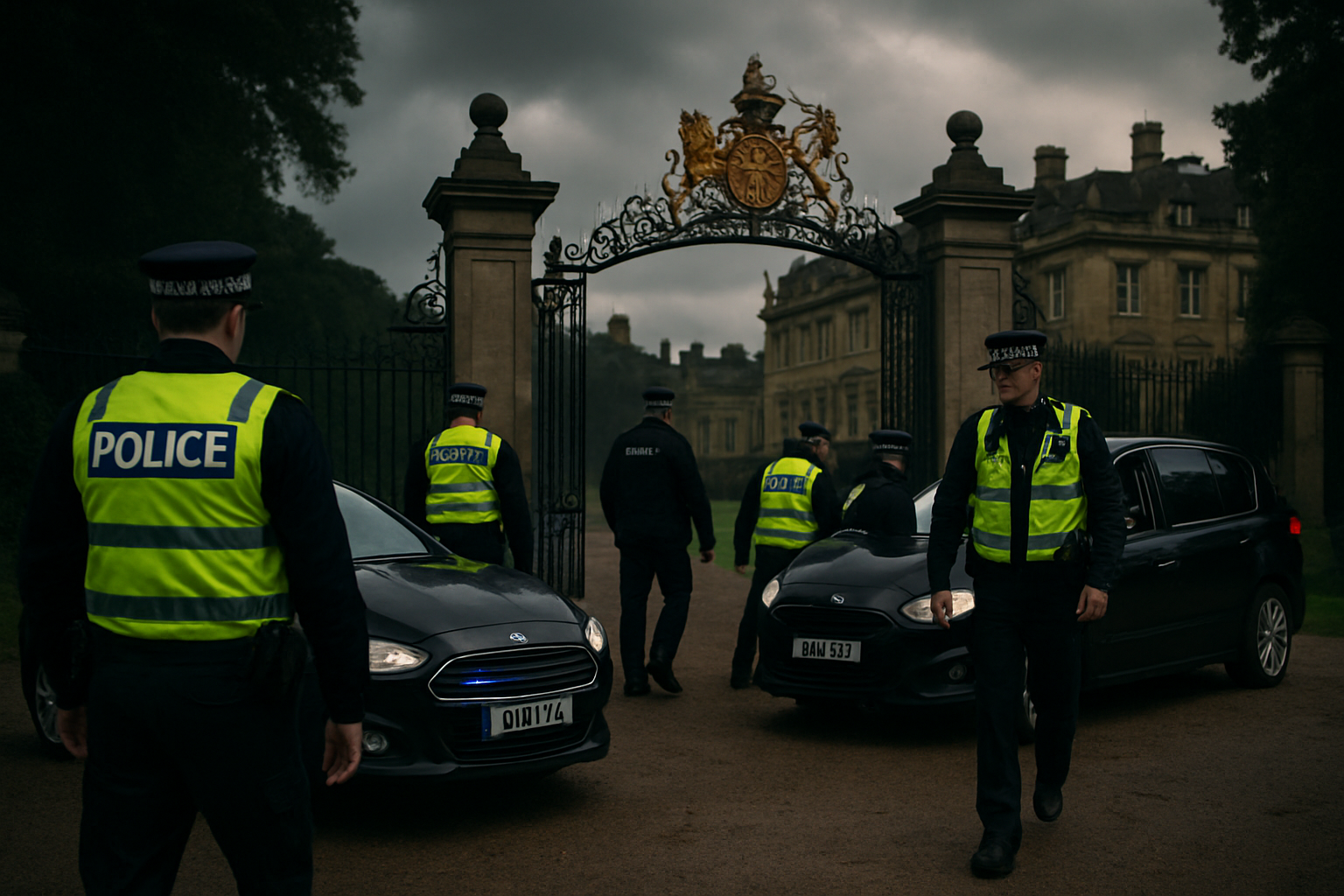
British police continue their investigation into Andrew Mountbatten-Windsor, the former Duke of York, with ongoing searches of royal properties and unprecedented cooperation from Buckingham Palace, marking the most significant criminal investigation involving a senior member of the British Royal Family in modern history.
The investigation has reached new levels of intensity following Prince Andrew's historic arrest on February 19, 2026—his 66th birthday—on suspicion of misconduct in public office. The arrest, conducted by Thames Valley Police at Sandringham Estate, represented the first detention of a senior British royal since King Charles I in 1647, creating a constitutional watershed moment for the monarchy.
Ongoing Police Operations and Palace Cooperation
Law enforcement sources confirm that searches of royal properties continue as part of the expanding investigation. Police officers have been observed conducting methodical searches at both Sandringham Estate, where Andrew currently resides, and his former Windsor residence, Royal Lodge, which he vacated in February 2026 under cover of darkness following new allegations.
In an unprecedented move, King Charles III has authorized Buckingham Palace staff to provide full access to archives and documents related to Andrew's official duties. This cooperation extends to government materials concerning Andrew's role as UK Special Representative for International Trade and Investment from 2001 to 2011, a position that lies at the heart of the current allegations.
"His Majesty has made it clear that the law must take its course and that the monarchy will provide full and wholehearted support and cooperation to the authorities."
— Palace Official
Central Allegations and Evidence
The investigation centers on allegations that Andrew shared classified government intelligence with convicted sex offender Jeffrey Epstein during his tenure as a trade envoy. Specifically, authorities are examining claims that Andrew transmitted confidential information about Afghanistan's Helmand province, including data on gold, uranium, and oil reserves, in a December 24, 2010 email sent during a UAE state visit with Queen Elizabeth II.
The allegations suggest a serious breach of official protocols, with Andrew potentially violating both his trade envoy responsibilities and the Official Secrets Act. These claims have gained credibility through documentary evidence reportedly linking Andrew directly to Epstein through official diplomatic channels during state visits.
International observers note that the case has implications far beyond Britain, as it forms part of what European law enforcement describes as "the largest international elite criminal network exposure in recent memory," spanning investigations across six countries.
Harry and Meghan's Strategic Silence
Notably, the Duke and Duchess of Sussex have maintained complete silence regarding Andrew's arrest and ongoing investigation. Royal commentators suggest this represents a calculated decision to avoid being drawn into the constitutional crisis while maintaining their distance from active royal duties.
Their silence contrasts sharply with the broader royal response, where King Charles has broken centuries of precedent by publicly supporting the investigation against his own brother. This approach demonstrates the monarchy's attempt to preserve institutional integrity over family loyalty, even at significant personal cost.
Constitutional and Legal Implications
The investigation has raised profound constitutional questions about the relationship between the monarchy and the rule of law in the 21st century. Unlike some European monarchies where royals enjoy constitutional immunity, British royal family members can face criminal prosecution like any other citizen.
Legal experts note that misconduct in public office is a serious criminal offense that could result in imprisonment if convicted. The charge requires proving that a public official willfully neglected their duty or misconducted themselves to abuse public trust—exactly what prosecutors appear to be investigating in Andrew's case.
The Crown Prosecution Service is currently reviewing all evidence gathered by Thames Valley Police to determine whether formal charges should be brought. This review process is being closely monitored internationally as a test of democratic accountability regardless of royal status.
International Context and Wider Network
The Andrew investigation cannot be viewed in isolation, as it forms part of a massive international probe into networks connected to Jeffrey Epstein. Document releases have implicated figures across multiple countries, with parallel investigations underway in Norway, France, and several Baltic states.
This broader context has led to enhanced international cooperation between law enforcement agencies, sharing intelligence and evidence in ways previously unseen. The coordination represents a new precedent for addressing transnational elite criminal networks that span multiple jurisdictions.
Romanian and Russian media reports suggest the investigation has exposed systematic attempts by the Epstein network to penetrate government circles across Europe and beyond, making Andrew's case emblematic of broader institutional vulnerabilities.
Public and Political Response
British public opinion has largely supported the investigation, with polling showing approximately 72% of respondents viewing Andrew's arrest as proof that no one is above the law. This contrasts with international reactions, including former President Trump calling the situation "very sad" and a "shame" for the royal family.
Parliamentary committees have announced comprehensive reviews of diplomatic appointment procedures, aiming to prevent future breaches of protocol. The investigation has also prompted calls for the UK government to consider legislation removing Andrew from the line of succession, though such a move would require extensive consultation with Commonwealth nations where King Charles III serves as head of state.
Impact on the Monarchy
The investigation represents the most serious challenge to the British monarchy's reputation since the abdication crisis of 1936. However, King Charles III's unprecedented decision to support the investigation publicly has been interpreted by constitutional experts as potentially strengthening the monarchy by demonstrating its commitment to operating within, rather than above, the law.
This approach marks a fundamental shift in royal protocol, prioritizing institutional integrity over traditional family loyalty. The success of this strategy will likely determine how constitutional monarchies worldwide handle similar challenges in the future.
Ongoing Developments and Timeline
Thames Valley Police continue their investigation with no definitive timeline for completion. Sources indicate that former protection officers who served during Andrew's working royal period are being questioned about what they "saw or heard" during his official duties.
The investigation's resolution will establish crucial precedents for constitutional monarchies globally, international justice cooperation, and democratic accountability mechanisms in the 21st century. As the probe continues, it represents perhaps the ultimate test of whether democratic institutions can hold powerful figures accountable regardless of their status, connections, or international standing.
The world watches as Britain navigates this constitutional crisis, with the outcome likely to influence how democracies address elite accountability challenges for generations to come. The continuation of searches at royal properties, combined with unprecedented palace cooperation, signals that this investigation is far from over and may yet yield additional revelations that could reshape the British monarchy's future role in democratic society.